

Kazakh live captions and productivity tool for traveling
For deaf and hard of hearing people.
Download for free


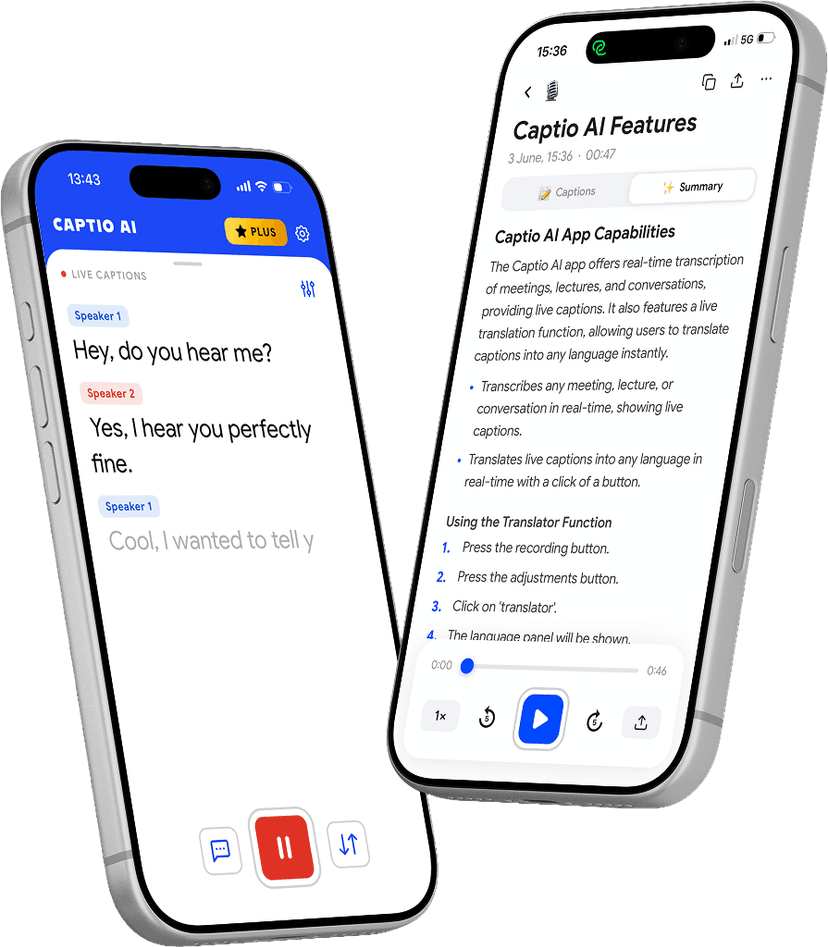
Everything you need to follow Kazakh traveling
Four tools built for deaf and hard of hearing Kazakh speakers.
Captions any spoken exchange, anywhere
- Airport staff, hotel receptionists, taxi drivers
- Real time, word by word, as they speak
- Works through travel noise and accents
- No setup — open the app and point it
No language barrier, anywhere in the world
- They speak their language — you read in yours
- 60+ languages, no manual switching
- For customs, hotels, restaurants, and local transport
- Translates in real time as they speak
Transcribe any recorded content
- Record a tour guide, a briefing, an important exchange
- Upload and get the full transcript to review
- Any language, any format
- Useful for travel information you want in writing
Key travel information extracted
- Instructions, directions, and key details from any transcript
- Organised into clear sections
- Useful after complex hotel check-ins or guided briefings
- Works on any saved recording
Download for free
Every situation covered
Designed for the real moments that matter — not just quiet controlled environments.
Departures at Almaty International (ALA) or Nursultan Nazarbayev International (NQZ) in Astana are announced in Kazakh, Russian, and English. Captio AI captions all three languages so you catch gate numbers and boarding times.
Kazakhstan Railways (KTZ) trains announce stops in Kazakh and Russian between Almaty, Astana, and Shymkent. Captio AI captions the ticket window exchange and platform PA at Almaty station in real time.
A hotel receptionist in Almaty or Astana explaining room details and local tips in Kazakh or Russian. Place Captio AI on the desk and follow the full conversation regardless of which language arrives.
Asking for directions near Almaty's Kok-Tobe cable car or navigating Astana's Nurzhol Boulevard on foot. Kazakh or Russian from locals — Captio AI captions their reply so you find your way.
Kazakhstan border control officers at Almaty International or the Dostyk land crossing speak quickly in formal Kazakh or Russian. Captio AI captions every question so you respond accurately.
A guide at the Charyn Canyon, the Medeu skating rink area, or Tamgaly petroglyphs delivering Kazakh commentary on the Steppe landscape and Silk Road history. Captio AI captions in real time.
Most accurate and fastest models
word accuracy
independent benchmark, 2025
real-time captions
first word appears as you speak
Download for free
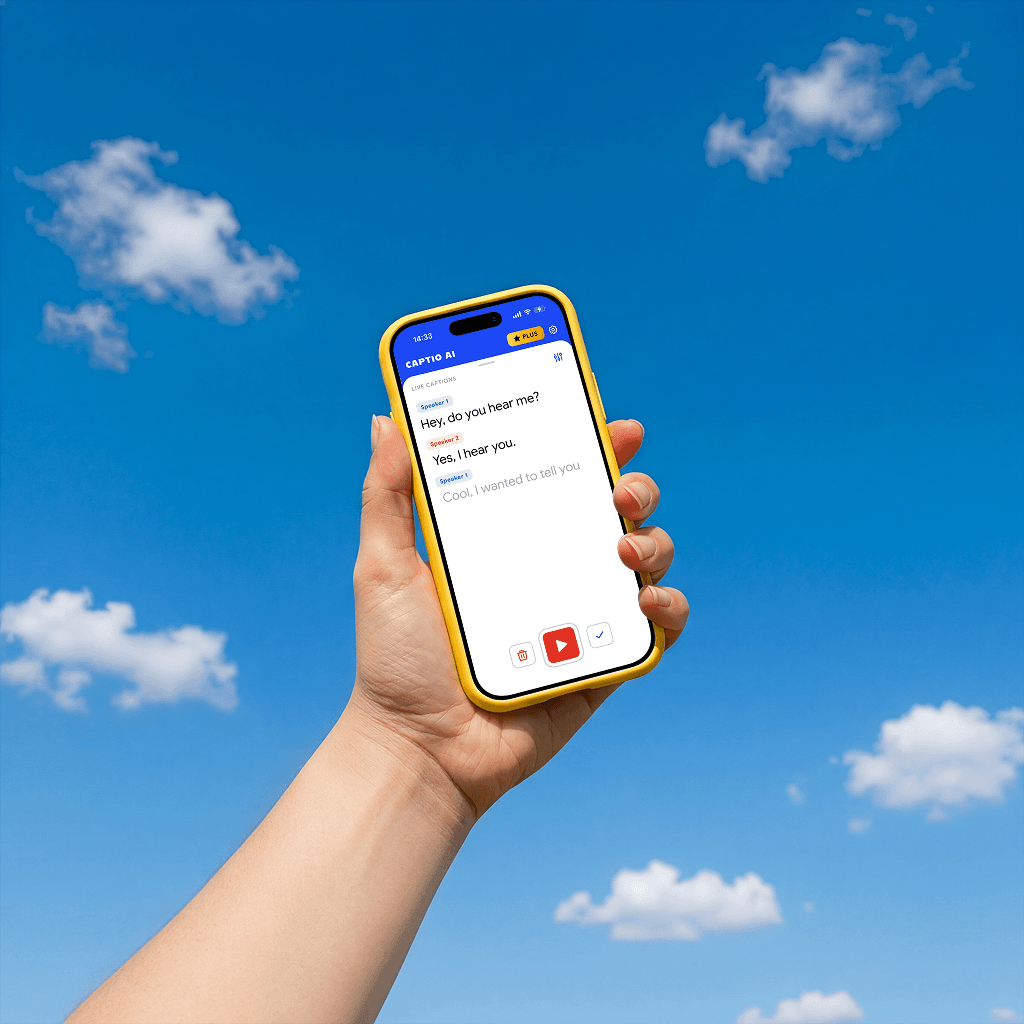

Built for a world that announces everything by sound
Captions any spoken exchange in real time
Airport staff, hotel receptionists, taxi drivers, tour guides. Hold the phone toward whoever is speaking and read the captions — in any setting, in any country.
60+ languages — no language barrier
Live Translator captions and translates in real time. They speak their language — you read in yours. For every country, every language, no manual setup between interactions.
Works anywhere with a data connection
Wi-Fi or mobile data. A local SIM or roaming plan keeps Captio AI running in any country — airports, hotels, rural areas, and everywhere in between.
Handles travel environments
Noisy airports, busy stations, echoing hotel lobbies. Captio AI is built for real environments — not quiet controlled rooms. It captions through the ambient noise of travel.
Discreet in any public setting
Hold the phone or place it near the speaker. Captio AI runs quietly and draws no attention — useful in customs, immigration, and any formal travel interaction where discretion matters.
Private by default
Travel conversations — customs declarations, hotel bookings, personal exchanges — are never stored or shared. Audio is processed in real time and discarded immediately.
Why Kazakh is hard to understand
Uvular stops /q/ and /ɢ/
- Kazakh's uvular consonants are produced at the back of the throat — invisible on the lips
- Kazakh has distinct uvular stops /q/ and /ɢ/ that contrast with velar stops /k/ and /ɡ/. These uvular sounds are produced at the uvula — the furthest point from the lips in the vocal tract — with no corresponding lip, jaw, or visible tongue movement. At Almaty International Airport or Astana's Nursultan Nazarbayev International Airport, an agent or immigration officer uses /q/ and /ɢ/ in standard Kazakh vocabulary. A deaf traveler watching the speaker's face receives no visual signal for these phonemically critical consonants.
Agglutinative suffix chains
- Kazakh words accumulate 5–6 suffixes — each harmonically shifted and invisible
- Kazakh is agglutinative with strict vowel harmony. A simple sentence at a ticket window or hotel desk involves Kazakh words with 5 or more suffixes, each harmonically matched to the stem vowel. Front/back and rounded/unrounded vowel distinctions across suffix chains shift minimally in lip position. A deaf traveler watching a long Kazakh word arrive cannot track the grammatical meaning encoded in a suffix chain that looks like a continuous stream of similar mouth shapes.
Kazakh-Russian bilingualism in Almaty
- Northern Kazakhstan uses Russian more than Kazakh — switching arrives without warning
- Kazakhstan is officially bilingual in Kazakh and Russian. In Almaty and northern cities like Nur-Sultan (Astana) and Karaganda, Russian remains the dominant everyday language for many residents. A hotel receptionist, taxi driver, or airport agent may speak Kazakh to start and switch to Russian mid-sentence. A deaf traveler calibrated to Kazakh encounters Russian phonology — a completely different sound system — without any visual transition moment.
Script transition (Cyrillic to Latin)
- Kazakh is transitioning scripts — announcements and signs may not match the lip-read sounds
- Kazakhstan is transitioning Kazakh from Cyrillic to a new Latin alphabet, with the transition ongoing through 2025. Airport and station signs may use Cyrillic, the new Latin, or transliterated Russian at the same time. A deaf traveler who prepared from one script system arrives at Almaty or Nur-Sultan to find signage in a different script — creating a disconnect between what is written and what the speaker's lips show.
Back vowel /ɯ/ vs /u/
- Kazakh's unrounded back vowel differs from /u/ only in lip rounding — the most visible distinction
- Kazakh has /ɯ/ (unrounded back vowel) alongside /u/ (rounded back vowel). Ironically, this is one distinction that does show on the lips — lip rounding is the visible difference. However, in fast natural Kazakh speech at an Almaty market or a Shymkent hotel, this distinction compresses and the lip rounding cue becomes unreliable, leaving a deaf traveler with ambiguous visual input for a critical phonemic contrast.
Download for free
Hearing loss and travel accessibility in Kazakhstan
A 2026 study published in Frontiers in Public Health — the first national analysis of its kind for Kazakhstan — estimated the age-standardized prevalence of hearing loss in Kazakhstan at 17,212 per 100,000 population (approximately 17.2%), with mild hearing loss accounting for 71.9% of cases. Approximately 150,000 individuals are officially registered as having hearing impairments in Kazakhstan; however, researchers estimate the actual number may be as high as 250,000, reflecting underdiagnosis and limited national hearing screening coverage. Official statistical data on hearing loss in Kazakhstan remain scarce, with no comprehensive population-based surveillance system, which has directly limited policy development.
Kazakhstan's travel infrastructure — including Almaty International Airport (the country's busiest, handling over 8 million passengers per year), Nursultan Nazarbayev International Airport, and Kazakhstan Railways' (KTZ) intercity network connecting Almaty, Astana, Shymkent, and Aktobe — communicates critical travel information through spoken Kazakh and Russian PA announcements. Real-time captioning is not a standard feature of Kazakh travel infrastructure. Natural attractions including Charyn Canyon, the Kolsai Lakes, and Medeu attract growing numbers of international visitors; guided tours of these sites are conducted verbally in Kazakh or Russian with no captioning alternative.
Captio AI captions Kazakh in real time — whether a gate announcement at Almaty International, an immigration officer at the Dostyk border crossing, or a guide at Tamgaly petroglyphs — so a deaf traveler in Kazakhstan follows every instruction and question without depending on audio infrastructure built without them in mind.
Download for free
What you hear stays with you.
Gone the moment it ends
Captio AI processes your audio in real time and discards it immediately. Nothing is recorded. Nothing is kept.
Not a product
Your conversations are not something Captio AI sells, shares, or monetizes — to anyone, for any reason.
Not used to train anything
What you say in a doctor's appointment or a job interview never ends up in a training dataset. Not ours. Not anyone else's.

Private by default
Captio AI supports 60+ languages
Download for free
Frequently asked questions
Navigate confidently in Kazakh.
Captio AI is free to start
Download for free