

Hebrew live captions and productivity tool for traveling
For deaf and hard of hearing people.
Download for free


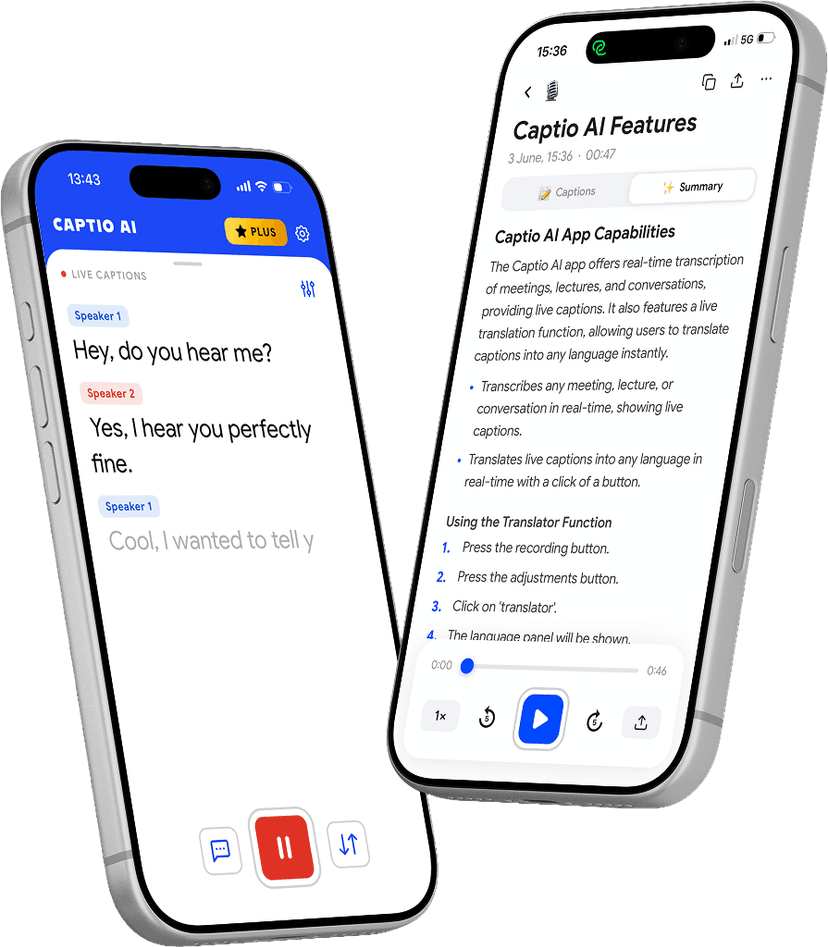
Everything you need to follow Hebrew traveling
Four tools built for deaf and hard of hearing Hebrew speakers.
Captions any spoken exchange, anywhere
- Airport staff, hotel receptionists, taxi drivers
- Real time, word by word, as they speak
- Works through travel noise and accents
- No setup — open the app and point it
No language barrier, anywhere in the world
- They speak their language — you read in yours
- 60+ languages, no manual switching
- For customs, hotels, restaurants, and local transport
- Translates in real time as they speak
Transcribe any recorded content
- Record a tour guide, a briefing, an important exchange
- Upload and get the full transcript to review
- Any language, any format
- Useful for travel information you want in writing
Key travel information extracted
- Instructions, directions, and key details from any transcript
- Organised into clear sections
- Useful after complex hotel check-ins or guided briefings
- Works on any saved recording
Download for free
Every situation covered
Designed for the real moments that matter — not just quiet controlled environments.
Gate changes and boarding calls at Ben Gurion International Airport (TLV) come in Hebrew and English. Captio AI captions both languages so you catch gate numbers and boarding times without relying on the PA system.
Israel Railways (Rakevet Israel) trains announce stops in Hebrew. At the HaHagana station in Tel Aviv or the Jerusalem Yitzhak Navon station, Captio AI captions the ticket window exchange and platform PA in real time.
A hotel receptionist in Tel Aviv's Florentin neighborhood or in Jerusalem's City Center explaining check-in details and local tips in Hebrew. Place Captio AI on the desk and follow the full conversation.
Asking for directions near the Mahane Yehuda market in Jerusalem or navigating Tel Aviv's bus network. Fast Hebrew from locals — Captio AI captions their reply so you find your way without confusion.
Israeli border control and security officers at Ben Gurion Terminal 3 speak quickly in formal Hebrew, sometimes switching to English. Captio AI captions every question so you respond accurately and confidently.
A guide at the Western Wall, Masada National Park, or Caesarea Maritime Archaeological Park delivering Hebrew commentary on Jewish and Roman history. Captio AI captions in real time so you follow every detail.
Most accurate and fastest models
word accuracy
independent benchmark, 2025
real-time captions
first word appears as you speak
Download for free
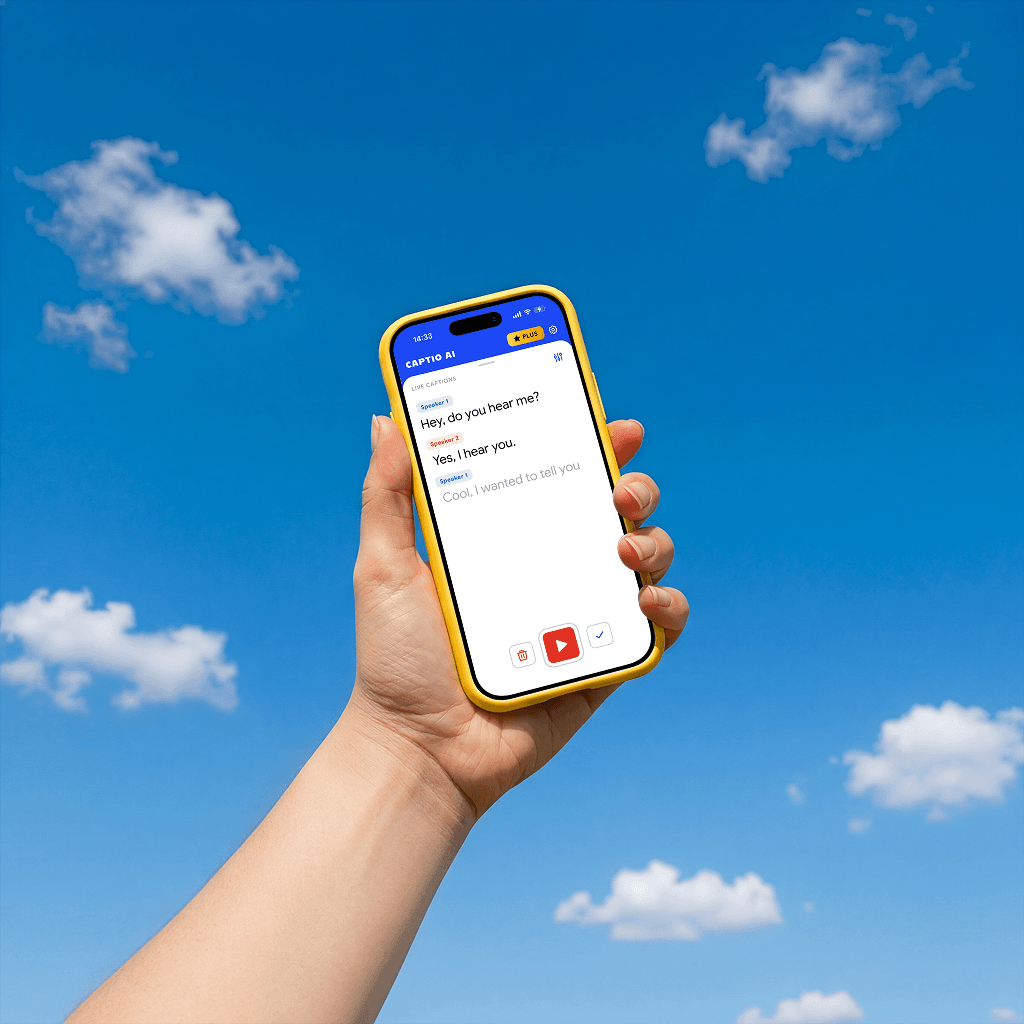
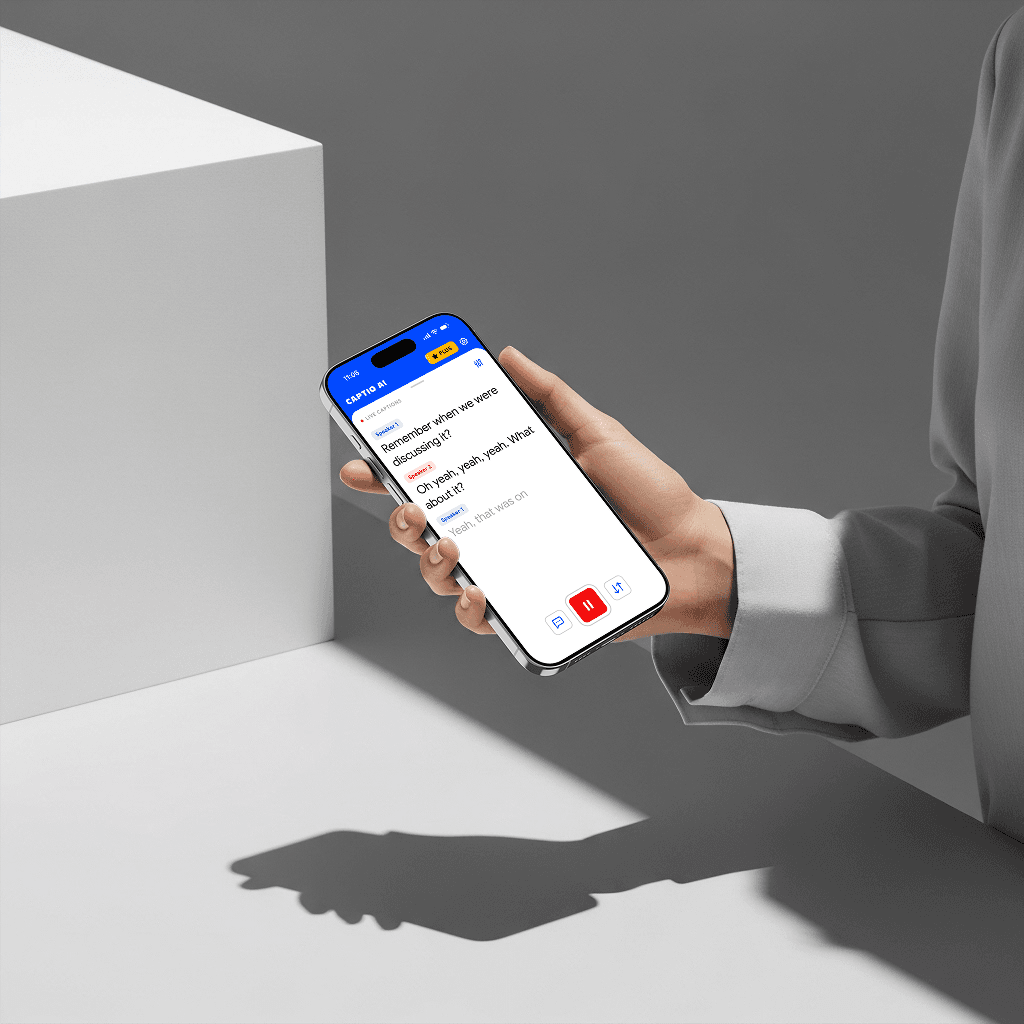
Built for a world that announces everything by sound
Captions any spoken exchange in real time
Airport staff, hotel receptionists, taxi drivers, tour guides. Hold the phone toward whoever is speaking and read the captions — in any setting, in any country.
60+ languages — no language barrier
Live Translator captions and translates in real time. They speak their language — you read in yours. For every country, every language, no manual setup between interactions.
Works anywhere with a data connection
Wi-Fi or mobile data. A local SIM or roaming plan keeps Captio AI running in any country — airports, hotels, rural areas, and everywhere in between.
Handles travel environments
Noisy airports, busy stations, echoing hotel lobbies. Captio AI is built for real environments — not quiet controlled rooms. It captions through the ambient noise of travel.
Discreet in any public setting
Hold the phone or place it near the speaker. Captio AI runs quietly and draws no attention — useful in customs, immigration, and any formal travel interaction where discretion matters.
Private by default
Travel conversations — customs declarations, hotel bookings, personal exchanges — are never stored or shared. Audio is processed in real time and discarded immediately.
Why Hebrew is hard to understand
Pharyngeal consonants in Mizrahi Hebrew
- The pharyngeal ח and ע of Mizrahi Hebrew are produced deep in the throat — invisible
- Mizrahi and Sephardic Modern Hebrew — widely spoken across Israel — preserves the pharyngeal fricative /ħ/ (ח) and pharyngeal approximant /ʕ/ (ע) as distinct sounds. These are produced at the pharynx with no lip or jaw movement. In Ashkenazi (General Modern Hebrew), /ʕ/ has merged with the glottal stop, but at a hotel desk in Bnei Brak, an immigration booth at Ben Gurion Terminal 3, or a market in Mahane Yehuda, a Mizrahi-accented speaker uses pharyngeal consonants throughout standard vocabulary. A deaf traveler watching their face sees nothing that maps to these phonemically distinct sounds.
General vs Mizrahi Hebrew divide
- Ashkenazi and Mizrahi Hebrew have different phonological systems — both common at airports
- General Modern Hebrew (primarily Ashkenazi) simplifies the guttural consonants to glottal stop or zero; Mizrahi Hebrew preserves them as full pharyngeal articulations. At Ben Gurion International Airport, immigration and airline staff may use either system. A deaf traveler calibrated to General Modern Hebrew encounters a Mizrahi-accented officer — with pharyngeal consonants at every turn — without visual warning that the phonological rules have changed.
Final stress and vowel reduction
- Unstressed penultimate syllables reduce heavily in fast Hebrew speech
- Modern Hebrew has default final-syllable stress. In fast natural speech — at a Tel Aviv train station, a Jerusalem bus terminal, or a hotel lobby — penultimate syllables reduce significantly: short vowels compress, sometimes approaching schwa or deleting. A deaf traveler who prepared from slower, clearer Hebrew resource recordings arrives at a real-world counter to find that common words sound — and look on the lips — shorter than what they practiced.
Arabic-Hebrew code-switching
- Arab Israeli speakers switch between Hebrew and Arabic mid-sentence — two phonological systems at once
- Many Arab Israeli citizens in Haifa, Jaffa, Nazareth, and the Galilee are fully bilingual in Arabic and Hebrew, switching between them in natural conversation. At travel counters in Haifa Port, a hotel in Jaffa, or near the Basilica of the Annunciation in Nazareth, a staff member may begin in Hebrew and switch to Arabic mid-sentence. A deaf traveler lip-reading Hebrew suddenly encounters Arabic consonants — pharyngeals, emphatics, a completely different phonological set — with no visual transition.
Unvoweled orthography
- Adult Hebrew text has no vowels — what you read and what you lip-read are both incomplete
- Modern Hebrew is written without vowels (nekudot/nikkud) in adult contexts. The vowel pattern of a word is carried inside the root's consonant skeleton and must be inferred from context. A deaf traveler using lip-reading relies on seeing vowel shapes as visual cues — but a Hebrew lip-reader has no orthographic reference to confirm what vowel was spoken: neither the written sign nor the speaker's face provides the vowel unambiguously.
Download for free
Hearing loss and travel accessibility in Israel
Israel has a notably complex genetic profile of hereditary hearing loss: more than 20 genes have been identified as causing deafness within the Jewish-Israeli hearing-impaired population, reflecting the diverse Diaspora origins of modern Israeli society — Ashkenazi, Sephardic, Mizrahi, and Ethiopian Jewish communities each carry different genetic hearing loss variants at population-relevant frequencies. A study on prenatal diagnosis in Israeli families found that genetic counseling and prenatal testing for hearing loss are common in both Jewish and Muslim communities, reflecting the acknowledged prevalence of hereditary deafness. Israel's Central Bureau of Statistics released population data on hearing impairment on World Hearing Day 2024, indicating a significant hearing-impaired community within the Israeli population of approximately 9.8 million.
Israel's travel infrastructure — including Ben Gurion International Airport (handling over 24 million passengers per year), Israel Railways' intercity network connecting Tel Aviv, Jerusalem, Haifa, and Be'er Sheva, and the Dan and Egged bus networks across major cities — communicates critical travel information through spoken Hebrew and sometimes Arabic PA announcements. Ben Gurion's intensive security questioning process — where all passengers are interviewed before and during check-in — is conducted verbally in Hebrew or English, with no structured captioning alternative for deaf travelers. Israel's major tourist sites — the Western Wall, Masada, the Sea of Galilee, Caesarea, and Nazareth — attract millions of annual visitors; guided tours are conducted verbally without real-time captioning infrastructure.
Captio AI captions Hebrew in real time — whether a security question at Ben Gurion Terminal 3, a guide at Masada, or a platform announcement at Jerusalem's Yitzhak Navon station — so a deaf traveler in Israel follows every instruction and question without depending on audio infrastructure built without them in mind.
Download for free
What you hear stays with you.
Gone the moment it ends
Captio AI processes your audio in real time and discards it immediately. Nothing is recorded. Nothing is kept.
Not a product
Your conversations are not something Captio AI sells, shares, or monetizes — to anyone, for any reason.
Not used to train anything
What you say in a doctor's appointment or a job interview never ends up in a training dataset. Not ours. Not anyone else's.

Private by default
Captio AI supports 60+ languages
Download for free
Frequently asked questions
Navigate confidently in Hebrew.
Captio AI is free to start
Download for free