

Tagalog live captions and productivity tool for traveling
For deaf and hard of hearing people.
Download for free


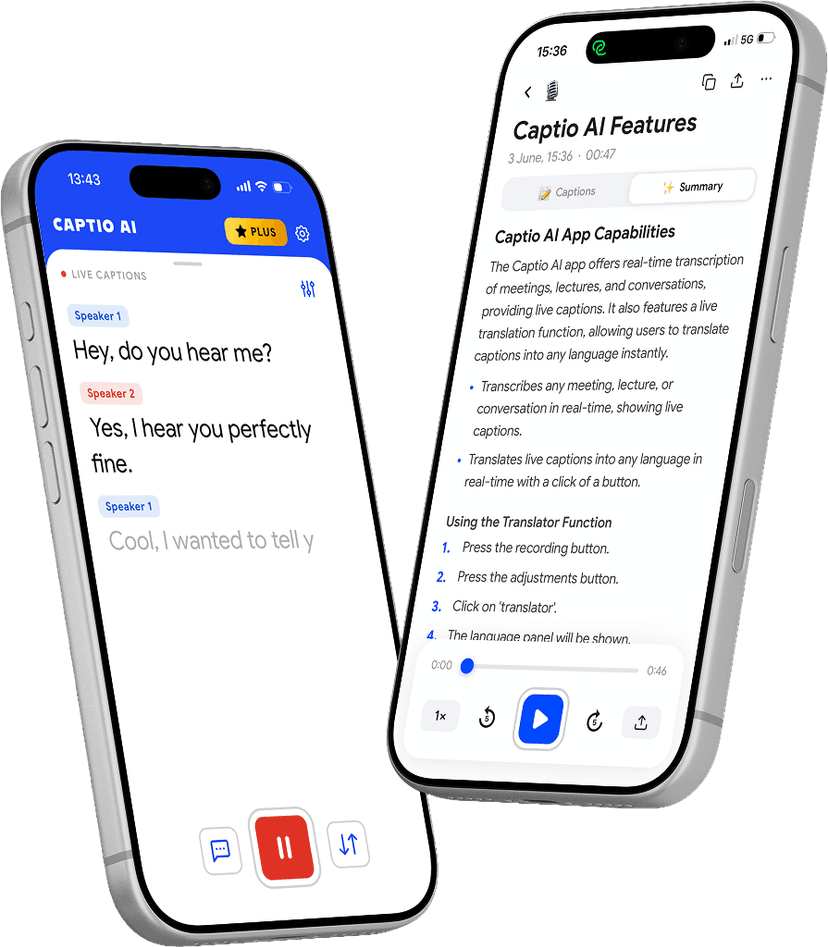
Everything you need to follow Tagalog traveling
Four tools built for deaf and hard of hearing Tagalog speakers.
Captions any spoken exchange, anywhere
- Airport staff, hotel receptionists, taxi drivers
- Real time, word by word, as they speak
- Works through travel noise and accents
- No setup — open the app and point it
No language barrier, anywhere in the world
- They speak their language — you read in yours
- 60+ languages, no manual switching
- For customs, hotels, restaurants, and local transport
- Translates in real time as they speak
Transcribe any recorded content
- Record a tour guide, a briefing, an important exchange
- Upload and get the full transcript to review
- Any language, any format
- Useful for travel information you want in writing
Key travel information extracted
- Instructions, directions, and key details from any transcript
- Organised into clear sections
- Useful after complex hotel check-ins or guided briefings
- Works on any saved recording
Download for free
Every situation covered
Designed for the real moments that matter — not just quiet controlled environments.
Gate changes and boarding calls at Ninoy Aquino International (NAIA) or Mactan-Cebu International come in Filipino and English. Captio AI captions both languages so you catch gate numbers and boarding times without relying on the distorted PA system.
Bus terminals at Cubao or Pasay in Manila announce departures in Tagalog. At LRT and MRT stations, Captio AI captions the exchange at ticket windows and the platform PA so you know which service to take.
A hotel receptionist in Manila, Cebu, or Boracay explaining check-in details and local tips in Filipino. Place Captio AI on the desk and follow the full conversation without asking for anything repeated.
Asking for directions in BGC or navigating Intramuros in Manila on foot. Fast Tagalog from locals and jeepney drivers — Captio AI captions their reply so you find your way without needing things repeated.
Philippine immigration and customs officers at NAIA speak quickly in formal Filipino and English. Captio AI captions every question so you respond accurately and confidently.
A guide at Intramuros, the Chocolate Hills in Bohol, or the underground river in Palawan delivering Filipino commentary on island history and ecology. Captio AI captions in real time so you follow the full story.
Most accurate and fastest models
word accuracy
independent benchmark, 2025
real-time captions
first word appears as you speak
Download for free
Built for a world that announces everything by sound
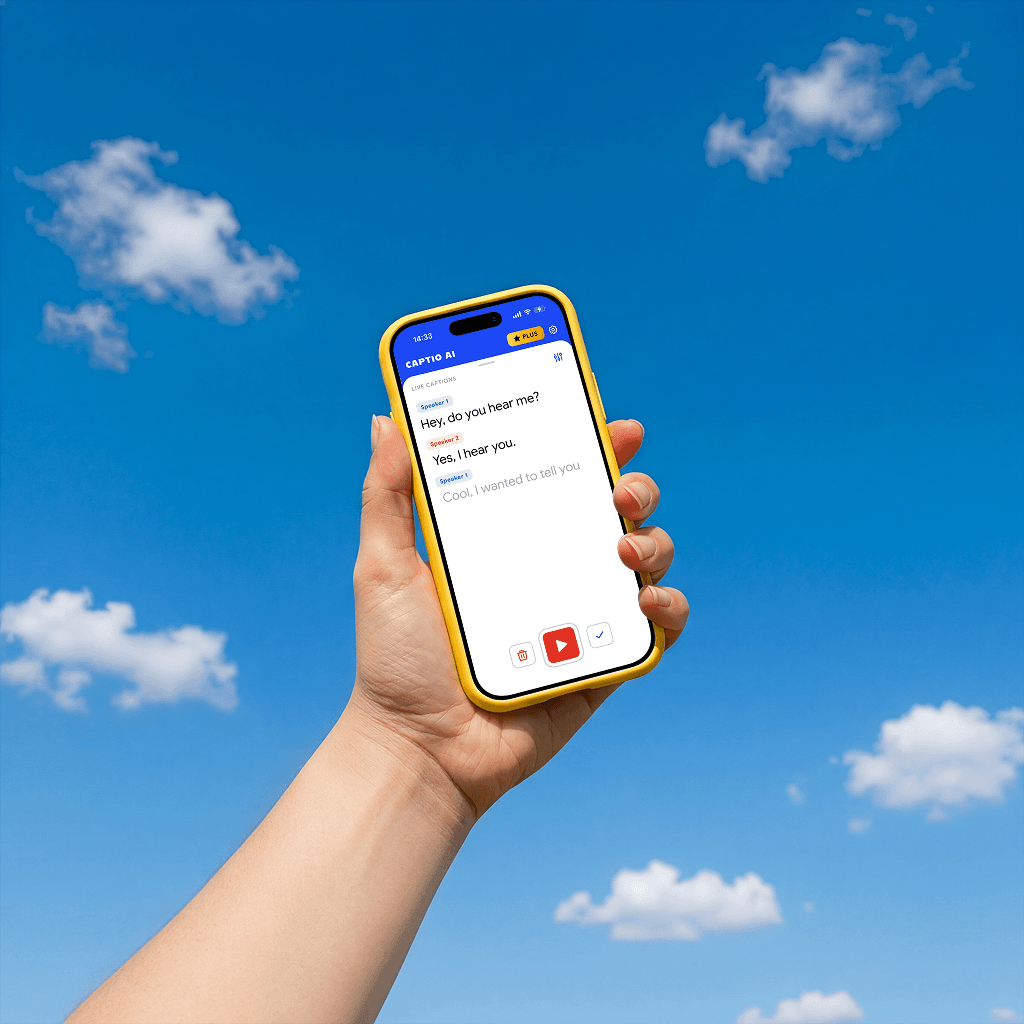
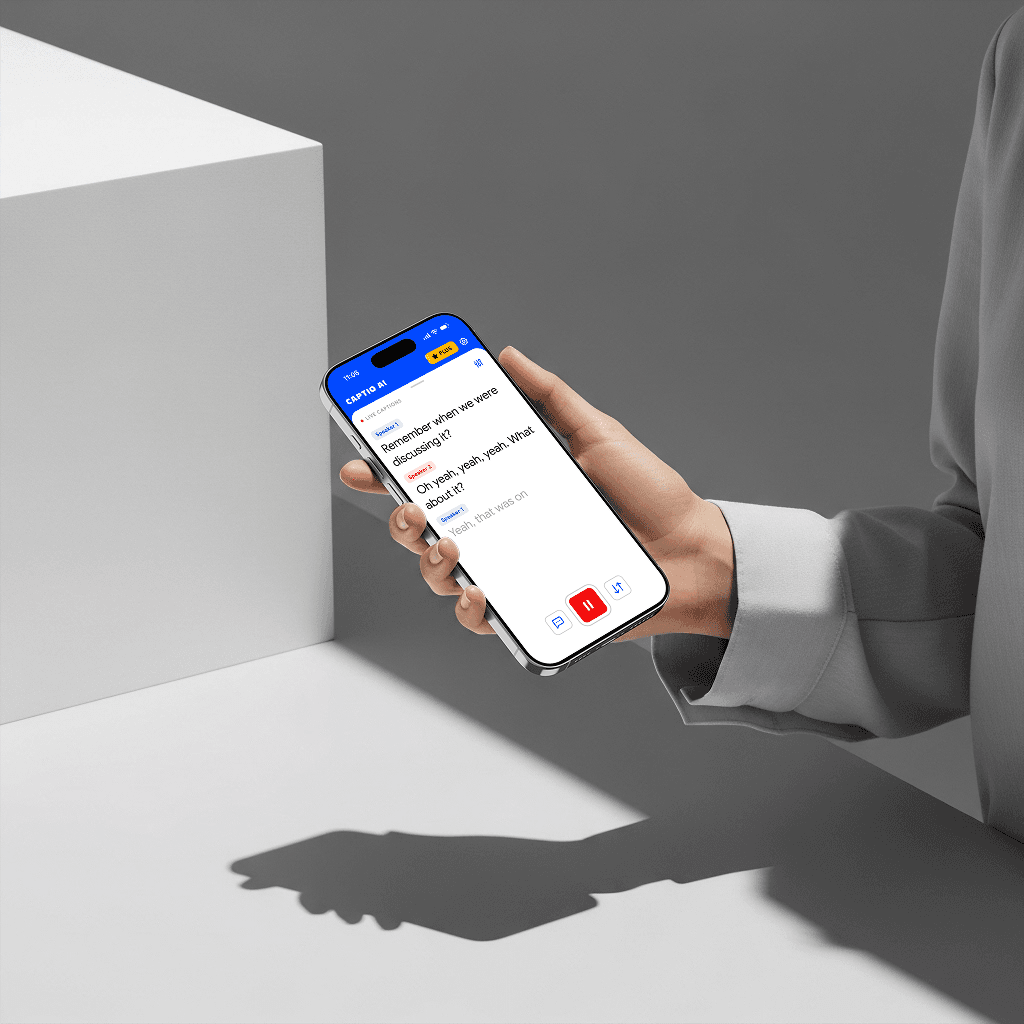
Captions any spoken exchange in real time
Airport staff, hotel receptionists, taxi drivers, tour guides. Hold the phone toward whoever is speaking and read the captions — in any setting, in any country.
60+ languages — no language barrier
Live Translator captions and translates in real time. They speak their language — you read in yours. For every country, every language, no manual setup between interactions.
Works anywhere with a data connection
Wi-Fi or mobile data. A local SIM or roaming plan keeps Captio AI running in any country — airports, hotels, rural areas, and everywhere in between.
Handles travel environments
Noisy airports, busy stations, echoing hotel lobbies. Captio AI is built for real environments — not quiet controlled rooms. It captions through the ambient noise of travel.
Discreet in any public setting
Hold the phone or place it near the speaker. Captio AI runs quietly and draws no attention — useful in customs, immigration, and any formal travel interaction where discretion matters.
Private by default
Travel conversations — customs declarations, hotel bookings, personal exchanges — are never stored or shared. Audio is processed in real time and discarded immediately.
Why Tagalog is hard to understand
Glottal stop phoneme
- Tagalog's glottal stop distinguishes words — and is produced at the larynx
- Tagalog has a phonemic glottal stop that appears between vowels and at word boundaries. This stop is produced at the glottis with no lip, jaw, or tongue movement visible from the front. At Ninoy Aquino International Airport in Manila or a Cebu Mactan hotel desk, word pairs that differ only by the presence of a glottal stop look completely identical on the speaker's lips — a deaf traveler watching the agent's face receives no visual information about which word was said.
Stress-shifted meaning
- Word stress changes meaning — but stress is not visible on the lips
- Tagalog word stress falls on either the penultimate or final syllable, and shifting stress changes word meaning. The stressed syllable has a longer, higher vowel — an acoustic property carried primarily in the larynx and not in any visible lip or jaw position. At a Manila bus terminal or a Boracay hotel reception, pairs of words that differ only in stress position look identical on a speaker's face.
Taglish code-switching
- Filipino conversation mixes Tagalog and English mid-sentence constantly
- Filipino speech freely mixes Tagalog and English within sentences (Taglish). At NAIA Terminal 1 or a Makati hotel check-in desk, a staff member may begin a sentence in Tagalog, switch to English for a technical term, and return to Tagalog — all without any visual signal. A deaf traveler who calibrated to Tagalog lip-shapes must suddenly apply English phoneme mappings with no transition moment to prepare.
Regional dialect variation
- Manila Tagalog and provincial Tagalog differ at the airport counter
- Manila Tagalog differs from Batangas Tagalog in stress placement and vowel quality, and Cebuano-influenced Tagalog from the Visayas differs from both in consonant realization and prosody. A deaf traveler prepared for Manila Tagalog arrives at Mactan-Cebu International to find Cebuano-influenced speech from immigration and hotel staff — with different phonological patterns at every counter.
Fast speech vowel reduction
- Final syllables reduce heavily in natural fast Filipino speech
- In fast casual Filipino conversation — at a Pasay bus terminal, Divisoria market, or a crowded departure hall at NAIA — unstressed final syllables reduce and elide. The trained phonological knowledge a deaf traveler brings from slower resources doesn't map onto the fast, compressed forms that arrive at a busy Manila counter.
Download for free
Hearing loss and travel accessibility in the Philippines
A national survey of hearing loss in the Philippines — the first of its kind, published in 2020 — found that 15% of the overall population had moderate or worse hearing loss. The rate rose to 49.1% among adults aged 65 and older. Prevalence in children aged 0–17 was 7.5%, and in working-age adults (18–65) was 14.7%. The Philippine Statistics Authority reported 1.23% of the entire population as deaf, mute, or hearing-impaired, with earlier projections estimating 241,624 totally deaf individuals and 275,942 partially deaf — figures that have grown as the population aged. As of June 2024, 1,638,588 persons with disability were registered nationally.
The Philippines' travel infrastructure — including NAIA's four terminals handling over 47 million passengers per year pre-pandemic, provincial airports in Cebu, Davao, Iloilo, and Zamboanga, and the inter-island ferry network connecting 7,641 islands — communicates critical travel information primarily through spoken Filipino and English PA announcements. Real-time captioning is not a standard accessibility feature at Philippine airports or ferry ports. For deaf and hard of hearing Filipinos navigating a domestic flight from Manila to Davao, a ferry crossing from Cebu to Bohol, or an international connection at NAIA, all critical timing and boarding information is delivered through audio channels.
Captio AI captions Filipino in real time — whether a gate announcement at NAIA Terminal 3, an immigration officer at the arrivals hall, or a guide at the Chocolate Hills in Bohol — so a deaf traveler in the Philippines follows every instruction and question without depending on audio infrastructure built without them in mind.
Download for free
What you hear stays with you.
Gone the moment it ends
Captio AI processes your audio in real time and discards it immediately. Nothing is recorded. Nothing is kept.
Not a product
Your conversations are not something Captio AI sells, shares, or monetizes — to anyone, for any reason.
Not used to train anything
What you say in a doctor's appointment or a job interview never ends up in a training dataset. Not ours. Not anyone else's.

Private by default
Captio AI supports 60+ languages
Download for free
Frequently asked questions
Navigate confidently in Tagalog.
Captio AI is free to start
Download for free