

Arabic live captions and productivity tool for traveling
For deaf and hard of hearing people.
Download for free


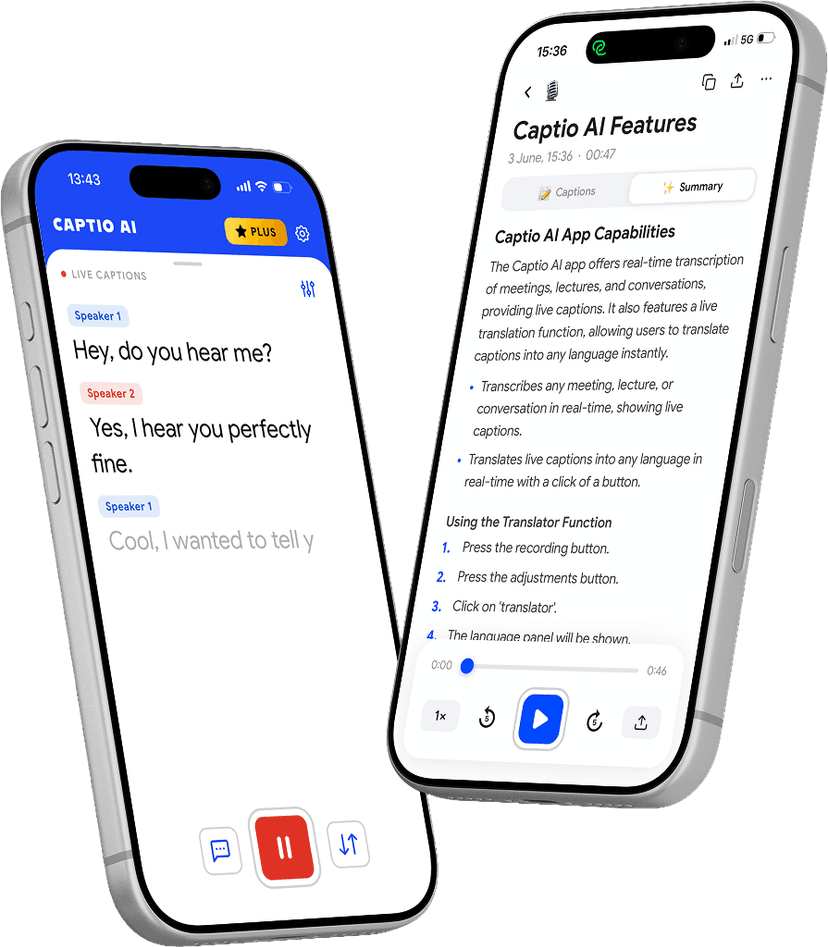
Everything you need to follow Arabic traveling
Four tools built for deaf and hard of hearing Arabic speakers.
Captions any spoken exchange, anywhere
- Airport staff, hotel receptionists, taxi drivers
- Real time, word by word, as they speak
- Works through travel noise and accents
- No setup — open the app and point it
No language barrier, anywhere in the world
- They speak their language — you read in yours
- 60+ languages, no manual switching
- For customs, hotels, restaurants, and local transport
- Translates in real time as they speak
Transcribe any recorded content
- Record a tour guide, a briefing, an important exchange
- Upload and get the full transcript to review
- Any language, any format
- Useful for travel information you want in writing
Key travel information extracted
- Instructions, directions, and key details from any transcript
- Organised into clear sections
- Useful after complex hotel check-ins or guided briefings
- Works on any saved recording
Download for free
Every situation covered
Designed for the real moments that matter — not just quiet controlled environments.
At Dubai International, Cairo's Terminal 3, or Riyadh's King Khalid, announcements come in Arabic — fast, formal, and often with local dialect colouring. Captio AI captions so you catch every gate change.
Cairo Metro, Riyadh Metro, or Casablanca Tramway staff communicate entirely in Arabic. Captio AI captions ticket counter conversations and platform instructions in real time.
A hotel receptionist in Amman or Abu Dhabi speaking colloquial Levantine or Gulf Arabic. Captio AI captions the check-in exchange so you follow room details and local tips without asking for repeats.
Asking for directions in a Marrakech medina or from a local in Beirut's streets. Rapid dialect Arabic — Captio AI captions and translates in real time.
Immigration and customs officers at Arab country borders speak quickly in formal Arabic. Captio AI captions every question so you respond accurately.
A guide at Petra, the Pyramids, or the souks of Marrakech delivering Arabic commentary. Captio AI captions so you follow the narrative through every historical site.
Most accurate and fastest models
word accuracy
independent benchmark, 2025
real-time captions
first word appears as you speak
Download for free
Built for a world that announces everything by sound
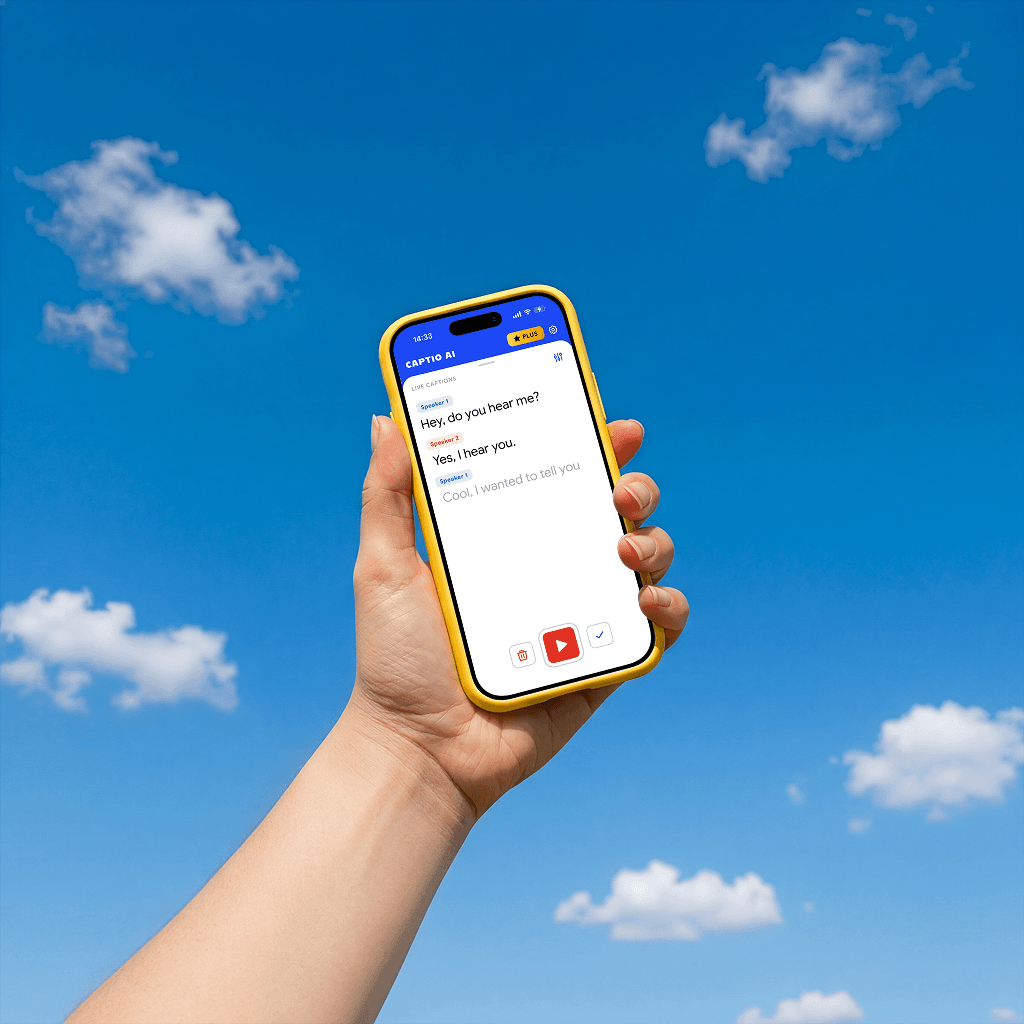
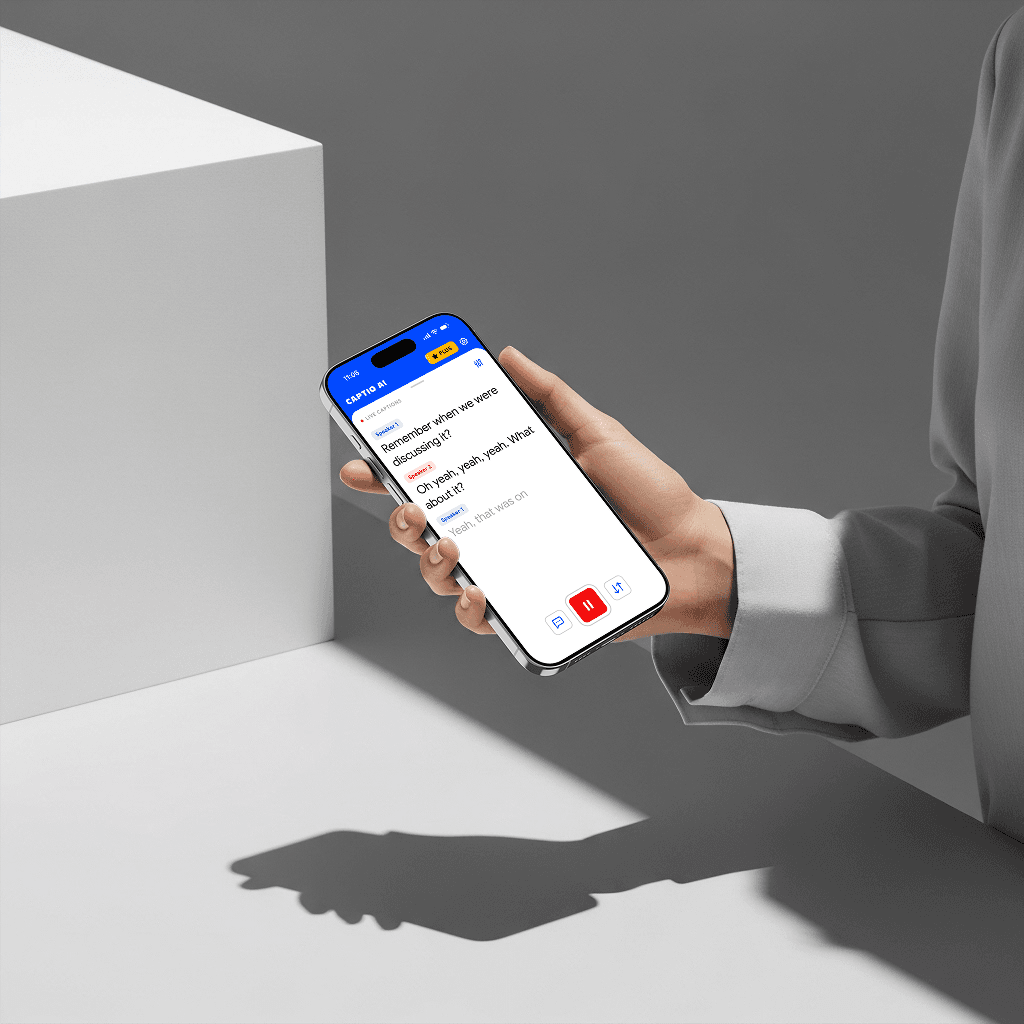
Captions any spoken exchange in real time
Airport staff, hotel receptionists, taxi drivers, tour guides. Hold the phone toward whoever is speaking and read the captions — in any setting, in any country.
60+ languages — no language barrier
Live Translator captions and translates in real time. They speak their language — you read in yours. For every country, every language, no manual setup between interactions.
Works anywhere with a data connection
Wi-Fi or mobile data. A local SIM or roaming plan keeps Captio AI running in any country — airports, hotels, rural areas, and everywhere in between.
Handles travel environments
Noisy airports, busy stations, echoing hotel lobbies. Captio AI is built for real environments — not quiet controlled rooms. It captions through the ambient noise of travel.
Discreet in any public setting
Hold the phone or place it near the speaker. Captio AI runs quietly and draws no attention — useful in customs, immigration, and any formal travel interaction where discretion matters.
Private by default
Travel conversations — customs declarations, hotel bookings, personal exchanges — are never stored or shared. Audio is processed in real time and discarded immediately.
Why Arabic is hard to understand
Pharyngeal consonants
- Sounds produced deep in the throat
- Arabic has two phonemes produced deep in the throat: /ħ/ (ح) and /ʕ/ (ع). These sounds produce almost no visible lip or jaw movement — to a deaf traveler watching a hotel receptionist or immigration officer in Cairo or Dubai, these consonants are entirely invisible, yet they carry critical meaning in common travel words.
Emphatic consonants
- Pharyngealization invisible at lip level
- Arabic distinguishes plain from emphatic (pharyngealized) consonants across four pairs: /s/-/sˤ/, /d/-/dˤ/, /t/-/tˤ/, /ð/-/ðˤ/. At the lip level these sounds look virtually identical — yet they produce completely different words. A deaf traveler at a customs counter cannot distinguish emphatic from plain variants from lip shapes alone.
Diglossia
- MSA on signs, dialect spoken everywhere
- Modern Standard Arabic is what appears on airport signs and official documents. The Arabic actually spoken by a Moroccan customs officer, an Egyptian hotel receptionist, or a Gulf airline crew member is a regional dialect — Darija, Egyptian Arabic, Gulf Arabic — that can differ so radically from MSA that even fluent speakers across regions struggle with mutual intelligibility.
Dialect diversity
- Levantine, Gulf, Egyptian, Maghrebi — all different on the lips
- The Arabic dialects a traveler encounters across a single Arab-world trip can span four mutually distinct spoken varieties. Cairo taxi drivers, Beirut hotel staff, Dubai immigration officers, and Casablanca market vendors all speak recognisably different Arabic — each presenting a new lip-reading challenge.
Uvular consonants
- Back-of-throat sounds at the counter
- Arabic /q/ (ق) and /ʁ/ (غ) are produced at the uvula, far back in the oral cavity — they produce no visible movement at the lips. Yet /q/ appears in essential travel words across dialects. A deaf traveler watching a customs officer's lips at a Gulf airport sees nothing where the most distinctive consonants are being made.
Download for free
Hearing loss and travel accessibility across the Arab world
The Arab world carries a significant hearing loss burden, compounded by structural barriers to diagnosis and support. According to the WHO World Report on Hearing, approximately 90% of people with disabling hearing loss globally live in low- and middle-income countries — a category that encompasses most of the Arab world outside the Gulf states. In many Arab countries, audiological services are concentrated in capital cities, leaving hearing-impaired populations in rural and secondary cities with limited access to diagnosis, hearing aids, or rehabilitation. Studies across Jordan, Saudi Arabia, and Morocco have documented elevated rates of autosomal recessive hearing loss linked to consanguineous marriage practices in some communities.
Sign language recognition remains limited across the Arab world. No unified Arab sign language exists — each country has developed its own, with limited mutual intelligibility across borders. For a deaf traveler from one Arab country visiting another, the local deaf community's communication system may be unreadable. In many Arab states, disability policy frameworks for deaf and hard of hearing citizens remain underdeveloped, with access to public services — including travel infrastructure — rarely designed to serve them. Airport PA systems, immigration desks, and hotel check-ins across the region are designed around spoken Arabic.
Captio AI captions Arabic speech in real time — Gulf, Levantine, Egyptian, or Maghrebi — so a deaf traveler navigating a Gulf airport, a Jordanian customs desk, or a Moroccan hotel follows every exchange without depending on audio infrastructure that was not built with them in mind.
Download for free
What you hear stays with you.
Gone the moment it ends
Captio AI processes your audio in real time and discards it immediately. Nothing is recorded. Nothing is kept.
Not a product
Your conversations are not something Captio AI sells, shares, or monetizes — to anyone, for any reason.
Not used to train anything
What you say in a doctor's appointment or a job interview never ends up in a training dataset. Not ours. Not anyone else's.

Private by default
Captio AI supports 60+ languages
Download for free
Frequently asked questions
Navigate confidently in Arabic.
Captio AI is free to start
Download for free