

Russian live captions and productivity tool for traveling
For deaf and hard of hearing people.
Download for free


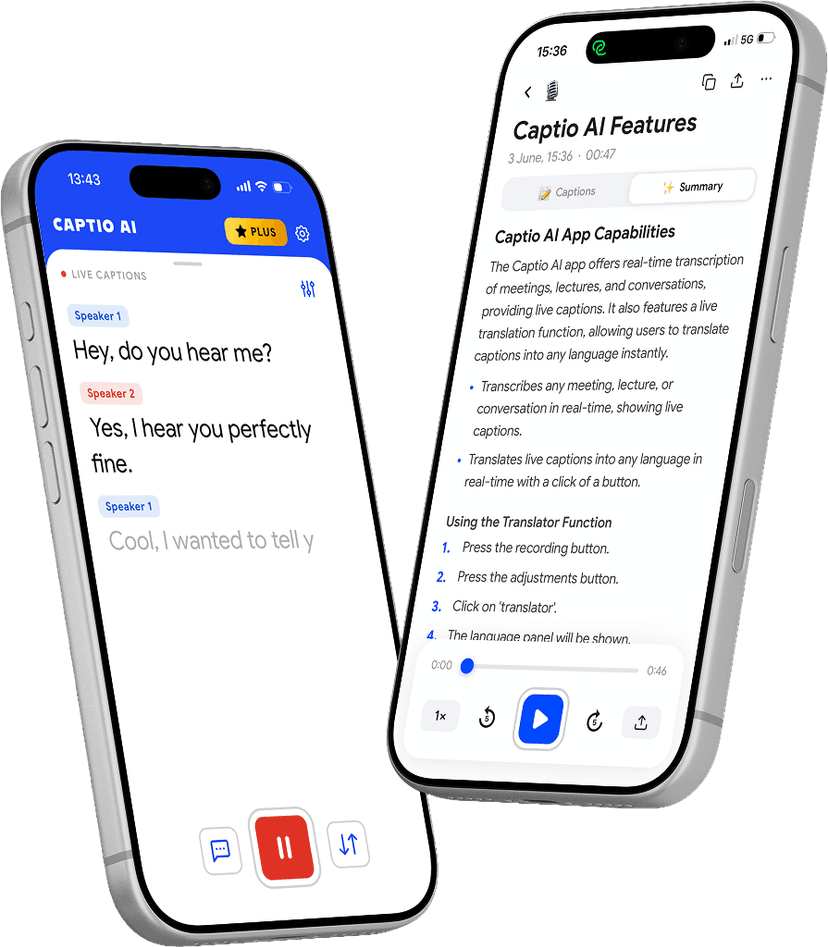
Everything you need to follow Russian traveling
Four tools built for deaf and hard of hearing Russian speakers.
Captions any spoken exchange, anywhere
- Airport staff, hotel receptionists, taxi drivers
- Real time, word by word, as they speak
- Works through travel noise and accents
- No setup — open the app and point it
No language barrier, anywhere in the world
- They speak their language — you read in yours
- 60+ languages, no manual switching
- For customs, hotels, restaurants, and local transport
- Translates in real time as they speak
Transcribe any recorded content
- Record a tour guide, a briefing, an important exchange
- Upload and get the full transcript to review
- Any language, any format
- Useful for travel information you want in writing
Key travel information extracted
- Instructions, directions, and key details from any transcript
- Organised into clear sections
- Useful after complex hotel check-ins or guided briefings
- Works on any saved recording
Download for free
Every situation covered
Designed for the real moments that matter — not just quiet controlled environments.
At Sheremetyevo, Pulkovo, or Domodedovo, gate changes and boarding calls come over PA systems in Russian at speed. Captio AI captions every announcement so you never miss an update or departure call.
Russian Railways announces departures in Russian at a pace that defeats even experienced learners. Captio AI captions ticket counter conversations and platform PA so you catch your train.
A hotel receptionist in Moscow or St. Petersburg explaining room details, key instructions, and local tips in Russian. Place Captio AI on the desk and follow the full check-in conversation.
Asking for directions on a Moscow street or getting help in a St. Petersburg museum. Russian spoken fast and colloquially — Captio AI captions in real time.
Russian border and customs officers speak quickly and precisely. Captio AI captions every question so you respond correctly.
A guide at the Hermitage, the Kremlin, or along Lake Baikal delivering Russian commentary. Captio AI captions the full narrative so you follow every historical detail.
Most accurate and fastest models
word accuracy
independent benchmark, 2025
real-time captions
first word appears as you speak
Download for free
Built for a world that announces everything by sound
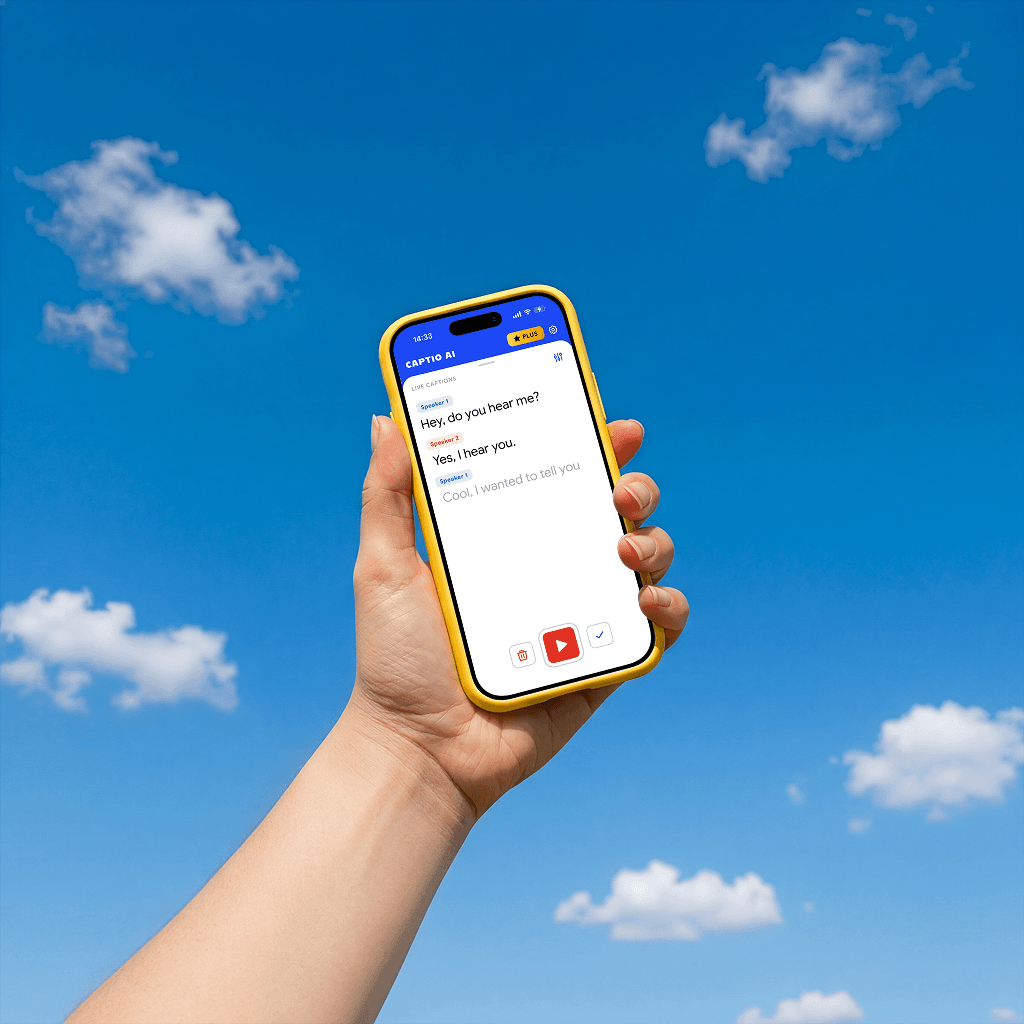
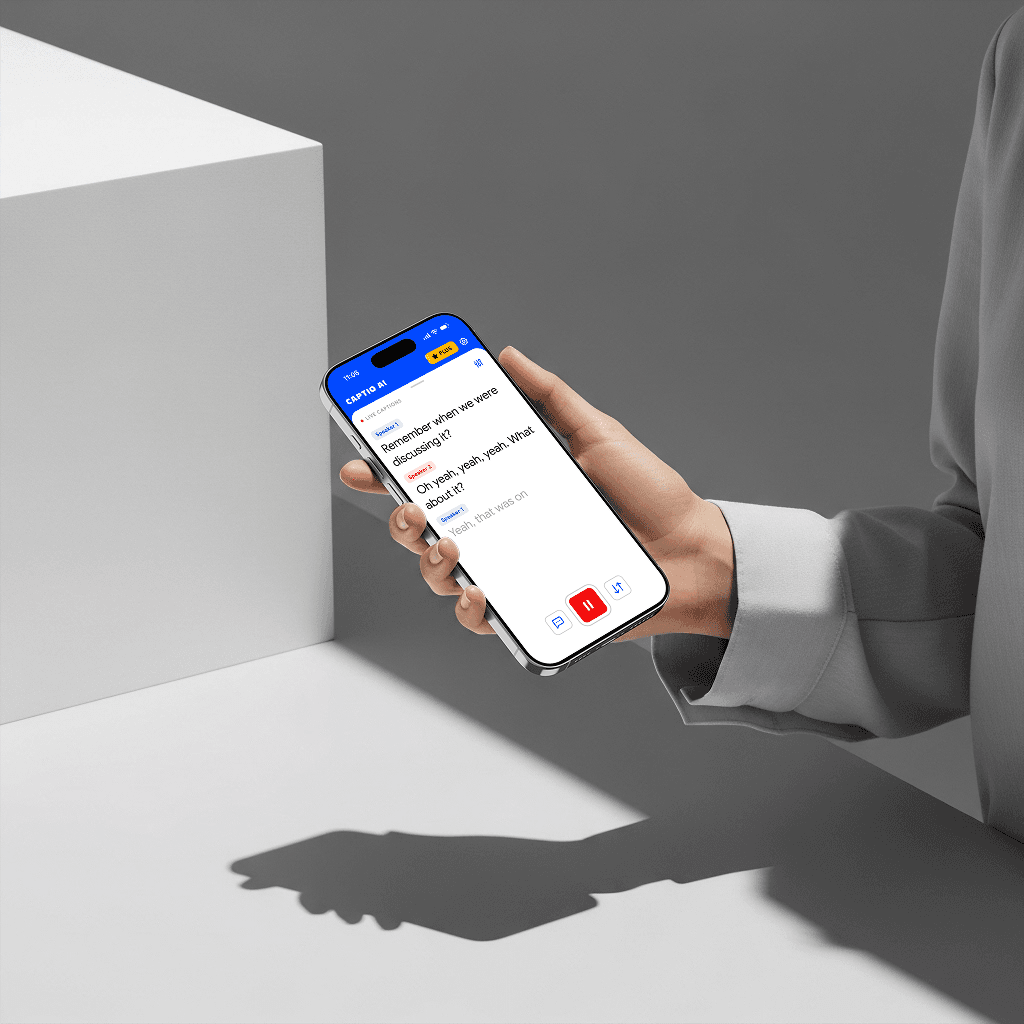
Captions any spoken exchange in real time
Airport staff, hotel receptionists, taxi drivers, tour guides. Hold the phone toward whoever is speaking and read the captions — in any setting, in any country.
60+ languages — no language barrier
Live Translator captions and translates in real time. They speak their language — you read in yours. For every country, every language, no manual setup between interactions.
Works anywhere with a data connection
Wi-Fi or mobile data. A local SIM or roaming plan keeps Captio AI running in any country — airports, hotels, rural areas, and everywhere in between.
Handles travel environments
Noisy airports, busy stations, echoing hotel lobbies. Captio AI is built for real environments — not quiet controlled rooms. It captions through the ambient noise of travel.
Discreet in any public setting
Hold the phone or place it near the speaker. Captio AI runs quietly and draws no attention — useful in customs, immigration, and any formal travel interaction where discretion matters.
Private by default
Travel conversations — customs declarations, hotel bookings, personal exchanges — are never stored or shared. Audio is processed in real time and discarded immediately.
Why Russian is hard to understand
Palatalization
- Every consonant has a hard and soft version
- Russian has 36 consonant phonemes, each existing in a plain (hard) and palatalized (soft) variant — /t/ vs. /tʲ/, /n/ vs. /nʲ/, /s/ vs. /sʲ/. Palatalization is produced by raising the tongue toward the palate — it produces almost no change in the visible lip position. At a Moscow hotel desk or a train station counter, the consonant that changes a word's meaning leaves no trace a deaf traveler can read on the speaker's lips.
Consonant clusters
- Dense clusters that compress in connected speech
- Russian forms some of the densest consonant clusters in any European language — 'zdravstvuyte' (hello), 'vstupleniye' (introduction), 'vstrecha' (meeting). In fast speech at a Russian Railways ticket window or an airport counter, these clusters blend into rapid sequences with almost no distinguishing visible articulation.
Vowel reduction
- Unstressed vowels collapse to near-silence
- Unstressed /o/ in Russian shifts to /a/, and unstressed vowels in general reduce toward /ə/ or disappear. A deaf traveler lip-reading a Moscow receptionist finds the vowels they expect to see — and that make word boundaries legible — simply absent in natural connected speech.
Regressive assimilation
- Words change at their boundaries
- In Russian, voiced consonants devoice word-finally and at word boundaries: 'pod' (under) sounds like 'pot', 'vokzal' (station) begins with /f/. For a deaf traveler, a word they would recognise in isolation looks and sounds different when spoken in connected speech by a border officer or station announcer.
Dialect and register gap
- Northern okanye vs. Southern akanye vs. Siberian
- Northern Russian preserves full /o/ in unstressed positions; Southern Russian shifts it to /a/ (Moscow standard). Siberian and Far Eastern Russian varieties add further vowel and consonant differences. A deaf traveler lip-reading announcement Russian at Sheremetyevo may find the same words barely recognisable from a hotel receptionist in St. Petersburg or a ticket seller in Novosibirsk.
Download for free
Hearing loss and travel accessibility in Russia
A 2023 national survey on self-reported hearing aid use among Russian adults, published in PMC, found that the overall prevalence of hearing aid use was extremely low, with unmet need in 98% of cases where trouble with hearing was self-reported — worse than other population studies and global estimates. Russian Sign Language (RSL) has over 120,000 users, but legal recognition and active support for deaf Russians in public settings remains inconsistent. Deaf people are legally entitled to interpreter services and disability support under Russia's federal disability protection law, but in practice service quality is unevenly distributed, with rural and regional areas significantly underserved.
Russia's travel infrastructure — airports, the vast rail network of Russian Railways (RZhD), and intercity bus terminals — communicates almost entirely through spoken PA announcements and verbal counter exchanges. At major hubs like Sheremetyevo or Moskovsky Vokzal in St. Petersburg, there are no standardised real-time captioning services for deaf and hard of hearing passengers. The Trans-Siberian Railway, crossing eight time zones, announces station stops through onboard PA in Russian only. For a deaf traveler on a long-distance Russian rail journey, missing a stop announcement has real consequences.
Captio AI captions Russian speech in real time — whether a Moscow airport gate announcement, a Russian Railways counter in Yekaterinburg, or a border officer at a land crossing — so a deaf traveler across Russia follows every instruction and question without depending on audio infrastructure built without them in mind.
Download for free
What you hear stays with you.
Gone the moment it ends
Captio AI processes your audio in real time and discards it immediately. Nothing is recorded. Nothing is kept.
Not a product
Your conversations are not something Captio AI sells, shares, or monetizes — to anyone, for any reason.
Not used to train anything
What you say in a doctor's appointment or a job interview never ends up in a training dataset. Not ours. Not anyone else's.

Private by default
Captio AI supports 60+ languages
Download for free
Frequently asked questions
Navigate confidently in Russian.
Captio AI is free to start
Download for free