

Bengali live captions and productivity tool for traveling
For deaf and hard of hearing people.
Download for free


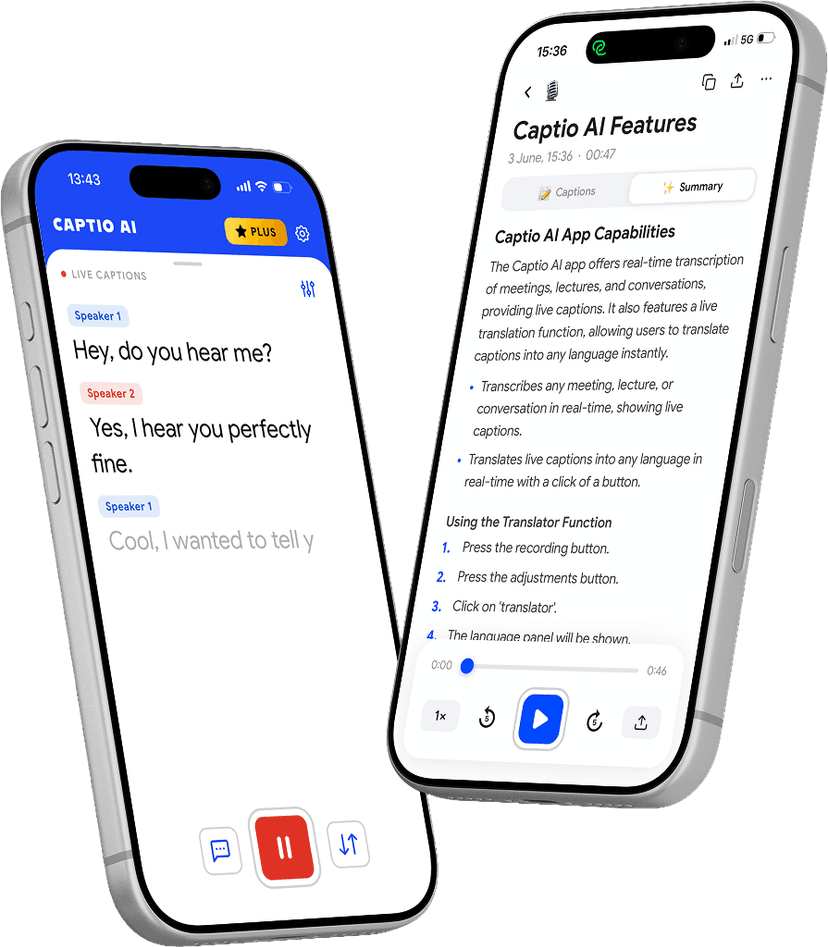
Everything you need to follow Bengali traveling
Four tools built for deaf and hard of hearing Bengali speakers.
Captions any spoken exchange, anywhere
- Airport staff, hotel receptionists, taxi drivers
- Real time, word by word, as they speak
- Works through travel noise and accents
- No setup — open the app and point it
No language barrier, anywhere in the world
- They speak their language — you read in yours
- 60+ languages, no manual switching
- For customs, hotels, restaurants, and local transport
- Translates in real time as they speak
Transcribe any recorded content
- Record a tour guide, a briefing, an important exchange
- Upload and get the full transcript to review
- Any language, any format
- Useful for travel information you want in writing
Key travel information extracted
- Instructions, directions, and key details from any transcript
- Organised into clear sections
- Useful after complex hotel check-ins or guided briefings
- Works on any saved recording
Download for free
Every situation covered
Designed for the real moments that matter — not just quiet controlled environments.
At Shahjalal International in Dhaka or Netaji Subhas Chandra Bose in Kolkata, announcements flow in Bengali and English. Captio AI captions both languages so you never miss a boarding call or gate change.
Bangladesh Railway and West Bengal train stations announce departures in Bengali. Captio AI captions the ticket counter conversation and platform PA so you catch every platform change.
A hotel receptionist in Dhaka or Kolkata explaining check-in procedures and local recommendations in fast Bengali. Captio AI captions every word on the reception desk.
Asking directions in Dhaka's Gulshan or Kolkata's narrow lanes. Bengali spoken fast with local dialect colouring — Captio AI captions in real time so you understand the first time.
Immigration officers at Dhaka airport speak in Bengali. Captio AI captions each question so you respond accurately and confidently.
A guide at the Sundarbans, the Dhaka Muslin Museum, or the Victoria Memorial in Kolkata delivering Bengali commentary. Captio AI captions so you follow the full story.
Most accurate and fastest models
word accuracy
independent benchmark, 2025
real-time captions
first word appears as you speak
Download for free


Built for a world that announces everything by sound
Captions any spoken exchange in real time
Airport staff, hotel receptionists, taxi drivers, tour guides. Hold the phone toward whoever is speaking and read the captions — in any setting, in any country.
60+ languages — no language barrier
Live Translator captions and translates in real time. They speak their language — you read in yours. For every country, every language, no manual setup between interactions.
Works anywhere with a data connection
Wi-Fi or mobile data. A local SIM or roaming plan keeps Captio AI running in any country — airports, hotels, rural areas, and everywhere in between.
Handles travel environments
Noisy airports, busy stations, echoing hotel lobbies. Captio AI is built for real environments — not quiet controlled rooms. It captions through the ambient noise of travel.
Discreet in any public setting
Hold the phone or place it near the speaker. Captio AI runs quietly and draws no attention — useful in customs, immigration, and any formal travel interaction where discretion matters.
Private by default
Travel conversations — customs declarations, hotel bookings, personal exchanges — are never stored or shared. Audio is processed in real time and discarded immediately.
Why Bengali is hard to understand
Aspirated pairs
- Six pairs of stops that look identical on the lips
- Bengali distinguishes aspirated and unaspirated stops across six positions: /p/-/ph/, /b/-/bh/, /t/-/th/, /d/-/dh/, /k/-/kh/, /g/-/gh/. All twelve sounds produce nearly identical lip configurations. At a station counter in Dhaka or a hotel desk in Kolkata, the aspiration that separates words is invisible to a deaf traveler watching the speaker's lips.
Nasalization
- East Bengali nasalized vowels — no lip signal
- Eastern Bengali, spoken throughout Bangladesh, makes heavy use of nasalized vowels. Nasalization is produced at the soft palate — there is almost no visual difference at the lips between a nasal and oral vowel. A deaf traveler in Dhaka watching for key travel words sees nothing of the nasalization that carries much of the phonemic contrast.
East-West dialect divide
- Bangladesh Bengali vs. West Bengal Bengali
- Bangladesh Bengali (Dhaka dialect) and West Bengal Bengali (Kolkata dialect) differ substantially in vowel quality, intonation, and several phonemes. A deaf traveler lip-reading airport staff in Kolkata may find the same words look quite different from equivalent exchanges at Dhaka's Shahjalal airport.
Fast colloquial reduction
- Word-final consonants dropped in fast speech
- In fast colloquial Bengali — the register of taxi drivers, station ticket staff, and market vendors — word-final consonants are frequently dropped and syllables merge. The careful Bengali of a formal announcement becomes entirely different from the rapid speech of a porter at Kamalapur railway station.
Retroflex consonants
- Tongue-back sounds invisible on the lips
- Bengali has a full retroflex series — /ʈ/, /ɖ/, /ɳ/ — produced with the tongue curled back. Like Hindi's retroflex consonants, these are invisible at the lip level. At customs or a train station, the distinction between dental and retroflex sounds that changes word meaning is simply unreadable from a speaker's face.
Download for free
Hearing loss and travel accessibility in Bangladesh and West Bengal
Bangladesh carries one of the most significant hearing loss burdens in South Asia. Research published in the Journal of Laryngology and Otology estimates that approximately 9.6% of Bangladesh's population — around 13.7 million people as estimated from the 2011 census — are deaf or hard of hearing with a loss of 40 dB or more. A further 34.6% of the total population have hearing loss to some degree. Common causes include chronic suppurative otitis media, untreated middle-ear infections, and limited access to early diagnosis and hearing aids, particularly across rural areas.
Bangladesh's travel and public infrastructure offers almost no structured accessibility for deaf and hard of hearing passengers. Shahjalal International Airport and major railway termini like Kamalapur in Dhaka communicate almost entirely through spoken Bengali announcements and verbal counter exchanges. There is no national framework for real-time visual captioning at transport hubs. In India's West Bengal, access gaps are similar: despite a larger urban infrastructure, standardised in-station visual captioning does not exist, and deaf travelers must navigate busy Kolkata terminals without reliable alternatives to the PA system.
Captio AI captions Bengali speech in real time — at a Dhaka airport gate, a Kamalapur station counter, or a hotel reception in Kolkata — so a deaf traveler in Bangladesh or West Bengal follows every instruction, announcement, and question without depending on audio infrastructure built without them in mind.
Download for free
What you hear stays with you.
Gone the moment it ends
Captio AI processes your audio in real time and discards it immediately. Nothing is recorded. Nothing is kept.
Not a product
Your conversations are not something Captio AI sells, shares, or monetizes — to anyone, for any reason.
Not used to train anything
What you say in a doctor's appointment or a job interview never ends up in a training dataset. Not ours. Not anyone else's.

Private by default
Captio AI supports 60+ languages
Download for free
Frequently asked questions
Navigate confidently in Bengali.
Captio AI is free to start
Download for free