

Welsh live captions and productivity tool for restaurants & cafes
For deaf and hard of hearing people.
Download for free


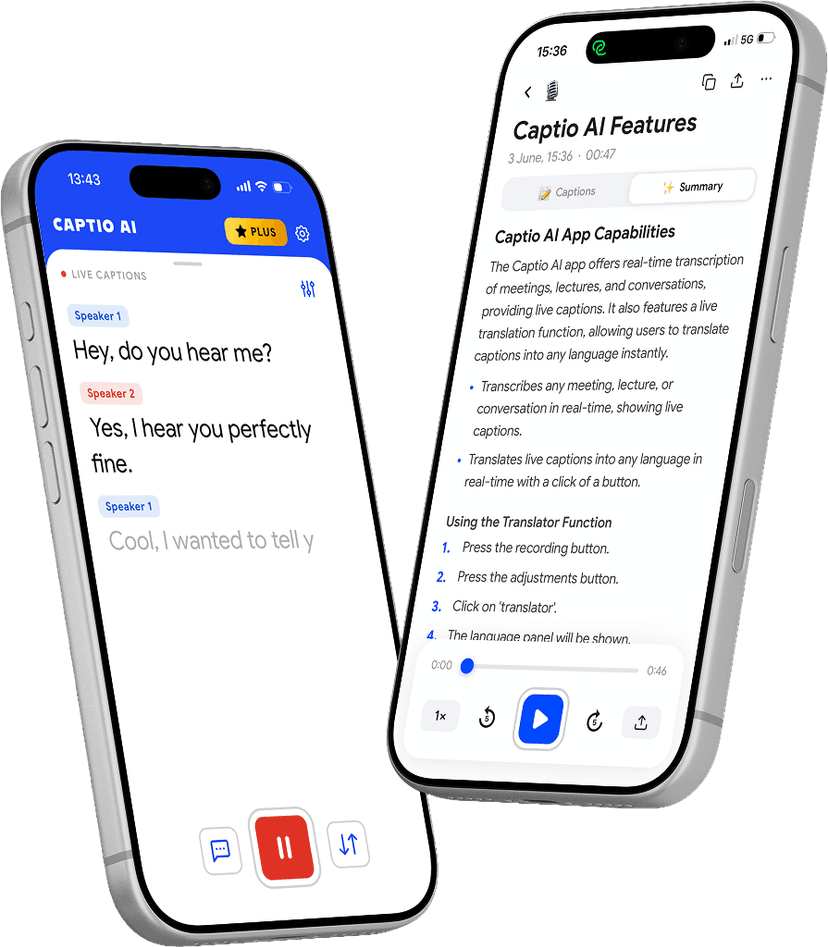
Everything you need to follow Welsh restaurants & cafes
Four tools built for deaf and hard of hearing Welsh speakers.
Follow the conversation through the noise
- Captions the person across the table in real time
- Works through typical restaurant background noise
- Place the phone between you — no adjustment needed
- No lip reading, no facing the speaker
Restaurants abroad or with foreign speakers
- They speak their language — you read in yours
- For waitstaff, companions, or travel dining
- 60+ languages, no setup
- Translates in real time as they speak
Transcribe any recorded conversation
- Record and get the full conversation in writing
- Review anything you missed after the meal
- Organised by speaker
- Any language, any format
Key points from any conversation
- Important points extracted from any recording
- Useful for business lunches and important catch-ups
- Organised into clear sections
- Works on any saved recording
Download for free
Every situation covered
Designed for the real moments that matter — not just quiet controlled environments.
An evening meal at a Cardiff bwyty with friends, the conversation shifting between Welsh and English depending on the topic and who's speaking.
A business lunch in a Swansea restaurant where colleagues discuss practical matters in Welsh but slip into English for specific product names.
Coffee in a Gwynedd café, the barista and a regular talking entirely in rapid northern Welsh while you wait for a free table.
Ordering in a Welsh-medium restaurant in the Valleys where the server switches to English when there's any sign of confusion.
A birthday meal with family — some members Welsh-speaking, others English-speaking — the table splitting into two linguistic worlds and then rejoining.
A quiet dinner for two in a Ceredigion village restaurant where soft voices, low ambient sound, and unexpected Welsh phrases make every sentence a challenge.
Most accurate and fastest models
word accuracy
independent benchmark, 2025
real-time captions
first word appears as you speak
Download for free
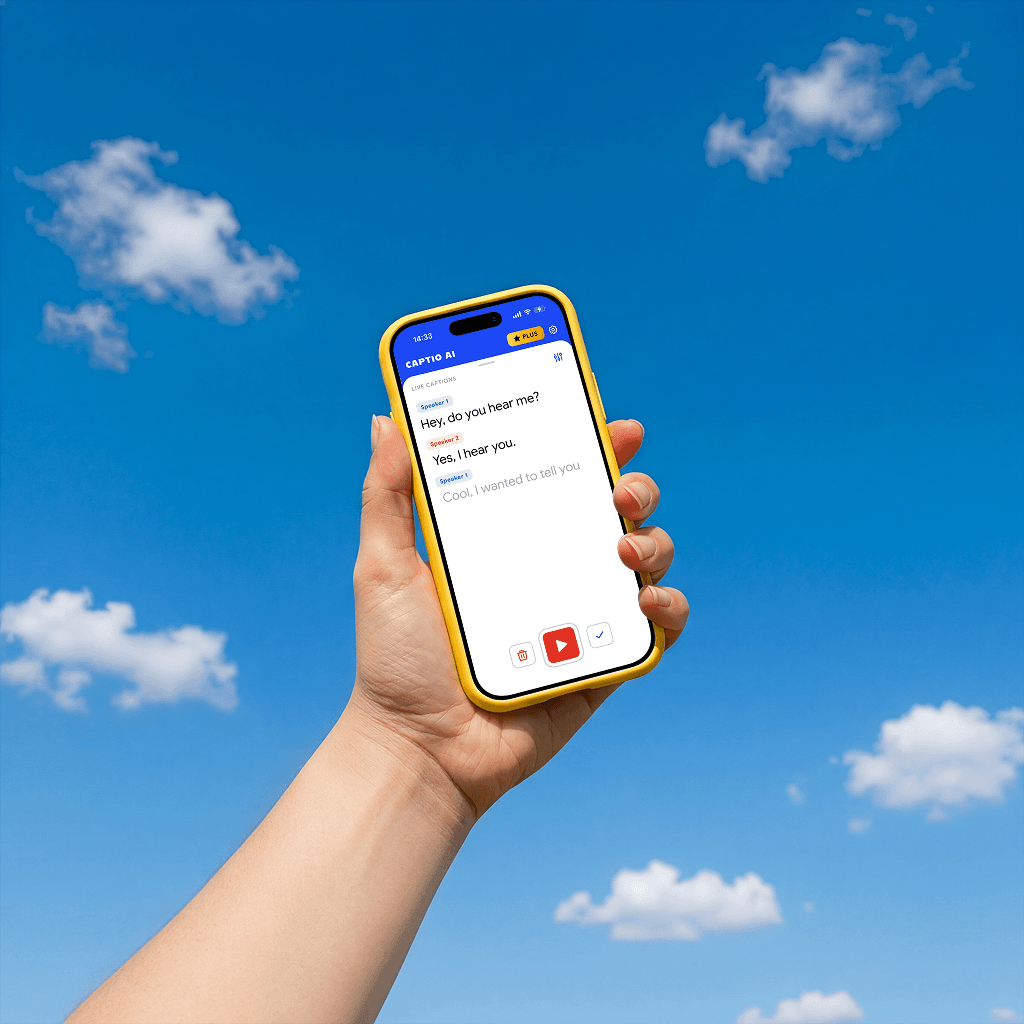
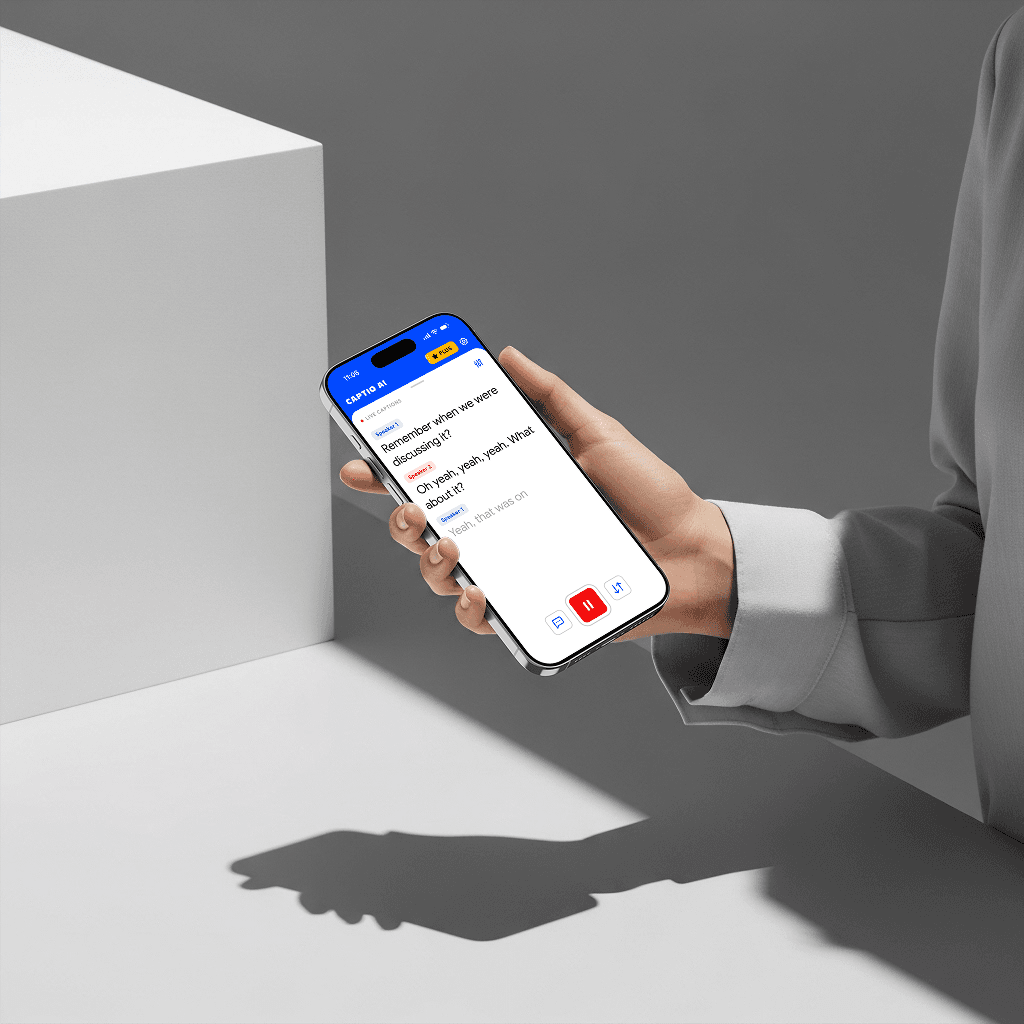
Built for the table — however noisy the room
Follows the person across the table
Point the microphone toward the person speaking and Captio AI captions them through the background noise. You do not need to face them, watch their lips, or lean in.
Works through restaurant noise
Restaurant noise averages 80 dBA — well above comfortable conversation level. Captio AI is built for these real environments, not quiet controlled rooms.
Place it and forget it
Put the phone on the table between you and the other person, microphone facing them. You glance at it as needed. No adjusting between sentences, no managing the setup.
No asking for repeats during the meal
Every word appears in real time. If you missed something, the caption is there — you do not need to stop the conversation and ask anyone to say it again.
Any language
For restaurants abroad, multilingual dining companions, or waitstaff who speak a different language. Live Translator captions and translates in real time with no manual setup.
Discreet
A phone on a restaurant table is unremarkable. Captio AI runs quietly, the screen faces you, and most dining companions adapt naturally once they understand what it does.
Why Welsh is hard to understand
Voiceless lateral fricative (LL)
- The LL sound is almost invisible
- Welsh's /ɬ/ — written LL — is a voiceless alveolar lateral fricative that has no equivalent in English. It is produced with the tongue against the alveolar ridge while air escapes laterally, with minimal labial movement. On the lips it looks like nothing at all, and words containing LL appear identical to nearby words without it, creating systematic ambiguity for a deaf person at a Welsh restaurant table.
Consonant mutations
- Word-initial consonants change with grammar
- Welsh has a system of initial consonant mutations where the first consonant of a word changes depending on grammatical context. For a deaf person, mutations mean the visual form of a word at the start of a sentence can look completely different from the citation form they recognise — making word identification difficult even for common vocabulary in fast restaurant conversation.
North-South dialect divide
- Northern and Southern Welsh differ markedly
- Northern Welsh (Arfon, Anglesey, Gwynedd) and Southern Welsh (Cardiff, Swansea, the Valleys) differ markedly in vowel quality, certain consonant realisations, and vocabulary. A deaf Welsh speaker who learned the southern variety may find a northern speaker's restaurant conversation uses different phonological patterns — and vice versa.
Welsh-English code-switching (Wenglish)
- Languages shift mid-sentence with no visual cue
- In much of Wales, particularly in the south, Welsh and English shift freely within a single utterance. For a deaf speaker, a mid-sentence shift between Welsh phonology and English phonology requires constant recalibration, with no visual signal marking when the switch occurs.
Penultimate stress exceptions
- Stress position shifts in proper names and compounds
- Welsh regularly places stress on the penultimate syllable, and deaf people often use stress position as a word-segmentation cue. Compound words, loanwords, and proper names — common on Welsh restaurant menus and in place-name discussions — can violate this pattern, disrupting the segmentation strategy for a deaf diner.
Download for free
Hearing loss in Wales: 610,000 people, one in six of the population
Approximately 610,000 people in Wales have hearing loss — 17% of the Welsh population. More than 593,000 adults in Wales currently have a hearing loss according to RNID and NHS Wales data. Prevalence rises steeply with age: more than half the population aged 55 and over in Wales experiences deafness or hearing loss, rising to 80% of people over 70. These figures sit against a backdrop of ongoing NHS Wales capacity pressures — the Welsh Government's December 2025 statement on audiology services acknowledged the need for a new approach to improve timely access to hearing care across primary and community settings.
Wales's unique linguistic situation adds a distinct layer of challenge for deaf and hard of hearing Welsh speakers. Wales has approximately 880,000 Welsh speakers, but specialist audiology services, deaf education, and communication support that operate through the medium of Welsh are significantly fewer than English-language equivalents. The Equality Act 2010 protects deaf people in Wales, but Welsh-medium communication access — captioning and interpretation in Welsh specifically — remains an underprovided area relative to the scale of demand from both Welsh speakers and people learning or using the language in everyday life.
Captio AI captions live Welsh conversation in real time, so a table at a Cardiff bwyty or a Gwynedd village restaurant means following the conversation whether it is in Welsh, English, or moving between both.
Download for free
What you hear stays with you.
Gone the moment it ends
Captio AI processes your audio in real time and discards it immediately. Nothing is recorded. Nothing is kept.
Not a product
Your conversations are not something Captio AI sells, shares, or monetizes — to anyone, for any reason.
Not used to train anything
What you say in a doctor's appointment or a job interview never ends up in a training dataset. Not ours. Not anyone else's.

Private by default
Captio AI supports 60+ languages
Download for free
Frequently asked questions
Have a real conversation through the noise in Welsh.
Captio AI is free to start
Download for free