

Korean live captions and productivity tool for restaurants & cafes
For deaf and hard of hearing people.
Download for free


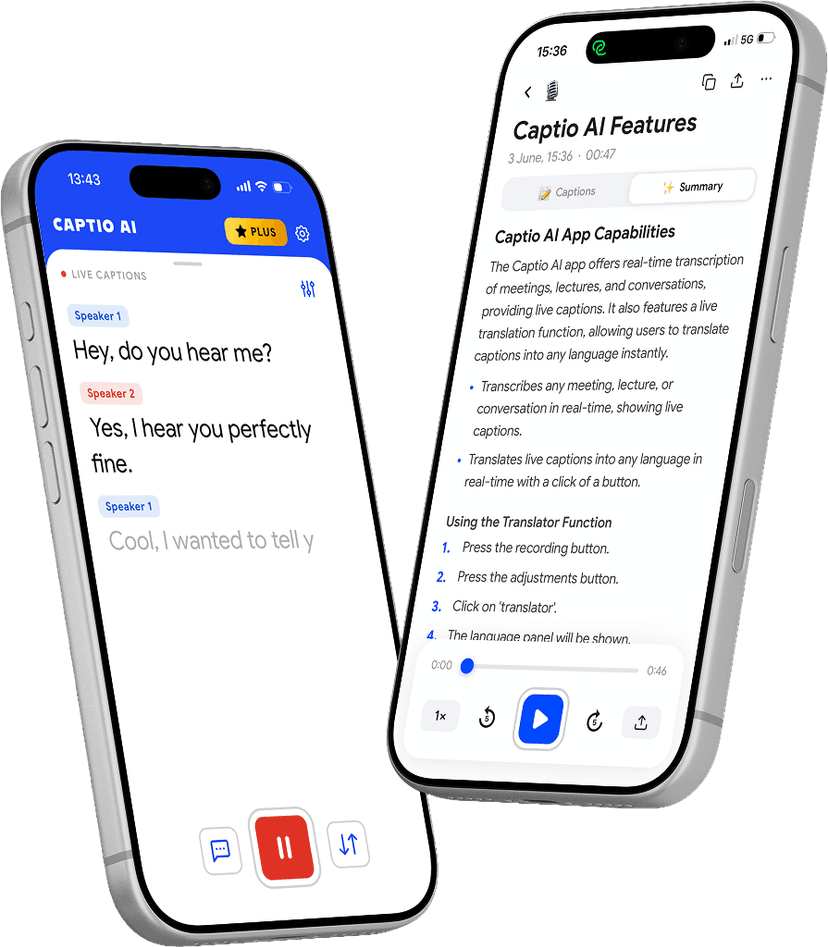
Everything you need to follow Korean restaurants & cafes
Four tools built for deaf and hard of hearing Korean speakers.
Follow the conversation through the noise
- Captions the person across the table in real time
- Works through typical restaurant background noise
- Place the phone between you — no adjustment needed
- No lip reading, no facing the speaker
Restaurants abroad or with foreign speakers
- They speak their language — you read in yours
- For waitstaff, companions, or travel dining
- 60+ languages, no setup
- Translates in real time as they speak
Transcribe any recorded conversation
- Record and get the full conversation in writing
- Review anything you missed after the meal
- Organised by speaker
- Any language, any format
Key points from any conversation
- Important points extracted from any recording
- Useful for business lunches and important catch-ups
- Organised into clear sections
- Works on any saved recording
Download for free
Every situation covered
Designed for the real moments that matter — not just quiet controlled environments.
Dinner with friends in Korea — whether Korean barbecue, a shared jjigae pot, or samgyeopsal — is built around a shared grill and continuous conversation. Following multiple friends talking at once over a noisy grill requires captioning.
Business lunches in Seoul are frequent and carry social weight. The politeness register is high — sentence endings carry deference — and missing the final clause means missing the actual stance of what was said.
A quick stop at a Korean café is a daily routine for millions. Fast counter orders and catch-up conversation in Seoul or Busan add busy café noise on top of fast Korean.
Travelling across Korea — from Jeju Island to Busan — means encountering regional dialects, especially the Gyeongsang variety that differs significantly from Seoul Korean. Captio AI captions whatever is spoken.
Group celebrations in Korea — hoesik dinners, birthday meals, graduation parties — are loud and run late. Overlapping conversation at a noisy KBBQ restaurant is exactly the setting where a deaf or hard of hearing person is most excluded.
A one-on-one dinner in a quieter Seoul restaurant carries the pressure of flowing conversation in Korean. Missing a sentence-final verb form — which signals the key meaning — creates a gap that real-time captions close.
Most accurate and fastest models
character accuracy
independent benchmark, 2025
real-time captions
first word appears as you speak
Download for free
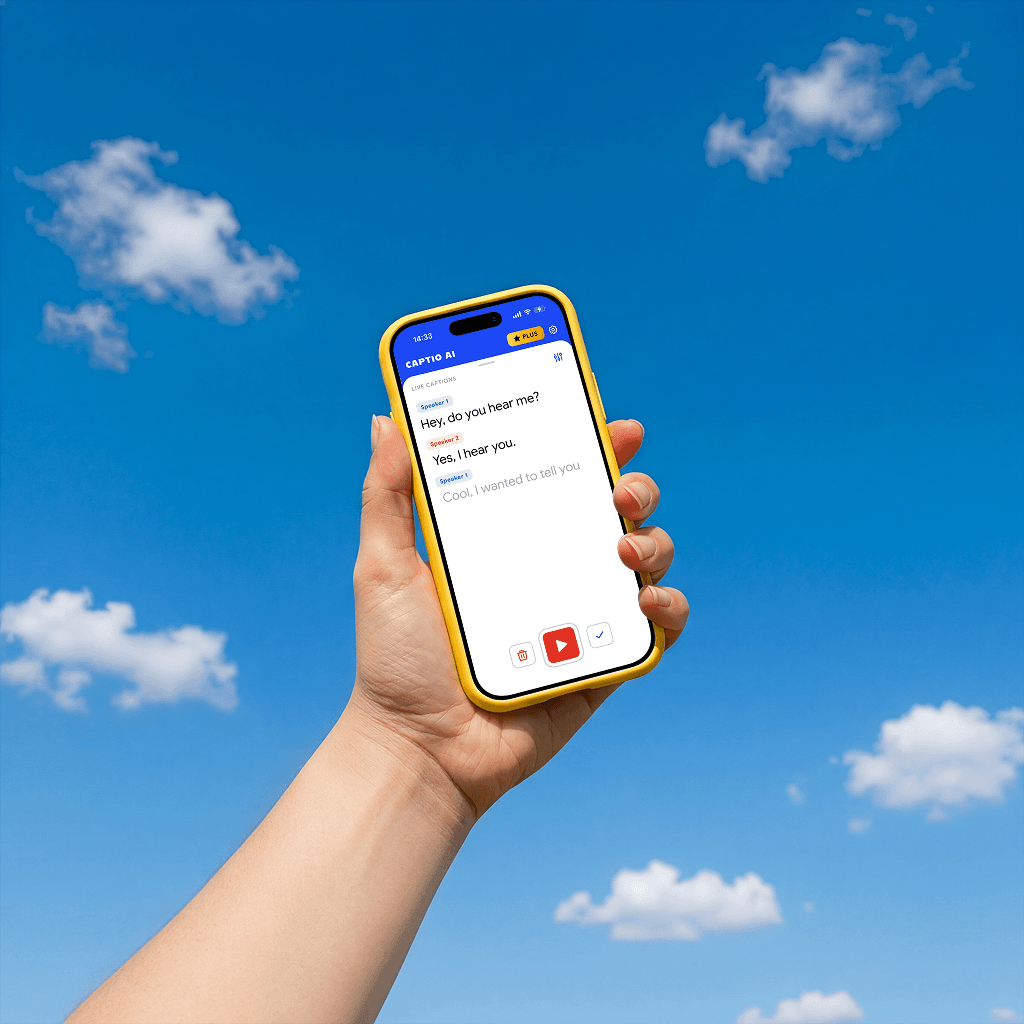
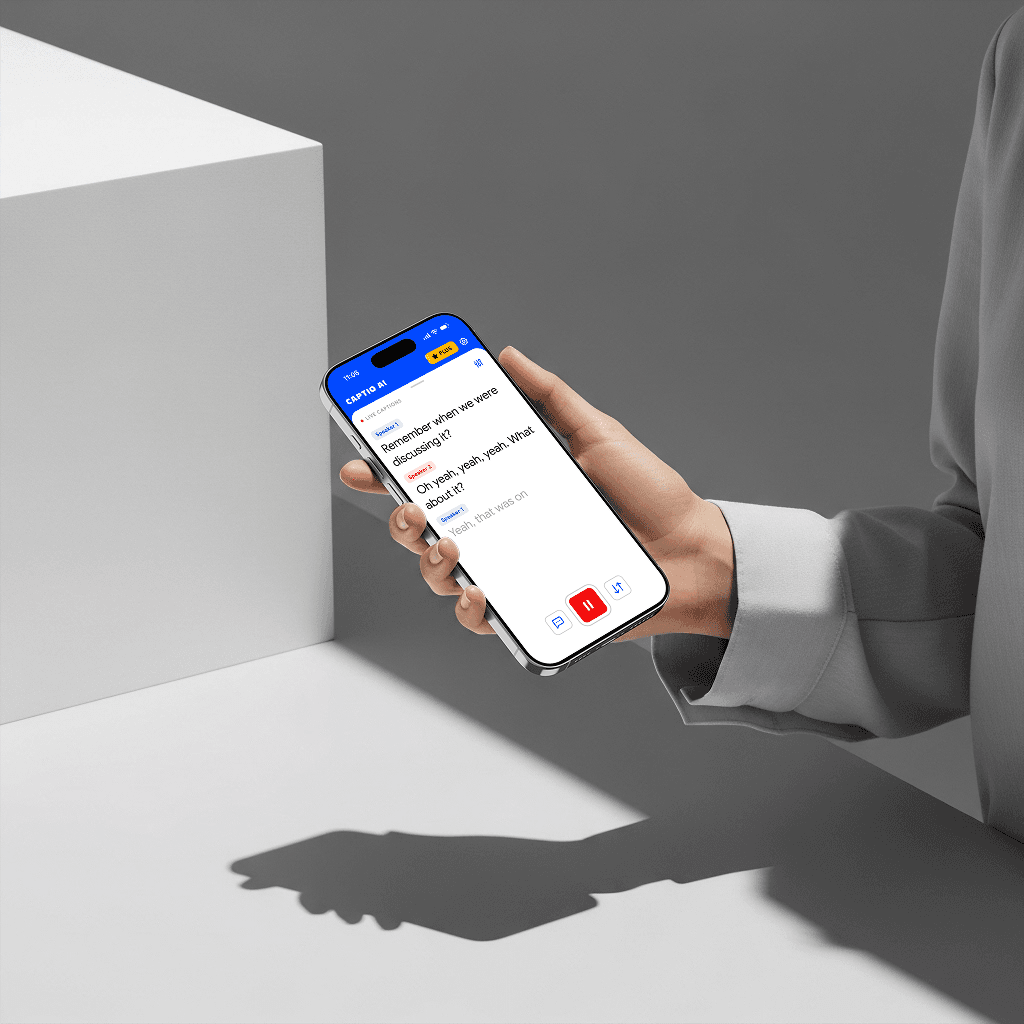
Built for the table — however noisy the room
Follows the person across the table
Point the microphone toward the person speaking and Captio AI captions them through the background noise. You do not need to face them, watch their lips, or lean in.
Works through restaurant noise
Restaurant noise averages 80 dBA — well above comfortable conversation level. Captio AI is built for these real environments, not quiet controlled rooms.
Place it and forget it
Put the phone on the table between you and the other person, microphone facing them. You glance at it as needed. No adjusting between sentences, no managing the setup.
No asking for repeats during the meal
Every word appears in real time. If you missed something, the caption is there — you do not need to stop the conversation and ask anyone to say it again.
Any language
For restaurants abroad, multilingual dining companions, or waitstaff who speak a different language. Live Translator captions and translates in real time with no manual setup.
Discreet
A phone on a restaurant table is unremarkable. Captio AI runs quietly, the screen faces you, and most dining companions adapt naturally once they understand what it does.
Why Korean is hard to understand
Three-way consonant distinction
- Lax, aspirated, and tense — identical on the lips
- Korean is among very few languages with a three-way distinction in voiceless stops: lax (평음), aspirated (격음), and tense (경음). All three are produced with the same basic lip shape — the difference is in airflow and laryngeal tension deep in the throat. At a Korean restaurant table, food names and everyday words rest on these distinctions: 'bap' (rice) and 'pap' (to crumble) differ by nothing visible.
Vowel deletion in fast speech
- Vowels disappear in casual table conversation
- In natural Korean speech, unstressed or short vowels reduce and disappear at conversational pace. The gap between formal pronunciations heard in broadcast Korean and the actual sounds at a busy Korean barbecue table is wide — casual speech compresses whole syllables.
Seoul vs Gyeongsang dialect
- Busan and Daegu retain a pitch accent system Seoul lost
- Gyeongsang dialect (Busan, Daegu) retains a tonal pitch accent system that Seoul Korean lost — words carry high-low patterns that change meaning, and the accent pattern itself sounds different from the standard. A hard of hearing person calibrated to Seoul Korean will find a Busan speaker at the same table uses a different phonological rhythm entirely.
Sentence-final endings carry meaning
- Meaning accumulates at the end — where noise peaks
- Korean is verb-final: the main verb, tense, politeness level, and illocutionary force all arrive at the end of the sentence. In a noisy restaurant, the most informationally dense part of the sentence arrives just as surrounding noise peaks, or as the speaker's volume drops. A lip-reader catches the topic and misses the predicate.
Korean-English code-switching
- Urban restaurants blend both languages at the order level
- In Seoul, Busan, and Incheon restaurants, Korean and English are blended freely — English loan terms for menu items, ordering phrases, foreign dish names. The switch happens within sentences and without signal.
Download for free
Hearing loss in South Korea: behind the noise of everyday meals
South Korea's National Disability Registry (NDR) recorded 237,272 people with hearing disability in 2015, representing 0.458% of the population. Prevalence was notably higher in rural areas than urban (1.4 times higher), and among those with moderate-to-profound hearing loss, hearing aid adoption stood at just 12.6% — meaning the majority of those with significant impairment navigate public life without amplification.
Beyond registered disability, broader prevalence studies suggest that 37.4% of the South Korean population has some degree of minimal or mild hearing loss. Research published in Scientific Reports found that total prevalence of severe-profound hearing loss peaked at 0.5% of the population in 2010. For the country's large and growing older population, hearing loss is an increasingly significant barrier to social participation, including in the restaurant and café culture that is central to Korean social life.
Captio AI captions Korean conversation in real time — whether friends at a Seoul KBBQ table talk over the grill smoke, or a colleague mentions a key point at the end of a long sentence at a business lunch in Gangnam.
Download for free
What you hear stays with you.
Gone the moment it ends
Captio AI processes your audio in real time and discards it immediately. Nothing is recorded. Nothing is kept.
Not a product
Your conversations are not something Captio AI sells, shares, or monetizes — to anyone, for any reason.
Not used to train anything
What you say in a doctor's appointment or a job interview never ends up in a training dataset. Not ours. Not anyone else's.

Private by default
Captio AI supports 60+ languages
Download for free
Frequently asked questions
Have a real conversation through the noise in Korean.
Captio AI is free to start
Download for free