

Swahili live captions and productivity tool for restaurants & cafes
For deaf and hard of hearing people.
Download for free


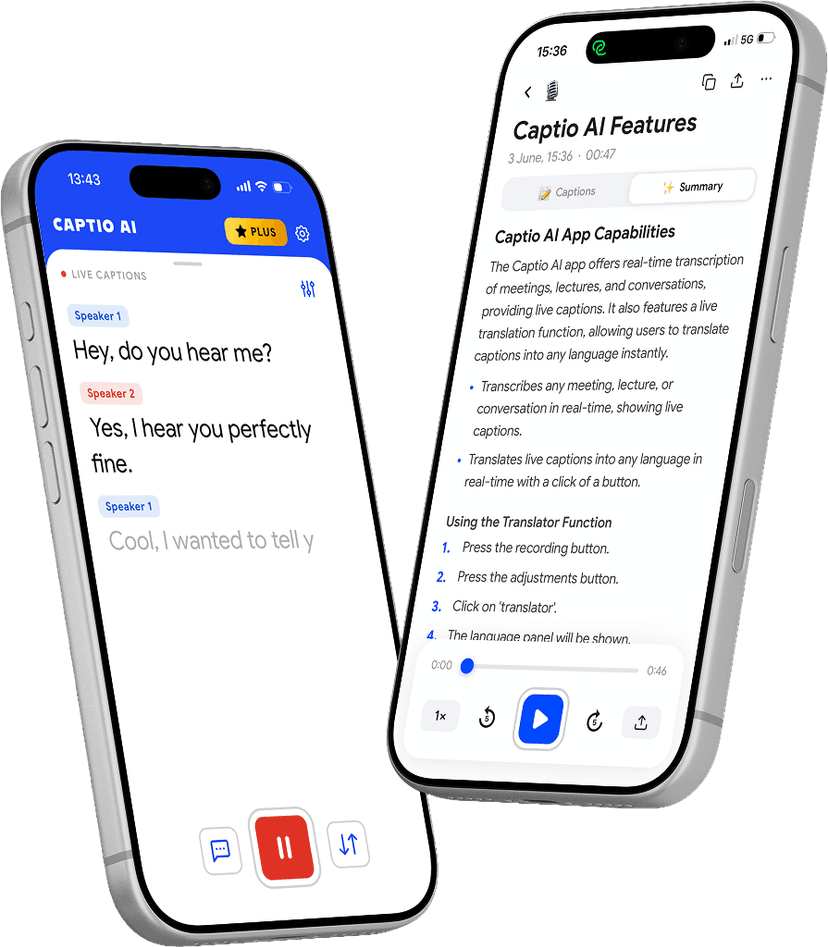
Everything you need to follow Swahili restaurants & cafes
Four tools built for deaf and hard of hearing Swahili speakers.
Follow the conversation through the noise
- Captions the person across the table in real time
- Works through typical restaurant background noise
- Place the phone between you — no adjustment needed
- No lip reading, no facing the speaker
Restaurants abroad or with foreign speakers
- They speak their language — you read in yours
- For waitstaff, companions, or travel dining
- 60+ languages, no setup
- Translates in real time as they speak
Transcribe any recorded conversation
- Record and get the full conversation in writing
- Review anything you missed after the meal
- Organised by speaker
- Any language, any format
Key points from any conversation
- Important points extracted from any recording
- Useful for business lunches and important catch-ups
- Organised into clear sections
- Works on any saved recording
Download for free
Every situation covered
Designed for the real moments that matter — not just quiet controlled environments.
Dinner with friends in East Africa is long, communal, and conversational — shared nyama choma, pilau, or ugali around a table where multiple conversations run at once. Following who said what in fast Swahili requires captioning.
Business lunches in Nairobi or Dar es Salaam often mix Swahili and English freely. Missing a key term — a figure, a deadline — in a code-switched sentence can leave you out of the decision entirely.
A café stop for chai and mandazi is a daily routine across East Africa. Counter orders and quick catch-ups happen in rapid Swahili, and the background noise of a busy town café adds another barrier.
Travelling through Kenya, Tanzania, Uganda, or Rwanda means encountering regional Swahili varieties and local languages mixed in. Captio AI captions whatever variety is spoken.
Group celebrations — harambee meals, graduation dinners, weekend nyama choma gatherings — are loud and festive. Overlapping conversation in Swahili around a shared grill is genuinely hard to follow without real-time captions.
A one-on-one dinner in a Nairobi restaurant carries the full social pressure of unbroken conversation. Missing a sentence — especially when the speaker switches registers — creates a gap that real-time captions close.
Most accurate and fastest models
word accuracy
independent benchmark, 2025
real-time captions
first word appears as you speak
Download for free
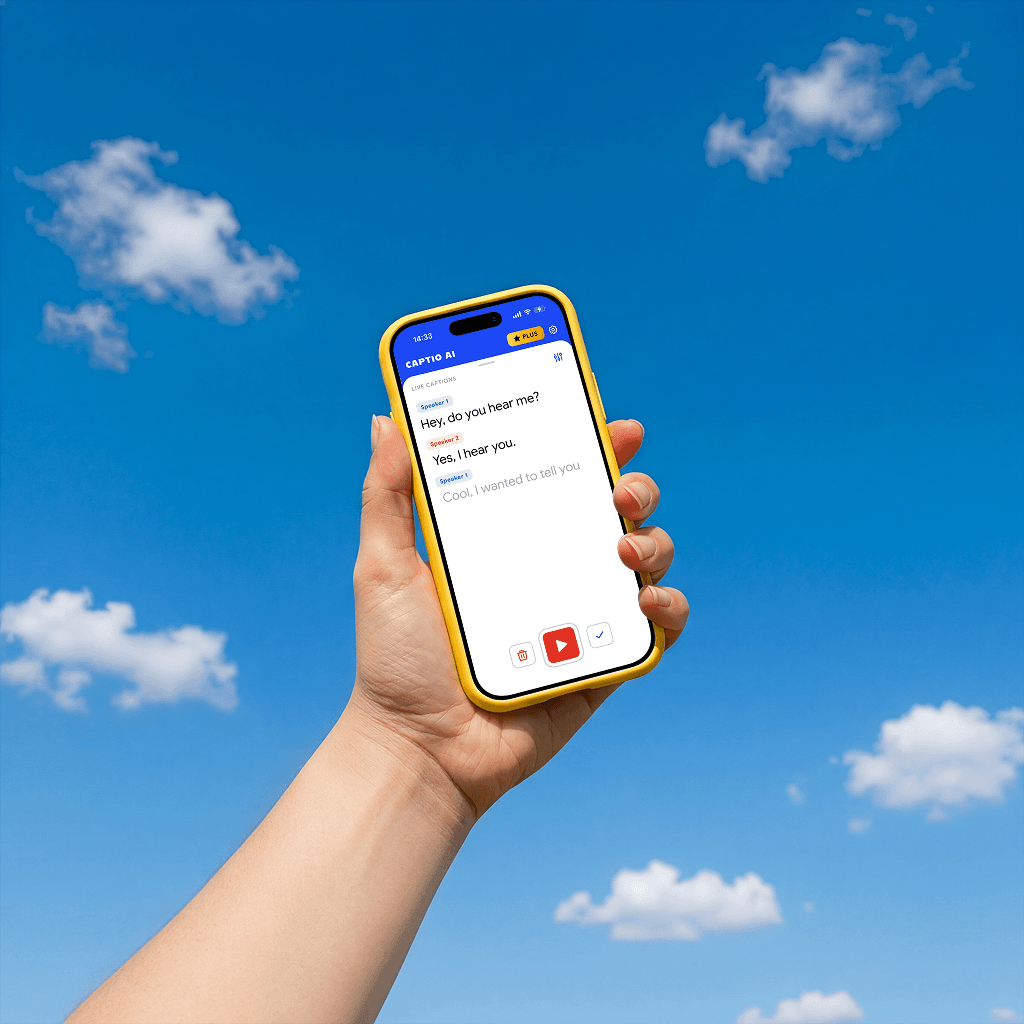
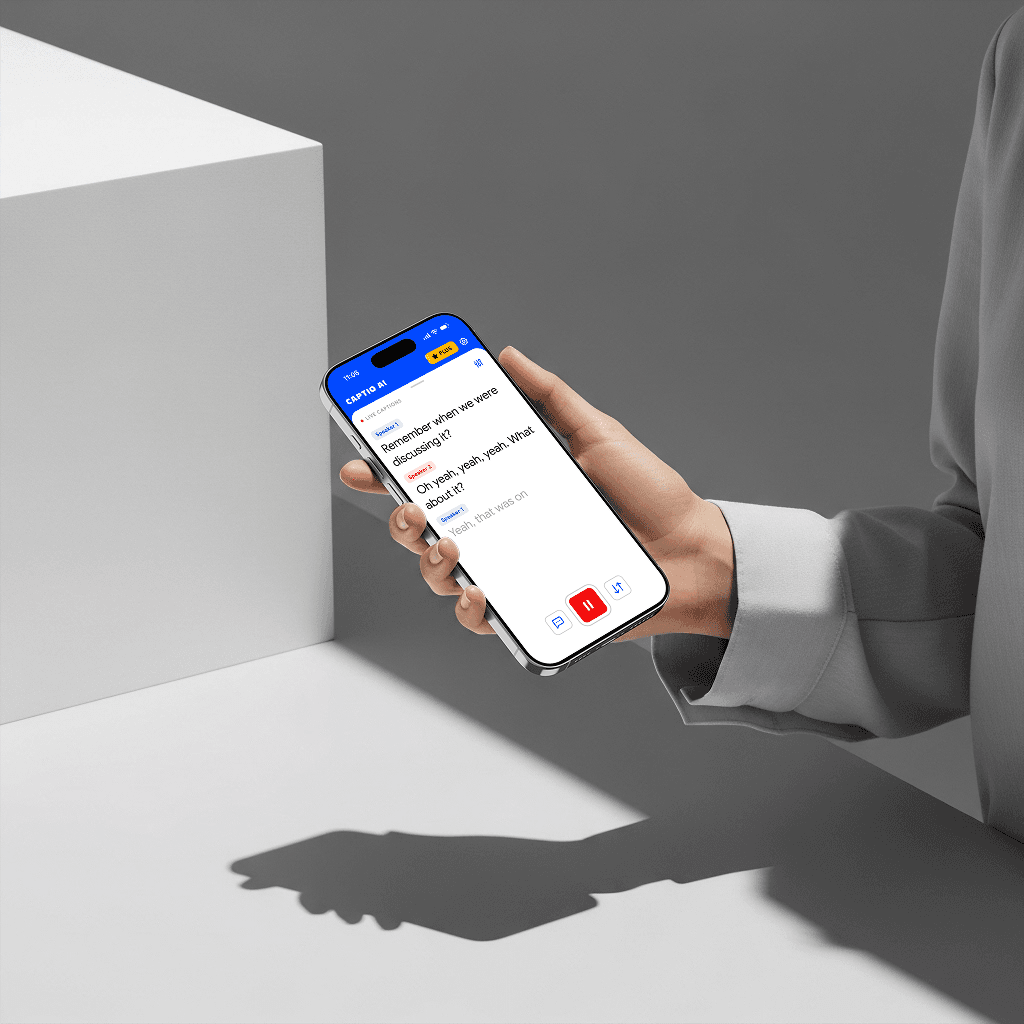
Built for the table — however noisy the room
Follows the person across the table
Point the microphone toward the person speaking and Captio AI captions them through the background noise. You do not need to face them, watch their lips, or lean in.
Works through restaurant noise
Restaurant noise averages 80 dBA — well above comfortable conversation level. Captio AI is built for these real environments, not quiet controlled rooms.
Place it and forget it
Put the phone on the table between you and the other person, microphone facing them. You glance at it as needed. No adjusting between sentences, no managing the setup.
No asking for repeats during the meal
Every word appears in real time. If you missed something, the caption is there — you do not need to stop the conversation and ask anyone to say it again.
Any language
For restaurants abroad, multilingual dining companions, or waitstaff who speak a different language. Live Translator captions and translates in real time with no manual setup.
Discreet
A phone on a restaurant table is unremarkable. Captio AI runs quietly, the screen faces you, and most dining companions adapt naturally once they understand what it does.
Why Swahili is hard to understand
Sheng urban mixing
- Nairobi street Swahili blends three languages in one sentence
- Sheng — the urban youth variety spoken across Nairobi and East African cities — freely mixes Swahili, English, and Kikuyu within a single sentence. For a deaf or hard of hearing person expecting standard coastal Swahili, Sheng's unpredictable switching makes lip-reading almost impossible: vocabulary, rhythm, and lip shapes shift mid-phrase.
Coastal vs inland gap
- Standard Swahili vs regional varieties look different
- Coastal Swahili (Mombasa, Zanzibar) preserves Arabic loanword phonology and a distinct vowel quality from the inland varieties spoken in Nairobi, Dar es Salaam, and Kampala. The same word can sound different enough across regions that a lip-reader attuned to one variety misses the other entirely.
Noun class morphology
- Agreement prefixes hide meaning in short, similar-looking syllables
- Swahili uses 16 noun classes, each triggering different agreement prefixes on verbs and adjectives. In fast table speech, these short agreement prefixes are said lightly and can look nearly identical on the lips. Missing them removes the grammatical anchor that tells you what or who the sentence is about.
Fast casual speech
- Rapid conversation compresses already short words
- Everyday Swahili in a busy restaurant setting is spoken fast. Swahili words are already relatively short compared to European languages, and at conversational pace they compress further, leaving a lip-reader with minimal visual time on each word.
English code-switching
- Formal and business settings shift registers mid-sentence
- In Nairobi, Dar es Salaam, and Mombasa upscale restaurants, Swahili and English are used interchangeably depending on the perceived status of the customer. Switching register mid-sentence creates double unpredictability for a deaf or hard of hearing diner.
Download for free
Hearing loss in East Africa: the cost of an unheard table
East Africa carries a significant and underreported burden of hearing loss. A 2016 review in Tropical Medicine & International Health found that hearing impairment prevalence in African population-based studies ranged as high as 31%, with school-based studies showing a median of 6.6%. In Kenya, the 2008 National Survey for Persons with Disabilities estimated approximately one million deaf individuals in a population of 50 million. In Tanzania, disability surveys document over four million people with disabilities, with hearing impairment among the most common conditions.
Access to intervention remains extremely limited. Across sub-Saharan Africa, hearing aids are scarce, audiological services are concentrated in capital cities, and sign language education reaches only a small fraction of deaf students. Research from rural East Africa found hearing loss to be the most frequently identified childhood disability, linked to chronic otitis media and preventable infections. For adults navigating urban restaurant life in Nairobi, Dar es Salaam, or Mombasa, untreated hearing loss in noisy public environments removes them from the social fabric of shared meals.
Captio AI captions Swahili conversation in real time — whether a friend at a Nairobi nyama choma table tells a story over grilled meat or a server at a Zanzibar seafood restaurant explains the day's catch.
Download for free
What you hear stays with you.
Gone the moment it ends
Captio AI processes your audio in real time and discards it immediately. Nothing is recorded. Nothing is kept.
Not a product
Your conversations are not something Captio AI sells, shares, or monetizes — to anyone, for any reason.
Not used to train anything
What you say in a doctor's appointment or a job interview never ends up in a training dataset. Not ours. Not anyone else's.

Private by default
Captio AI supports 60+ languages
Download for free
Frequently asked questions
Have a real conversation through the noise in Swahili.
Captio AI is free to start
Download for free