

Afrikaans live captions and productivity tool for restaurants & cafes
For deaf and hard of hearing people.
Download for free


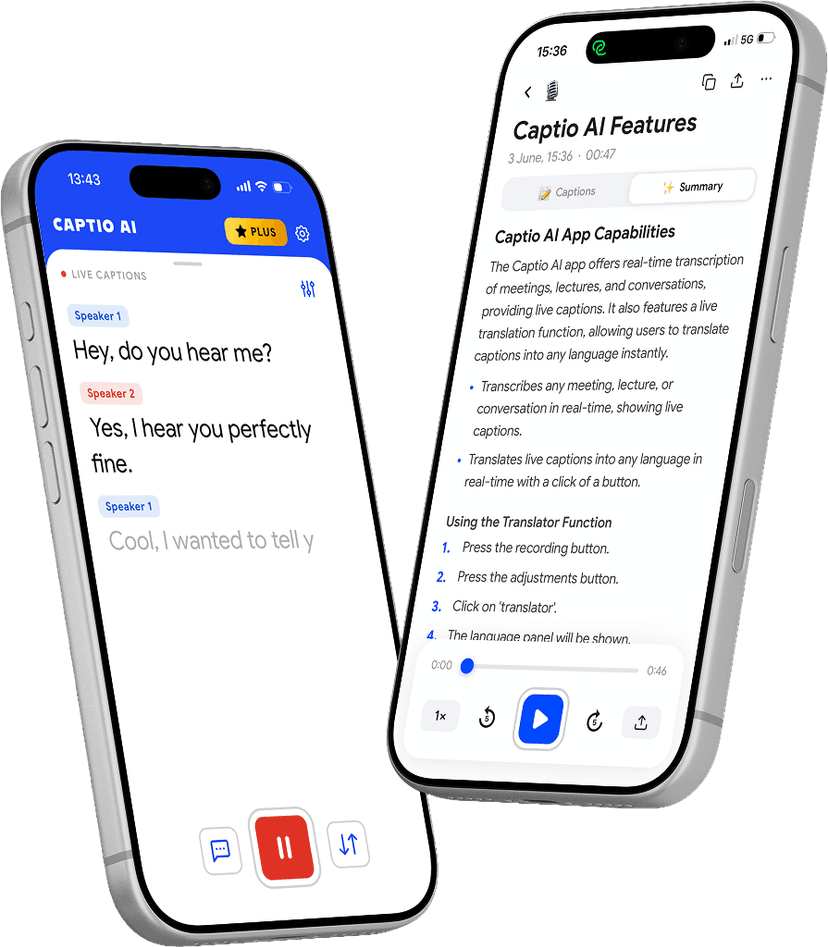
Everything you need to follow Afrikaans restaurants & cafes
Four tools built for deaf and hard of hearing Afrikaans speakers.
Follow the conversation through the noise
- Captions the person across the table in real time
- Works through typical restaurant background noise
- Place the phone between you — no adjustment needed
- No lip reading, no facing the speaker
Restaurants abroad or with foreign speakers
- They speak their language — you read in yours
- For waitstaff, companions, or travel dining
- 60+ languages, no setup
- Translates in real time as they speak
Transcribe any recorded conversation
- Record and get the full conversation in writing
- Review anything you missed after the meal
- Organised by speaker
- Any language, any format
Key points from any conversation
- Important points extracted from any recording
- Useful for business lunches and important catch-ups
- Organised into clear sections
- Works on any saved recording
Download for free
Every situation covered
Designed for the real moments that matter — not just quiet controlled environments.
Dinner with friends at a Cape Town or Stellenbosch restaurant, where the conversation flows naturally between Afrikaans and English over braai dishes and wine.
Business lunches in Cape Town's business districts or Johannesburg's northern suburbs, where Afrikaans and English mix across the table and following client conversation matters.
Café catch-ups at a Stellenbosch coffee shop or a Cape Town neighbourhood café, where the sound of espresso machines and nearby conversations compete with the person across from you.
Eating out in South Africa as a visitor, where Afrikaans menus and server explanations arrive fast and knowing what you are ordering — boerewors, bobotie, potjiekos — matters.
Family celebrations at an Afrikaans restaurant — braai gatherings, birthdays, Christmas lunches — where multiple conversations happen at once and background music fills the room.
Dates at a wine farm restaurant in Franschhoek or a Stellenbosch terrace where you want to follow every word without asking your partner to repeat themselves.
Most accurate and fastest models
word accuracy
independent benchmark, 2025
real-time captions
first word appears as you speak
Download for free
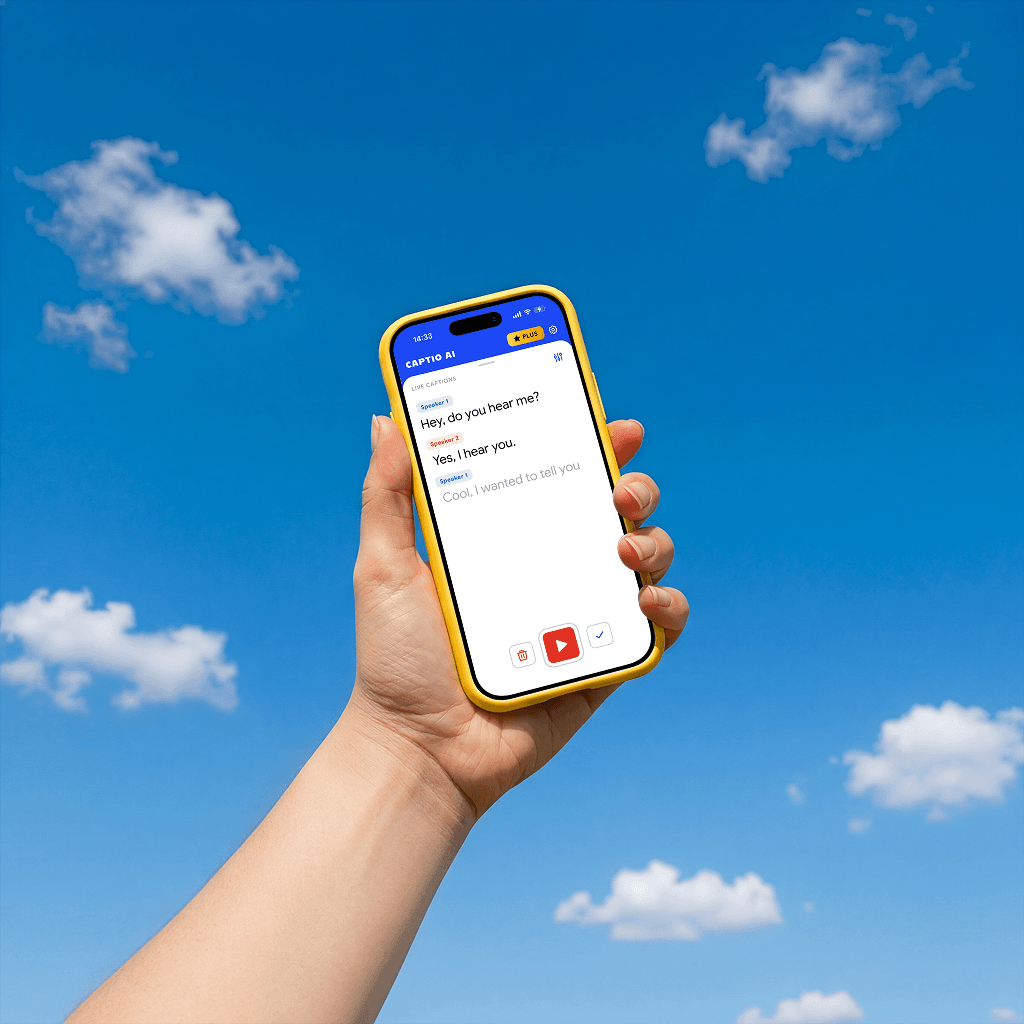
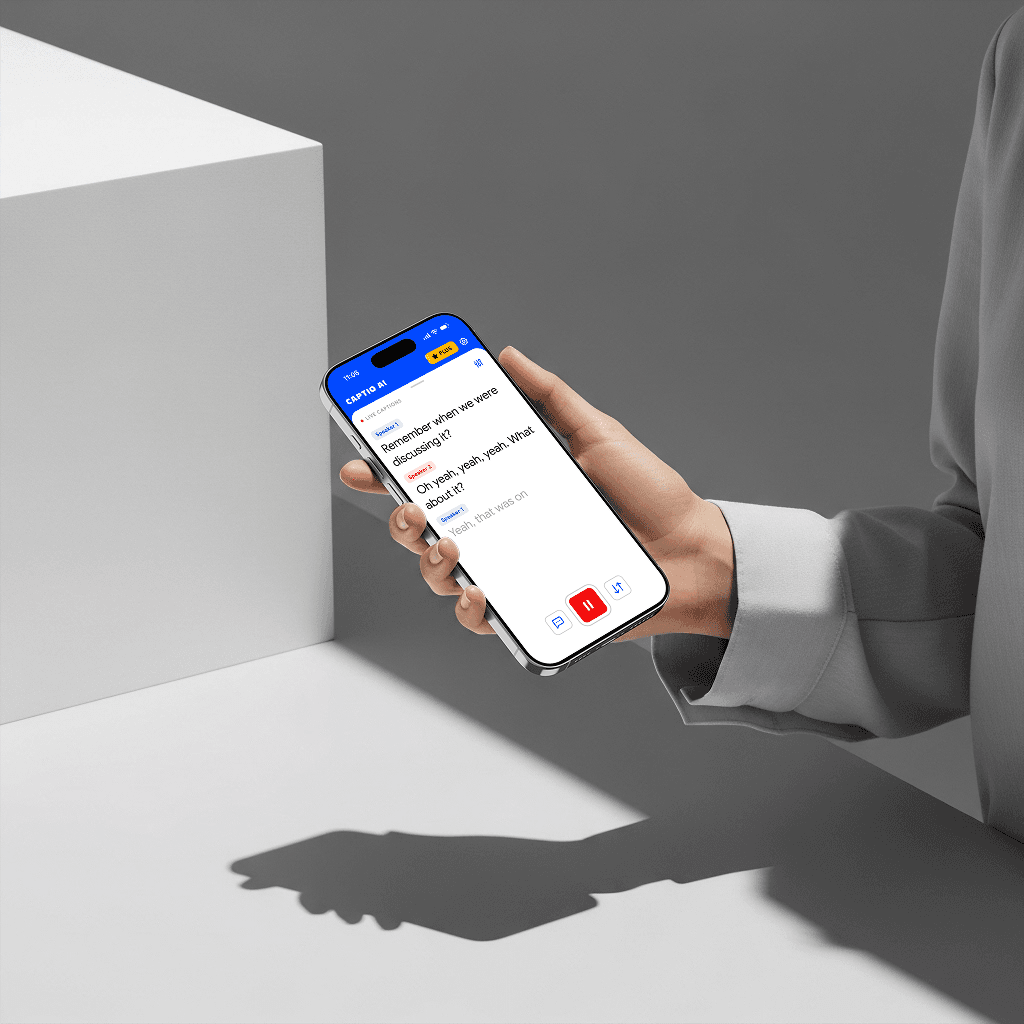
Built for the table — however noisy the room
Follows the person across the table
Point the microphone toward the person speaking and Captio AI captions them through the background noise. You do not need to face them, watch their lips, or lean in.
Works through restaurant noise
Restaurant noise averages 80 dBA — well above comfortable conversation level. Captio AI is built for these real environments, not quiet controlled rooms.
Place it and forget it
Put the phone on the table between you and the other person, microphone facing them. You glance at it as needed. No adjusting between sentences, no managing the setup.
No asking for repeats during the meal
Every word appears in real time. If you missed something, the caption is there — you do not need to stop the conversation and ask anyone to say it again.
Any language
For restaurants abroad, multilingual dining companions, or waitstaff who speak a different language. Live Translator captions and translates in real time with no manual setup.
Discreet
A phone on a restaurant table is unremarkable. Captio AI runs quietly, the screen faces you, and most dining companions adapt naturally once they understand what it does.
Why Afrikaans is hard to understand
Uvular and velar fricatives
- The 'g' and 'r' sounds are produced in the throat
- Afrikaans contains the velar fricative /x/ in words like mag, dag, and ag — produced entirely in the throat with no visible lip movement. Many Afrikaans speakers also use a uvular /r/ or uvular fricative. At a Cape Town or Stellenbosch restaurant table, these common sounds occur constantly and are completely invisible to a deaf lip-reader.
Rich vowel and diphthong inventory
- 10 monophthongs and 7 diphthongs — many look the same
- Afrikaans has one of the richest vowel inventories of any Germanic language — 17 vowel sounds in total. Many of these distinctions, particularly among the diphthongs, are produced with minimal visible lip difference. At an Afrikaans restaurant table, vowel contrasts that carry meaning are often invisible on the lips.
Four regional accent varieties
- Cape, Boland, East Cape, and Transvaal Afrikaans each sound different
- Afrikaans is spoken with four distinct regional accents across South Africa, each differing in vowel quality and consonant realization. A deaf person familiar with Cape Town Afrikaans may struggle at a restaurant table in Pretoria or Port Elizabeth, where the same words arrive shaped by a completely different regional phonological system.
Afrikaans-English code-switching
- English and Afrikaans mix in every conversation
- Urban South African English and Afrikaans mix constantly in what is sometimes called 'Engrikaans.' At a Cape Town or Johannesburg restaurant, speakers shift between Afrikaans and English mid-sentence without notice — confronting a deaf lip-reader with two phonological systems alternating throughout a single meal.
Fast Cape Town casual Afrikaans
- Informal Afrikaans at speed is far from the textbook form
- Informal Cape Town Afrikaans spoken at restaurant speed drops unstressed syllables, reduces vowels, and runs words together in ways that deviate significantly from written Afrikaans. The gap between careful Afrikaans and the fast Cape Malay-influenced Afrikaans of a Friday dinner in the Winelands is substantial.
Download for free
Hearing loss in South Africa: 12 million affected and deep inequality of access
Approximately 12 million people in South Africa may be affected by hearing loss — a figure that spans mild to profound severity. At primary health care clinics across the country, hearing loss prevalence was found to be 17.5% (PMC6306974). In the Cape Town metropolitan area, where Afrikaans is widely spoken, overall hearing impairment prevalence stands at 12.35%, with disabling hearing impairment at 4.57% (SciELO South Africa). In rural Afrikaans-speaking communities in the Northern and Western Cape, rates are even higher, reflecting the inequalities in access to audiological services and early diagnosis.
South African Sign Language (SASL) was officially recognized as the 12th official language of South Africa in 2023 — a landmark moment for the country's Deaf community. Estimates of SASL users range from 500,000 to 1.5 million people, though comprehensive census data is not yet available. Despite this recognition, accessibility infrastructure in everyday public settings — including restaurants and hospitality venues — has not kept pace with policy commitments. Deaf South Africans navigating a Cape Town restaurant, a Winelands lunch, or a family braai remain largely without real-time communication support.
Captio AI captions Afrikaans conversation in real time — at a Stellenbosch restaurant, a Cape Town café, or a family braai gathering — so a deaf person can follow every exchange without needing an interpreter present.
Download for free
What you hear stays with you.
Gone the moment it ends
Captio AI processes your audio in real time and discards it immediately. Nothing is recorded. Nothing is kept.
Not a product
Your conversations are not something Captio AI sells, shares, or monetizes — to anyone, for any reason.
Not used to train anything
What you say in a doctor's appointment or a job interview never ends up in a training dataset. Not ours. Not anyone else's.

Private by default
Captio AI supports 60+ languages
Download for free
Frequently asked questions
Have a real conversation through the noise in Afrikaans.
Captio AI is free to start
Download for free