

Hebrew live captions and productivity tool for restaurants & cafes
For deaf and hard of hearing people.
Download for free


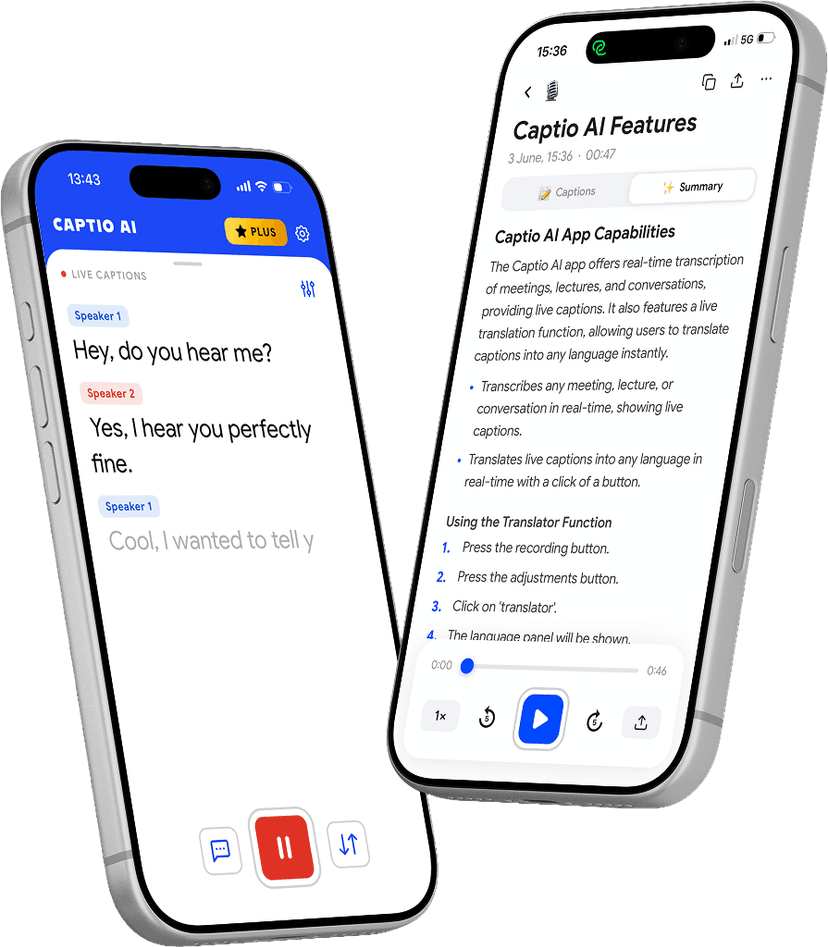
Everything you need to follow Hebrew restaurants & cafes
Four tools built for deaf and hard of hearing Hebrew speakers.
Follow the conversation through the noise
- Captions the person across the table in real time
- Works through typical restaurant background noise
- Place the phone between you — no adjustment needed
- No lip reading, no facing the speaker
Restaurants abroad or with foreign speakers
- They speak their language — you read in yours
- For waitstaff, companions, or travel dining
- 60+ languages, no setup
- Translates in real time as they speak
Transcribe any recorded conversation
- Record and get the full conversation in writing
- Review anything you missed after the meal
- Organised by speaker
- Any language, any format
Key points from any conversation
- Important points extracted from any recording
- Useful for business lunches and important catch-ups
- Organised into clear sections
- Works on any saved recording
Download for free
Every situation covered
Designed for the real moments that matter — not just quiet controlled environments.
Dinner with friends at a Tel Aviv restaurant or hummus spot, where the conversation is loud, fast, and everyone talks at once in casual Israeli Hebrew.
Business lunches in Tel Aviv's tech district or Herzliya Pituach, where Hebrew and English mix across the table and following client conversation at a startup lunch matters.
Café catch-ups at an Israeli café or a rooftop coffee bar, where the ambient sound of the city and background music compete with the conversation at your table.
Eating out in Israel as a visitor, where Hebrew menus and server recommendations arrive fast and knowing what is in the dish — especially for dietary considerations — matters.
Family celebrations at an Israeli restaurant — Shabbat dinners, holiday meals, bar and bat mitzvah gatherings — where the whole extended family talks simultaneously and music fills the room.
Dates at a Tel Aviv restaurant or a Jerusalem wine bar where you want to follow every word without asking your partner to repeat themselves over the background noise.
Most accurate and fastest models
word accuracy
independent benchmark, 2025
real-time captions
first word appears as you speak
Download for free
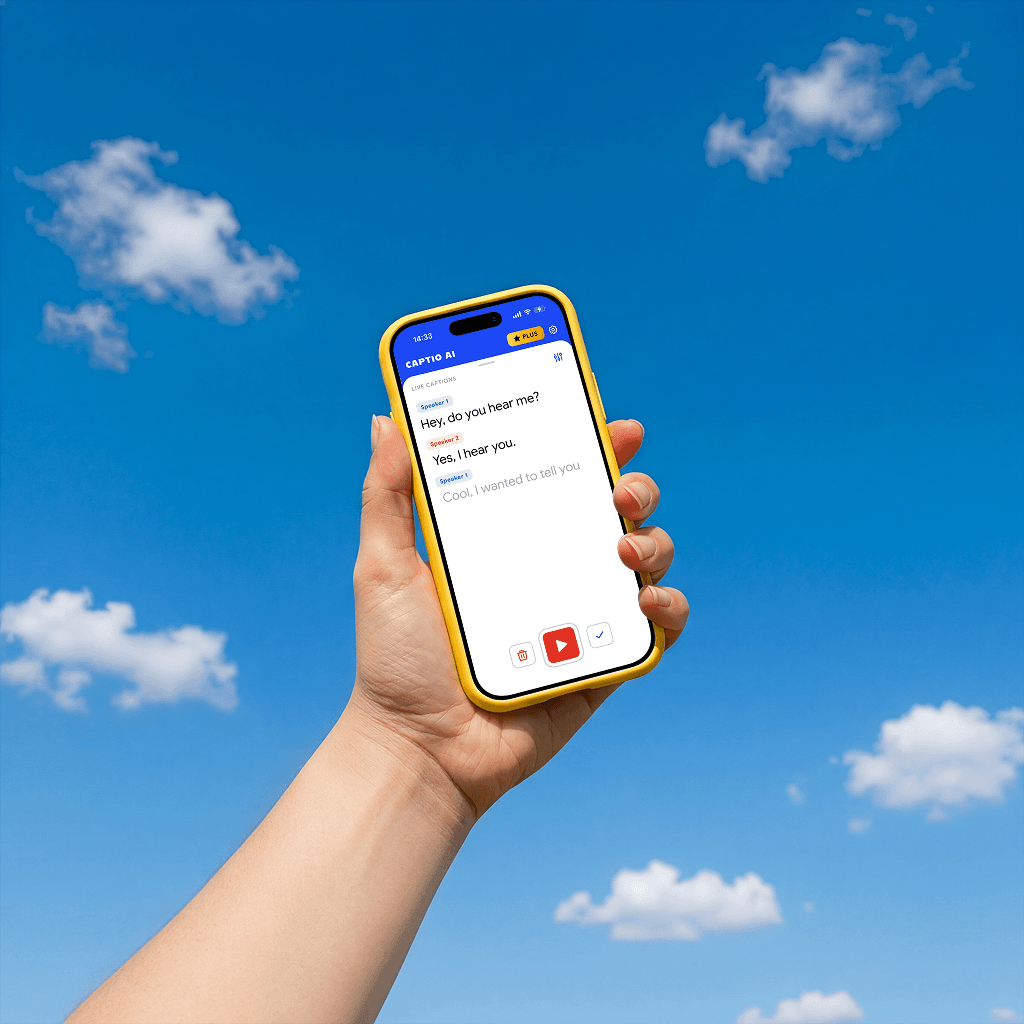
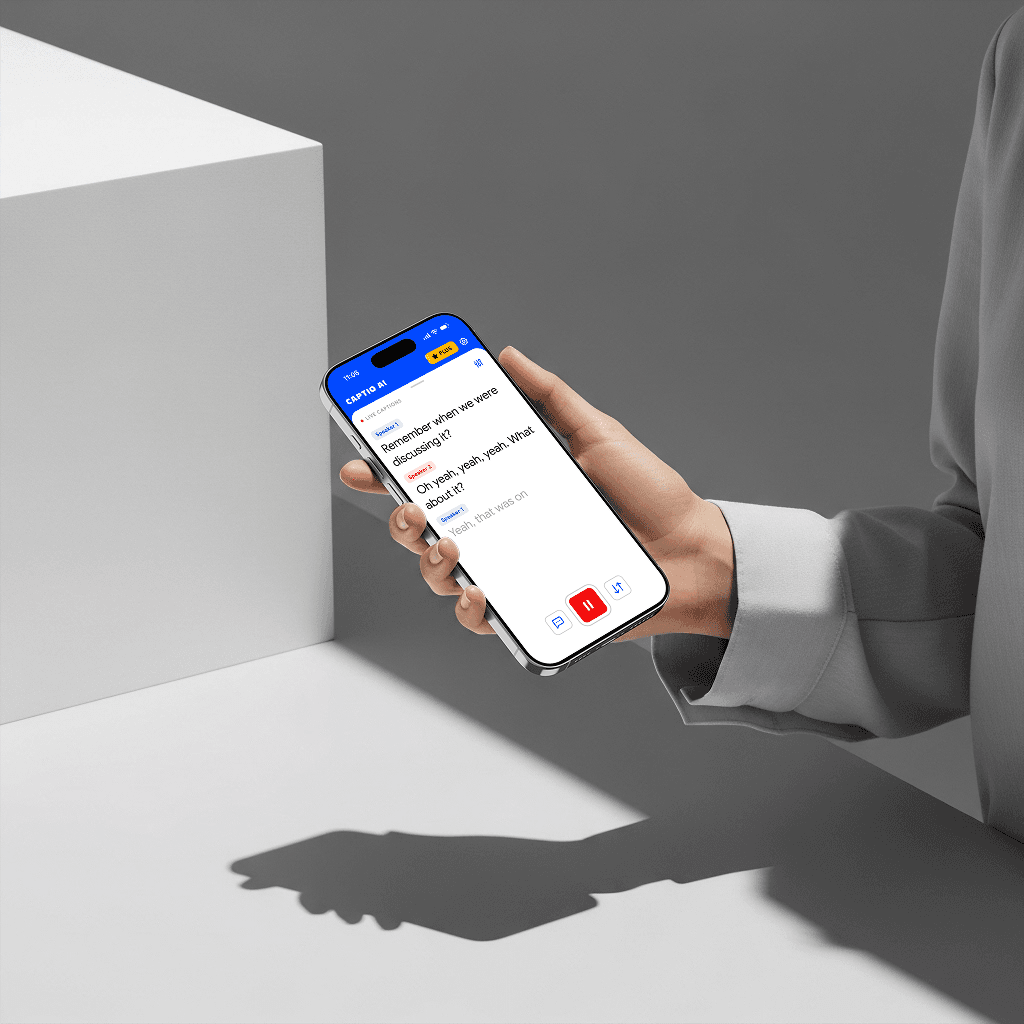
Built for the table — however noisy the room
Follows the person across the table
Point the microphone toward the person speaking and Captio AI captions them through the background noise. You do not need to face them, watch their lips, or lean in.
Works through restaurant noise
Restaurant noise averages 80 dBA — well above comfortable conversation level. Captio AI is built for these real environments, not quiet controlled rooms.
Place it and forget it
Put the phone on the table between you and the other person, microphone facing them. You glance at it as needed. No adjusting between sentences, no managing the setup.
No asking for repeats during the meal
Every word appears in real time. If you missed something, the caption is there — you do not need to stop the conversation and ask anyone to say it again.
Any language
For restaurants abroad, multilingual dining companions, or waitstaff who speak a different language. Live Translator captions and translates in real time with no manual setup.
Discreet
A phone on a restaurant table is unremarkable. Captio AI runs quietly, the screen faces you, and most dining companions adapt naturally once they understand what it does.
Why Hebrew is hard to understand
Pharyngeal and uvular consonants
- Ayin and het are produced in the throat — nothing to see
- Modern Hebrew contains /ʕ/ (ayin, ע) in traditional Sephardic pronunciation and /χ/ (het/khaf, ח/כ) — a uvular or velar fricative. These sounds are produced in the pharynx or the back of the mouth and are completely invisible on the lips. At an Israeli restaurant, they appear in everyday words like אוכל (food) and עכשיו (now) and leave a deaf diner with no visual signal at all.
Ashkenazi-Sephardic-Mizrahi phonological divide
- The same Hebrew word sounds different by community background
- Modern Israeli Hebrew has moved toward a compromise standard, but speaker phonology still varies by background. Ashkenazi speakers often merge /ʕ/ with /ʔ/ and simplify certain consonants, while Sephardic and Mizrahi speakers retain distinct pharyngeals. At an Israeli restaurant table with a multigenerational or mixed-background group, the same word arrives shaped by a completely different set of phonological habits.
Unwritten vowels in fast speech
- Hebrew is read without vowels — and spoken fast
- Standard written Hebrew typically appears without vowel diacritics (nikud). In fast spoken Hebrew, vowels in unstressed positions are often reduced or swallowed, making it difficult even for hearing people to segment speech at conversational speed. A deaf person watching lips at an Israeli restaurant table is trying to reconstruct words that carry minimal visible vowel information.
Arabic-Hebrew code-switching
- Arabic and Hebrew mix in Israel's mixed cities
- In Israel's mixed cities — Haifa, Jaffa, Jerusalem — restaurant conversations can shift between Arabic and Hebrew. The two languages share some consonant inventory overlap (both have pharyngeals) but follow completely different phonological patterns. A deaf person at a mixed restaurant table faces two systems simultaneously, each requiring a different lip-reading strategy.
Fast urban Israeli pace
- Tel Aviv restaurant Hebrew is rapid and information-dense
- Tel Aviv and Jerusalem restaurant culture is loud and fast-paced. Israeli Hebrew at a dinner table features rapid delivery with high information density, frequent informal contractions, and a rhythm that can be challenging even for native hearing speakers in noisy settings — let alone for a deaf diner watching lips across the table.
Download for free
Hearing loss in Israel: genetic burden, ethnic disparities, and daily barriers
Israel has an above-average genetic burden of hearing loss: over 20 genes causing deafness have been identified within the Jewish-Israeli hearing-impaired population, reflecting the genetic diversity and historical patterns of the communities that make up Israel's population (PMC10528870, Frontiers in Genetics 2023). This genetic predisposition means that hearing loss affects Israeli families across all socioeconomic and ethnic backgrounds, with prenatal diagnosis and early intervention practices varying by community.
Research published in the Israel Journal of Health Policy Research found significant disparities in habilitation access for children with hearing impairment — with ethnicity and place of residence affecting the quality and timing of intervention available to deaf children and their families (IJHPR, 2020). These early gaps in habilitation compound into adult barriers: reduced participation in professional settings, social exclusion from the fast-paced social environments of Israeli city life, and inadequate support in the loud, communal dining settings — Shabbat dinners, holiday meals, restaurant gatherings — that are central to Israeli social culture.
Captio AI captions Hebrew conversation in real time — at a Tel Aviv hummus spot, a Jerusalem restaurant, or a family Shabbat dinner — so a deaf person can follow every word from the table without needing an interpreter present.
Download for free
What you hear stays with you.
Gone the moment it ends
Captio AI processes your audio in real time and discards it immediately. Nothing is recorded. Nothing is kept.
Not a product
Your conversations are not something Captio AI sells, shares, or monetizes — to anyone, for any reason.
Not used to train anything
What you say in a doctor's appointment or a job interview never ends up in a training dataset. Not ours. Not anyone else's.

Private by default
Captio AI supports 60+ languages
Download for free
Frequently asked questions
Have a real conversation through the noise in Hebrew.
Captio AI is free to start
Download for free