

Belarusian live captions and productivity tool for restaurants & cafes
For deaf and hard of hearing people.
Download for free


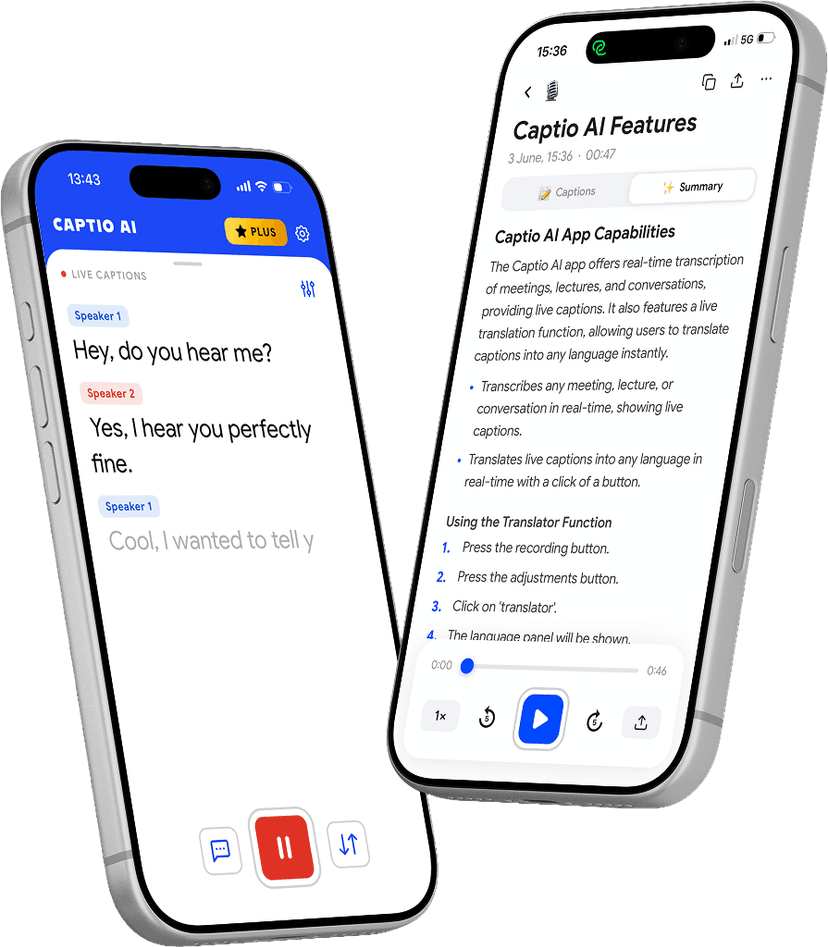
Everything you need to follow Belarusian restaurants & cafes
Four tools built for deaf and hard of hearing Belarusian speakers.
Follow the conversation through the noise
- Captions the person across the table in real time
- Works through typical restaurant background noise
- Place the phone between you — no adjustment needed
- No lip reading, no facing the speaker
Restaurants abroad or with foreign speakers
- They speak their language — you read in yours
- For waitstaff, companions, or travel dining
- 60+ languages, no setup
- Translates in real time as they speak
Transcribe any recorded conversation
- Record and get the full conversation in writing
- Review anything you missed after the meal
- Organised by speaker
- Any language, any format
Key points from any conversation
- Important points extracted from any recording
- Useful for business lunches and important catch-ups
- Organised into clear sections
- Works on any saved recording
Download for free
Every situation covered
Designed for the real moments that matter — not just quiet controlled environments.
Dinner with friends at a traditional Belarusian restaurant in Minsk, where the conversation flows freely between Belarusian and Russian over draniki and cold cuts and the noise of a full evening table fills the room.
Business lunches in Minsk's business districts where formal Belarusian or Russian mixes with English and following client detail across a restaurant table matters.
Café catch-ups at a Minsk café or tea house, where the ambient sound of a busy café and nearby conversations compete with the person sitting across from you.
Eating out in Belarus as a visitor, where Belarusian or Russian menus and fast server recommendations are hard to follow and knowing what you are ordering matters.
Family celebrations at a Belarusian restaurant — birthdays, New Year dinners, anniversary meals — where multiple conversations happen at once and the warmth of a full family table fills the room.
Dates at a restaurant in Minsk's Old Town where you want to follow every word without asking your partner to repeat themselves over the background music.
Most accurate and fastest models
word accuracy
independent benchmark, 2025
real-time captions
first word appears as you speak
Download for free
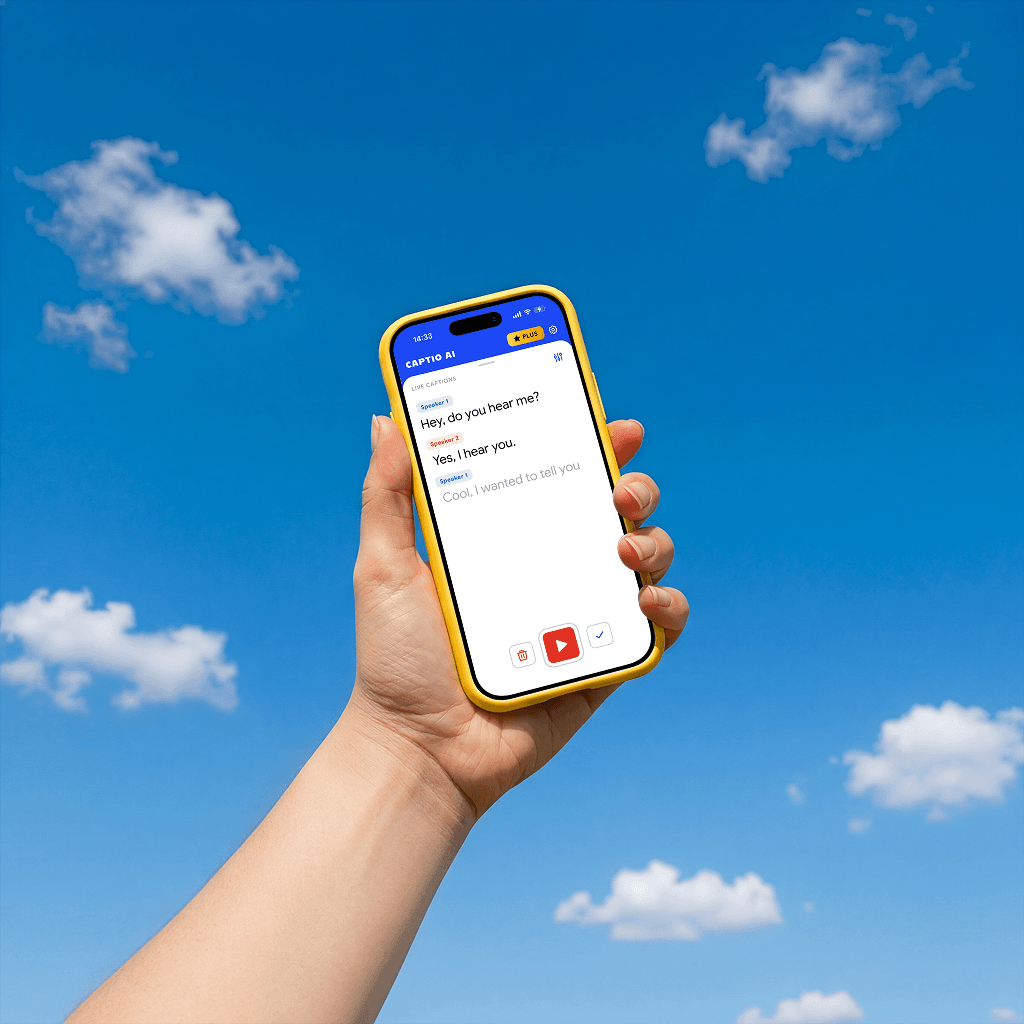
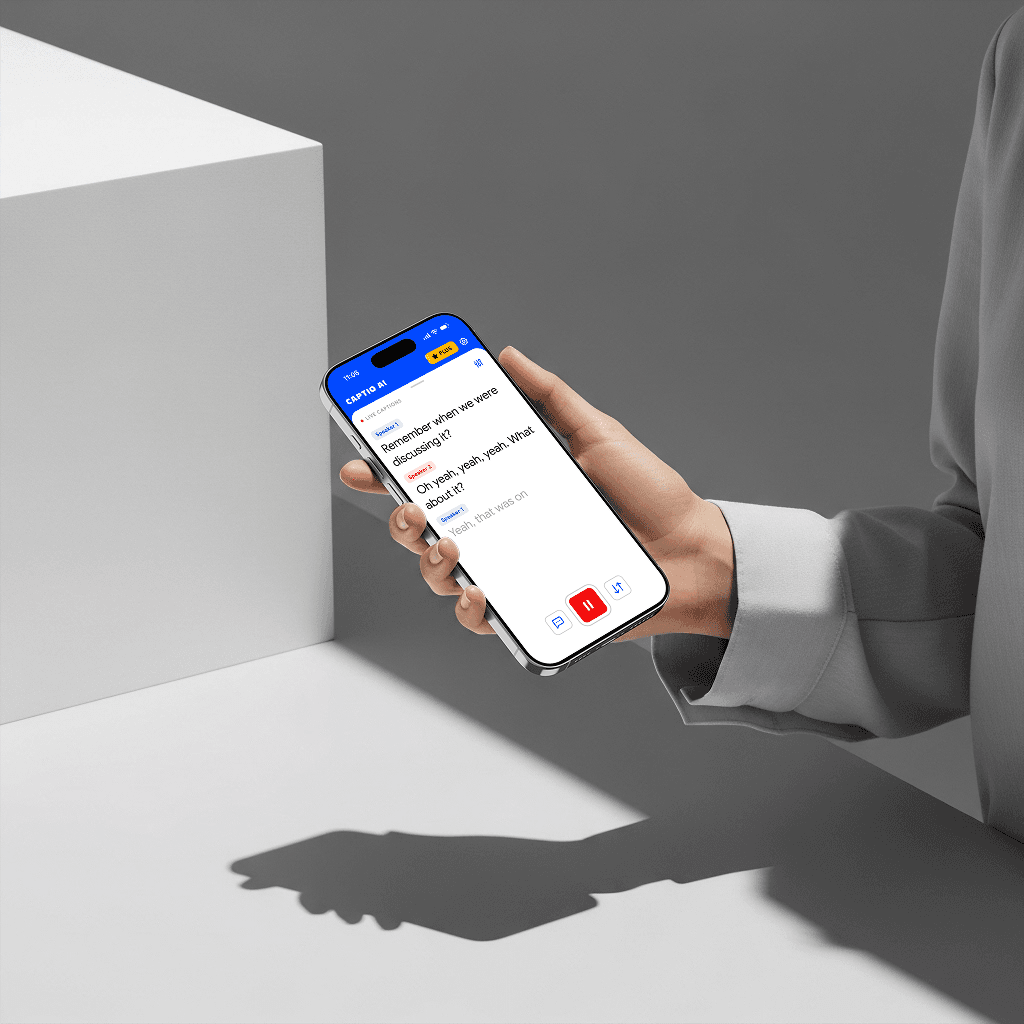
Built for the table — however noisy the room
Follows the person across the table
Point the microphone toward the person speaking and Captio AI captions them through the background noise. You do not need to face them, watch their lips, or lean in.
Works through restaurant noise
Restaurant noise averages 80 dBA — well above comfortable conversation level. Captio AI is built for these real environments, not quiet controlled rooms.
Place it and forget it
Put the phone on the table between you and the other person, microphone facing them. You glance at it as needed. No adjusting between sentences, no managing the setup.
No asking for repeats during the meal
Every word appears in real time. If you missed something, the caption is there — you do not need to stop the conversation and ask anyone to say it again.
Any language
For restaurants abroad, multilingual dining companions, or waitstaff who speak a different language. Live Translator captions and translates in real time with no manual setup.
Discreet
A phone on a restaurant table is unremarkable. Captio AI runs quietly, the screen faces you, and most dining companions adapt naturally once they understand what it does.
Why Belarusian is hard to understand
Akannye — /o/ becomes /a/ when unstressed
- Words sound different from how they look
- The most distinctive feature of Belarusian is akannye: unstressed /o/ merges into /a/ in pronunciation. This means that a word written with 'o' is pronounced with an 'a' sound in natural speech. At a Minsk restaurant, a deaf person trying to match a lip pattern to a remembered word shape may be looking for the wrong vowel entirely.
Hard-soft palatalization pairs
- Same lip shape, two different sounds
- Belarusian has 39 consonant phonemes organized around hard/soft palatalized pairs. The same visible lip position produces two distinct sounds — a hard consonant and its palatalized counterpart — with different meanings. In fast restaurant conversation, these distinctions are entirely inaudible to a lip-reader watching from across the table.
Trasianka code-mixing
- Belarusian and Russian blend unpredictably
- Most Belarusians use Trasianka — a blend of Belarusian and Russian that mixes elements of both languages in proportions that vary by speaker. At a Minsk restaurant table, conversation might be mostly Russian, mostly Belarusian, or unpredictably mixed. A deaf diner watching lips faces two phonological systems blended without clear boundaries.
Dzekanne and Tsekanne
- Dialect shifts change /d/ and /t/ in front of certain vowels
- Some Belarusian dialects convert /d/ to /dz/ and /t/ to /ts/ before certain vowels (a process called dzekanne and tsekanne). These shifts mean that the same word sounds different depending on the speaker's dialectal background — and the visible lip articulation changes accordingly at a restaurant table with mixed regional speakers.
Northeast-Southwest dialect divide
- Different vowel and consonant patterns by region
- Belarusian has two main dialect groups — Northeastern and Southwestern — with different consonant realizations and vowel patterns. The West-Polesian dialect group is distinctive enough to be considered a separate variety by some linguists. At a restaurant table with speakers from different parts of Belarus, a deaf diner encounters different phonological systems arriving without notice.
Download for free
Hearing loss in Belarus: limited advocacy and constrained civil society
Belarus ratified the UN Convention on the Rights of Persons with Disabilities in 2016, formally committing to accessible communication and social inclusion for deaf and hard-of-hearing citizens. However, civil society organizations in Belarus — including disability advocacy groups — operate under significant political constraints, limiting the extent to which commitments translate into monitored, independently reported outcomes. Globally, the GBD 2019 study estimated 1.57 billion people living with hearing loss (PMC7960691), and the WHO estimates that nearly 80% of people with disabling hearing loss live in low- and middle-income countries.
Belarusian Sign Language (BSL, distinct from British Sign Language) serves the deaf community in Belarus, but the availability of qualified sign language interpreters in everyday public settings — restaurants, transport, health services — remains limited. Research on the broader Eastern European region has documented that stigma, socio-cultural barriers, and insufficient accessibility infrastructure compound the daily experience of hearing loss (PMC12101339). For a deaf Belarusian navigating a Minsk restaurant table — where Belarusian, Russian, and Trasianka mix freely — the communication environment is particularly complex.
Captio AI captions Belarusian conversation in real time — at a Minsk restaurant, a café in the Old Town, or a family birthday dinner — so a deaf person can follow every exchange without needing an interpreter present.
Download for free
What you hear stays with you.
Gone the moment it ends
Captio AI processes your audio in real time and discards it immediately. Nothing is recorded. Nothing is kept.
Not a product
Your conversations are not something Captio AI sells, shares, or monetizes — to anyone, for any reason.
Not used to train anything
What you say in a doctor's appointment or a job interview never ends up in a training dataset. Not ours. Not anyone else's.

Private by default
Captio AI supports 60+ languages
Download for free
Frequently asked questions
Have a real conversation through the noise in Belarusian.
Captio AI is free to start
Download for free