

Tagalog live captions and productivity tool for restaurants & cafes
For deaf and hard of hearing people.
Download for free


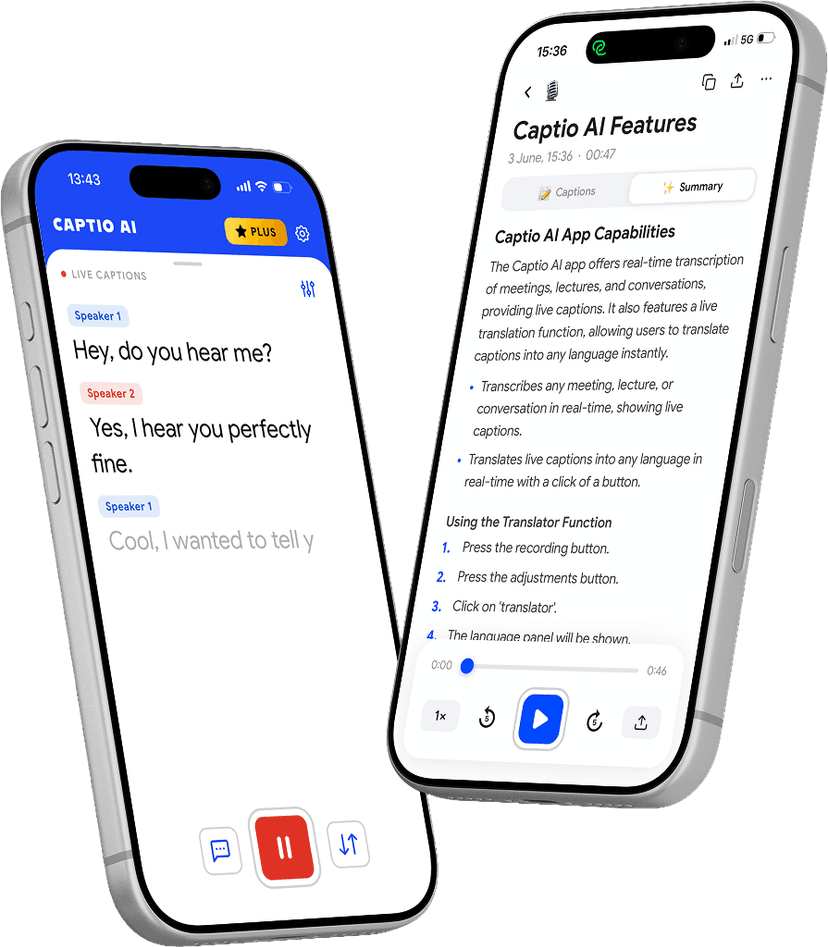
Everything you need to follow Tagalog restaurants & cafes
Four tools built for deaf and hard of hearing Tagalog speakers.
Follow the conversation through the noise
- Captions the person across the table in real time
- Works through typical restaurant background noise
- Place the phone between you — no adjustment needed
- No lip reading, no facing the speaker
Restaurants abroad or with foreign speakers
- They speak their language — you read in yours
- For waitstaff, companions, or travel dining
- 60+ languages, no setup
- Translates in real time as they speak
Transcribe any recorded conversation
- Record and get the full conversation in writing
- Review anything you missed after the meal
- Organised by speaker
- Any language, any format
Key points from any conversation
- Important points extracted from any recording
- Useful for business lunches and important catch-ups
- Organised into clear sections
- Works on any saved recording
Download for free
Every situation covered
Designed for the real moments that matter — not just quiet controlled environments.
Catching up with friends at a Manila neighbourhood restaurant, where the conversation flows naturally between Tagalog and English and everyone talks at once over shared dishes.
Business lunches in BGC or Makati, where formal Filipino mixes with English terms and reading lips across a crowded lunch table in a noisy restaurant is harder than it sounds.
Café catch-ups at a Quezon City coffee shop, where barista calls and background music compete with the conversation you are actually trying to follow.
Eating out at a local Filipino restaurant on a visit to the Philippines, where menu explanations and server recommendations arrive fast and vary by province.
Family celebrations at a Filipino restaurant — fiestas, birthdays, graduations — where the whole extended family talks simultaneously in a mix of Tagalog, English, and regional languages.
Dates at a restaurant in Poblacion or Bonifacio where the music is always too loud and you want to follow every word without asking your partner to repeat themselves.
Most accurate and fastest models
word accuracy
independent benchmark, 2025
real-time captions
first word appears as you speak
Download for free
Built for the table — however noisy the room
Follows the person across the table
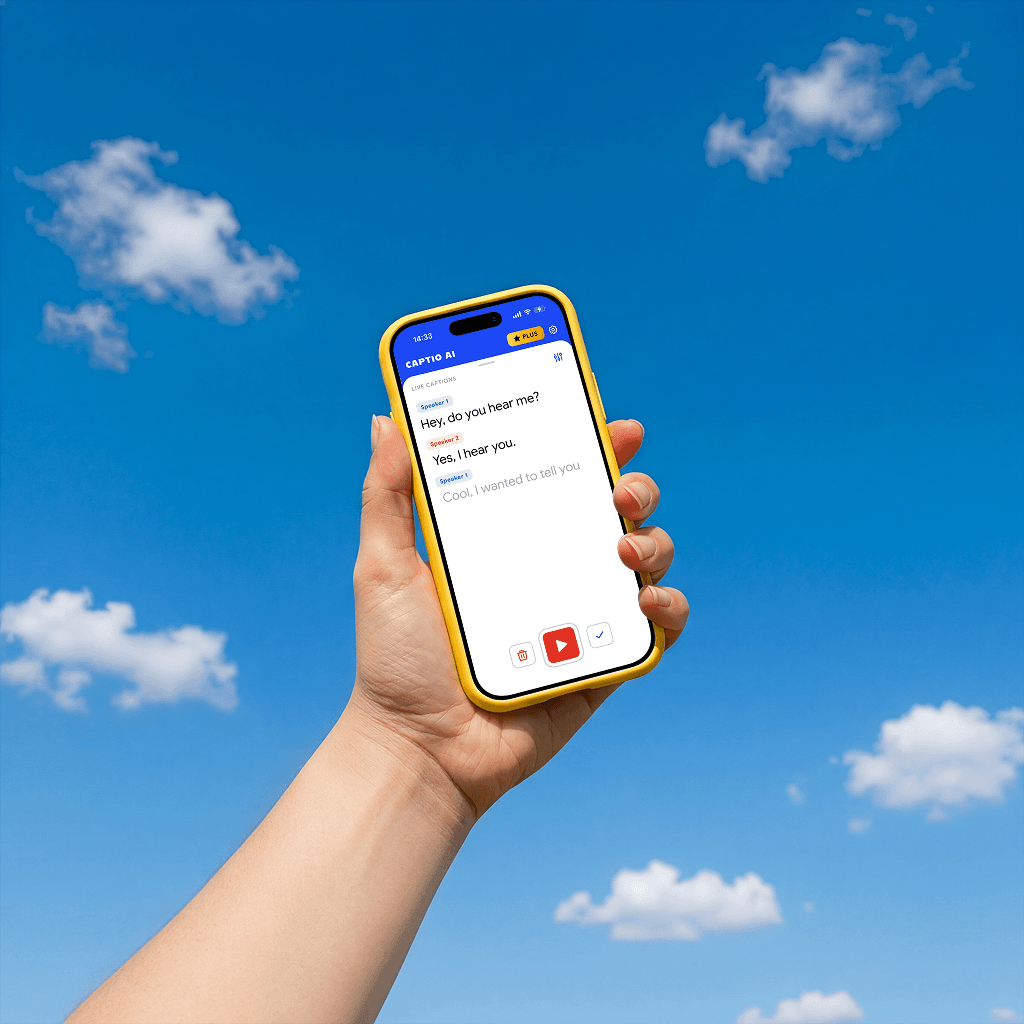
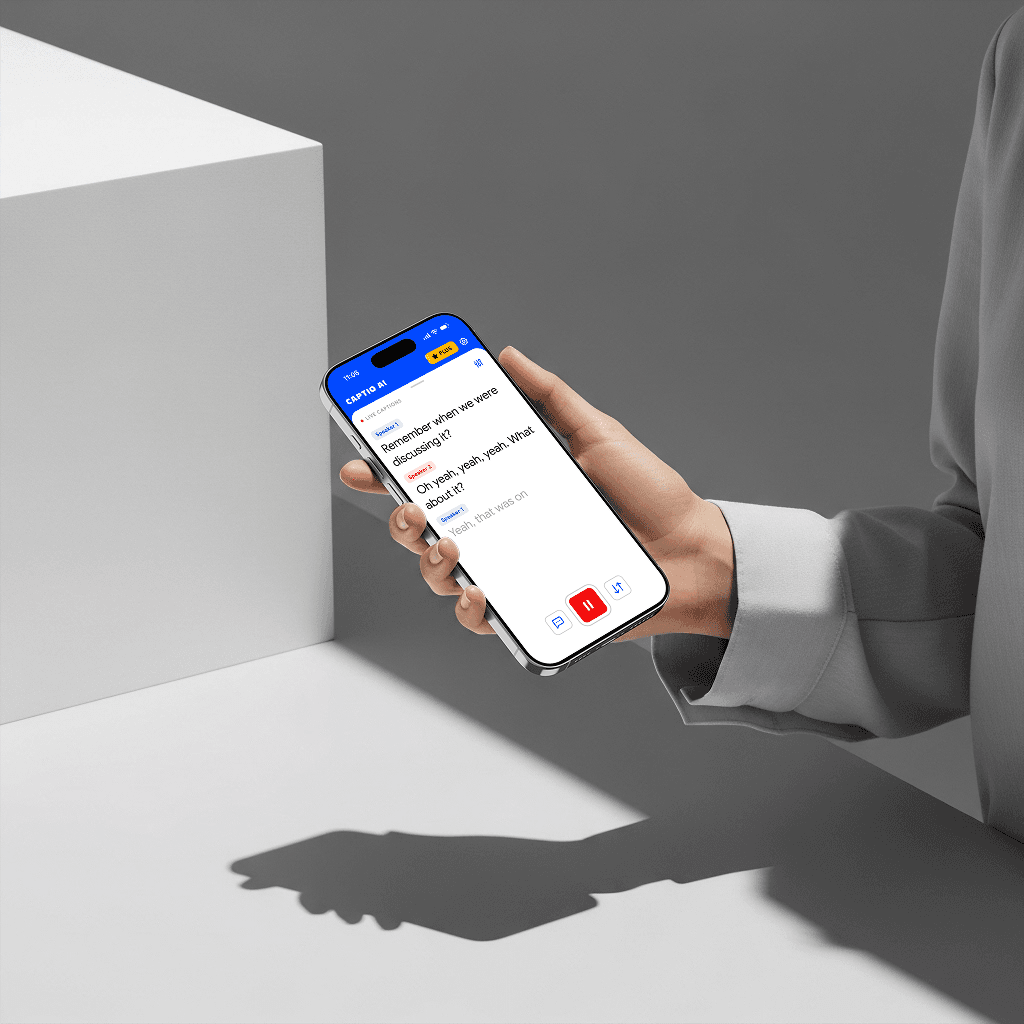
Point the microphone toward the person speaking and Captio AI captions them through the background noise. You do not need to face them, watch their lips, or lean in.
Works through restaurant noise
Restaurant noise averages 80 dBA — well above comfortable conversation level. Captio AI is built for these real environments, not quiet controlled rooms.
Place it and forget it
Put the phone on the table between you and the other person, microphone facing them. You glance at it as needed. No adjusting between sentences, no managing the setup.
No asking for repeats during the meal
Every word appears in real time. If you missed something, the caption is there — you do not need to stop the conversation and ask anyone to say it again.
Any language
For restaurants abroad, multilingual dining companions, or waitstaff who speak a different language. Live Translator captions and translates in real time with no manual setup.
Discreet
A phone on a restaurant table is unremarkable. Captio AI runs quietly, the screen faces you, and most dining companions adapt naturally once they understand what it does.
Why Tagalog is hard to understand
Taglish code-switching
- The language shifts mid-sentence
- Filipino restaurant conversation constantly switches between Tagalog and English without pause or signal. This Taglish mixing is so fluid that even lip-readers familiar with Tagalog lose the thread when the language shifts to English mid-phrase at a Manila dinner table.
Glottal stop compression
- Syllable boundaries collapse
- Tagalog's glottal stop /ʔ/ appears between vowels and at word boundaries but leaves no visible lip movement. In fast table talk, these stops collapse syllable boundaries — words blend together with nothing on the lips to signal where one ends and another begins.
Regional stress variation
- The same word sounds different by province
- Tagalog stress placement changes meaning — baba vs babá, halika vs halíka — and speakers from Cebu, Iloilo, or Pampanga carry different rhythms. At a group dinner with mixed regional backgrounds, the same word arrives with a different shape depending on who is speaking.
Fast casual elision
- Syllables drop in everyday speech
- Casual Filipino speech drops syllables and runs words together: 'ano' becomes ''no,' 'hindi' becomes ''di,' 'ganito' becomes 'nito.' Around a busy restaurant table, this compression leaves a deaf diner tracking fragments rather than whole words.
Multilingual environment
- The language of the table is never fixed
- Philippine restaurants mix Tagalog, regional languages like Cebuano or Ilocano, English, and Spanish loanwords in a single meal. A deaf person watching lips has no way of anticipating which language any given phrase will arrive in — or which lip patterns apply.
Download for free
Hearing loss in the Philippines: the numbers behind the silence
The Philippines has one of the highest rates of hearing loss in Southeast Asia. A national survey published in the Asia-Pacific Journal of Public Health (2020) found an overall prevalence of moderate or worse hearing loss of 15% across the Philippine population — rising to 49.1% among adults aged 65 and older. In children, the rate stands at 7.5%, and among working-age adults it is 14.7%. These figures are substantially higher than those reported in high-income countries, with a greater proportion of severe-to-profound cases linked to limited access to early diagnosis and hearing devices.
The Philippine Statistics Authority recorded 1.64 million persons with disability as of mid-2024 — a number widely acknowledged as an undercount, given the barriers to official registration that many communities face. Filipino Sign Language was formally recognized as the national sign language through Republic Act 11106 in 2018, a landmark law. Yet implementation of accessible communication in public settings — restaurants, shops, transport — remains uneven. The restaurant and hospitality sector operates almost entirely without real-time captioning or interpreter access.
Captio AI captions Filipino and Tagalog conversation in real time — at a Makati business lunch, a Manila fiesta dinner, or a neighbourhood restaurant in Quezon City — so a deaf person can follow every exchange from the table without needing an interpreter present.
Download for free
What you hear stays with you.
Gone the moment it ends
Captio AI processes your audio in real time and discards it immediately. Nothing is recorded. Nothing is kept.
Not a product
Your conversations are not something Captio AI sells, shares, or monetizes — to anyone, for any reason.
Not used to train anything
What you say in a doctor's appointment or a job interview never ends up in a training dataset. Not ours. Not anyone else's.

Private by default
Captio AI supports 60+ languages
Download for free
Frequently asked questions
Have a real conversation through the noise in Tagalog.
Captio AI is free to start
Download for free