

Kazakh live captions and productivity tool for restaurants & cafes
For deaf and hard of hearing people.
Download for free


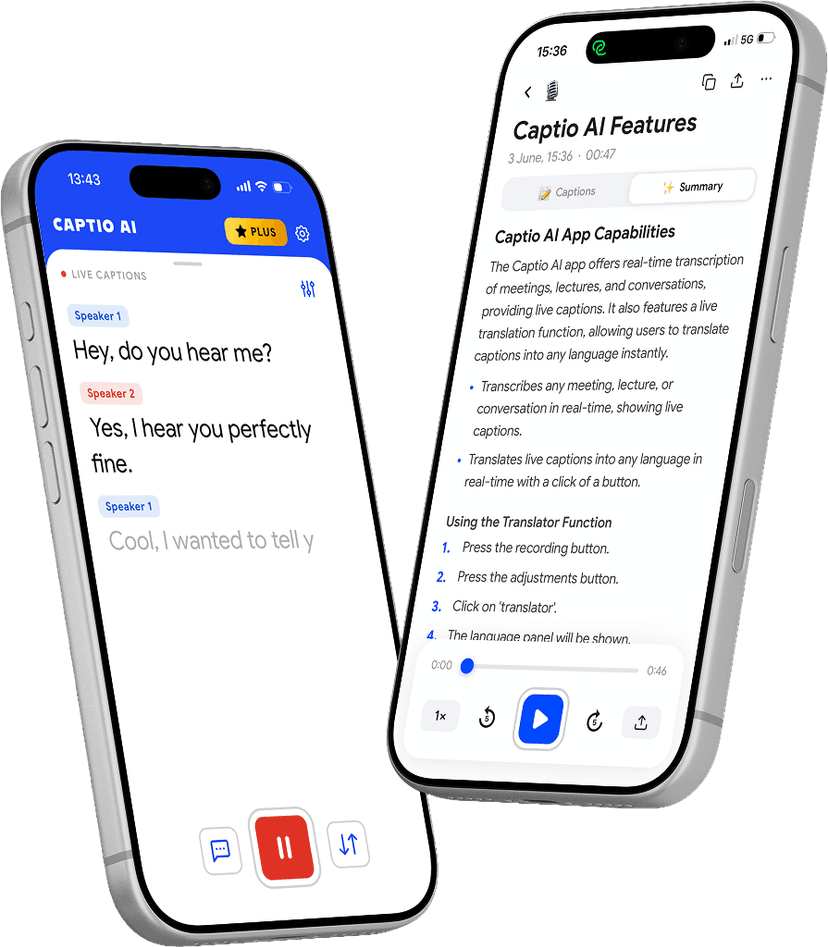
Everything you need to follow Kazakh restaurants & cafes
Four tools built for deaf and hard of hearing Kazakh speakers.
Follow the conversation through the noise
- Captions the person across the table in real time
- Works through typical restaurant background noise
- Place the phone between you — no adjustment needed
- No lip reading, no facing the speaker
Restaurants abroad or with foreign speakers
- They speak their language — you read in yours
- For waitstaff, companions, or travel dining
- 60+ languages, no setup
- Translates in real time as they speak
Transcribe any recorded conversation
- Record and get the full conversation in writing
- Review anything you missed after the meal
- Organised by speaker
- Any language, any format
Key points from any conversation
- Important points extracted from any recording
- Useful for business lunches and important catch-ups
- Organised into clear sections
- Works on any saved recording
Download for free
Every situation covered
Designed for the real moments that matter — not just quiet controlled environments.
Dinner with friends at a traditional Kazakh restaurant in Almaty or Nur-Sultan, where the conversation switches between Kazakh and Russian around the table and everyone talks at once.
Business lunches in Kazakhstan's business districts where formal Kazakh or Russian mixes with English terms and following the detail of a negotiation matters.
Café catch-ups at a Kazakh chaikhana or a modern Almaty café, where background music and nearby tables compete with the person sitting across from you.
Eating out in Kazakhstan as a visitor, where Kazakh menus and server explanations arrive in fast Kazakh or Russian and knowing what is being served matters.
Family celebrations at a Kazakh restaurant — toizha feasts, birthdays, Nauryz gatherings — where toasts, music, and multiple conversations fill the room all at once.
Dates at a restaurant in Almaty or Nur-Sultan where the city noise and restaurant music make following conversation by lip-reading alone almost impossible.
Most accurate and fastest models
word accuracy
independent benchmark, 2025
real-time captions
first word appears as you speak
Download for free


Built for the table — however noisy the room
Follows the person across the table
Point the microphone toward the person speaking and Captio AI captions them through the background noise. You do not need to face them, watch their lips, or lean in.
Works through restaurant noise
Restaurant noise averages 80 dBA — well above comfortable conversation level. Captio AI is built for these real environments, not quiet controlled rooms.
Place it and forget it
Put the phone on the table between you and the other person, microphone facing them. You glance at it as needed. No adjusting between sentences, no managing the setup.
No asking for repeats during the meal
Every word appears in real time. If you missed something, the caption is there — you do not need to stop the conversation and ask anyone to say it again.
Any language
For restaurants abroad, multilingual dining companions, or waitstaff who speak a different language. Live Translator captions and translates in real time with no manual setup.
Discreet
A phone on a restaurant table is unremarkable. Captio AI runs quietly, the screen faces you, and most dining companions adapt naturally once they understand what it does.
Why Kazakh is hard to understand
Vowel harmony blur
- Suffix vowels encode grammar — and all look the same
- Kazakh has 9 vowel phonemes that alternate systematically through vowel harmony — suffixes change their vowel to match the root. In fast restaurant conversation, these alternating vowel patterns make suffixes (which carry grammatical meaning) sound almost identical to one another, and the distinction is invisible on the lips.
Kazakh-Russian code-switching
- Russian arrives mid-sentence without warning
- In Kazakhstan, particularly in Almaty and Nur-Sultan, speakers switch between Kazakh and Russian constantly — sometimes within a single sentence. At a restaurant table, a deaf person accustomed to Kazakh lip patterns is suddenly confronted with Russian consonant clusters (/str/, /vzd/, /skr/) that follow completely different phonological rules.
Agglutinative compression
- One Kazakh word can hold an entire English phrase
- Kazakh is highly agglutinative — a single word carries what English would express in several words, through stacked suffixes. These long, suffix-heavy words are produced rapidly in natural speech, collapsing multiple grammatical distinctions into a single visual blur when watched at a restaurant conversation pace.
Northern-Southern dialect gap
- Nur-Sultan Kazakh vs. Shymkent Kazakh
- Northern Kazakh (Nur-Sultan region) is closer to the standard literary form, while Southern Kazakh (Shymkent, Almaty area) carries stronger Uzbek and Uyghur influences, with different vowel qualities and consonant patterns. A deaf person familiar with Northern Kazakh faces a distinctly different phonological landscape at a Southern Kazakh restaurant.
Script transition ambiguity
- Menus and signs appear in two scripts simultaneously
- Kazakhstan is actively transitioning Kazakh from Cyrillic to the Latin alphabet. In urban restaurants, menus and signs appear in both scripts. Deaf patrons reading captions while watching lip movements navigate a written environment that is itself in flux — adding a visual layer of complexity to an already challenging setting.
Download for free
Hearing loss in Kazakhstan: 250,000 people and 30 hours of support per year
Kazakhstan has approximately 150,000 people officially registered with hearing impairments, but experts estimate the actual number may be as high as 250,000, reflecting limited screening coverage in rural and semi-urban areas (Astana Times, 2015). A 2026 Frontiers in Public Health study confirmed that the burden of hearing loss in Kazakhstan is concentrated among working-age adults aged 18 to 59, who account for 20% of all reported cases — making it a challenge that directly affects economic participation and social life.
The state provides deaf citizens with only 30 hours of sign language interpretation per year — the equivalent of two and a half hours per month — which experts and advocacy groups have repeatedly called insufficient for daily communication needs. People classified with hearing impairment are assigned to the third disability group, which excludes them from state housing support and several social provisions. Employment remains one of the most persistent challenges: the government has acknowledged the non-competitiveness of deaf people on the labour market as a direct consequence of communication barriers.
Captio AI captions Kazakh conversation in real time — at an Almaty chaikhana, a Nur-Sultan restaurant, or a family toizha feast — so a deaf person can follow every exchange from the table without needing a sign language interpreter present.
[1]Kazakhstan's deaf population works toward greater integration (Astana Times, 2015)
[2]Burden of hearing loss in Kazakhstan (Frontiers in Public Health, 2026)
[3]Expert says the deaf still face challenges in Kazakhstan (Astana Times, 2016)
[4]GBD 2019 – Hearing loss prevalence and years lived with disability (PMC)
Download for free
What you hear stays with you.
Gone the moment it ends
Captio AI processes your audio in real time and discards it immediately. Nothing is recorded. Nothing is kept.
Not a product
Your conversations are not something Captio AI sells, shares, or monetizes — to anyone, for any reason.
Not used to train anything
What you say in a doctor's appointment or a job interview never ends up in a training dataset. Not ours. Not anyone else's.

Private by default
Captio AI supports 60+ languages
Download for free
Frequently asked questions
Have a real conversation through the noise in Kazakh.
Captio AI is free to start
Download for free