

Thai live captions and productivity tool for restaurants & cafes
For deaf and hard of hearing people.
Download for free


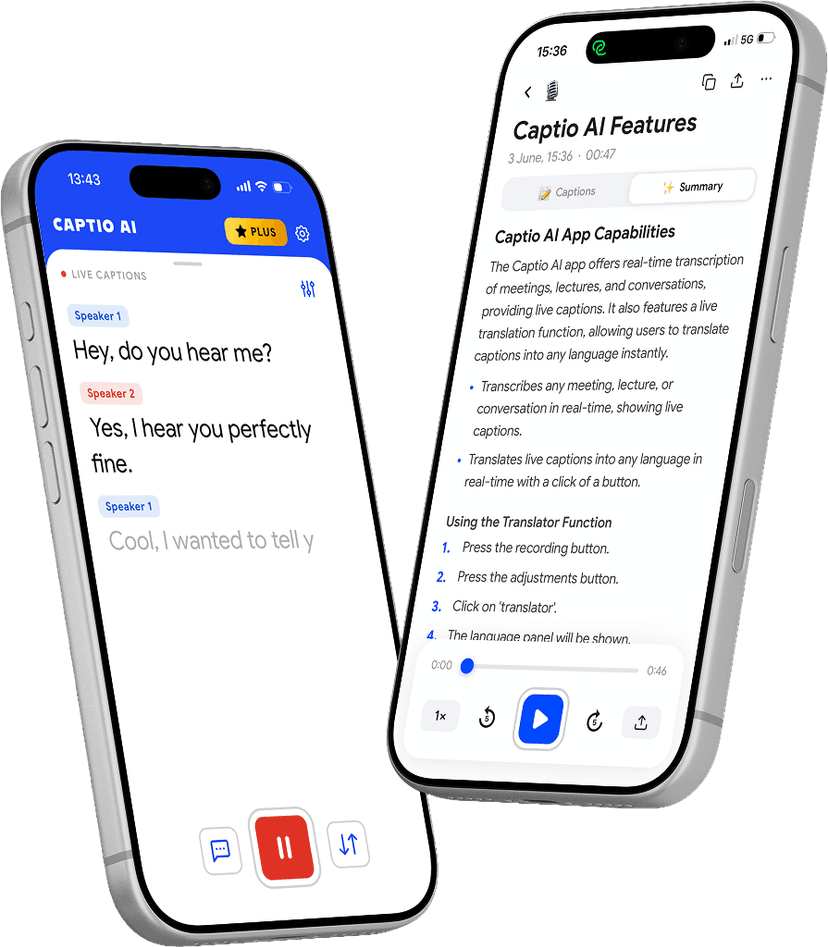
Everything you need to follow Thai restaurants & cafes
Four tools built for deaf and hard of hearing Thai speakers.
Follow the conversation through the noise
- Captions the person across the table in real time
- Works through typical restaurant background noise
- Place the phone between you — no adjustment needed
- No lip reading, no facing the speaker
Restaurants abroad or with foreign speakers
- They speak their language — you read in yours
- For waitstaff, companions, or travel dining
- 60+ languages, no setup
- Translates in real time as they speak
Transcribe any recorded conversation
- Record and get the full conversation in writing
- Review anything you missed after the meal
- Organised by speaker
- Any language, any format
Key points from any conversation
- Important points extracted from any recording
- Useful for business lunches and important catch-ups
- Organised into clear sections
- Works on any saved recording
Download for free
Every situation covered
Designed for the real moments that matter — not just quiet controlled environments.
Dinner with friends or family in Thailand — shared tom yum, laab, and sticky rice — is a communal meal where conversation runs continuously in fast Thai. A hard of hearing person at a Thai family table needs real-time captions to follow.
Business lunches in Bangkok are part of Thai professional culture. The politeness embedded in Thai language means that missing a sentence can mean misreading the entire social dynamic of the meal.
A café stop for Thai iced tea or a street food lunch is a daily Bangkok ritual. Fast orders at a busy food court or street stall happen in rapid Thai with significant background noise.
Travelling and eating out across Thailand — from a Chiang Mai khao soi restaurant to a Phuket seafood table — means navigating Northern and Southern Thai varieties with different tone patterns from Bangkok.
Group celebrations in Thailand — birthdays, merit-making dinners, family gatherings — are loud and run long. Overlapping Thai conversation around a shared table is exactly the setting where captioning makes participation possible.
A one-on-one dinner at a quieter Bangkok restaurant carries the weight of sustained conversation in Thai. Missing a tonal distinction — which can reverse a word's meaning — creates confusion that real-time captions prevent.
Most accurate and fastest models
character accuracy
independent benchmark, 2025
real-time captions
first word appears as you speak
Download for free

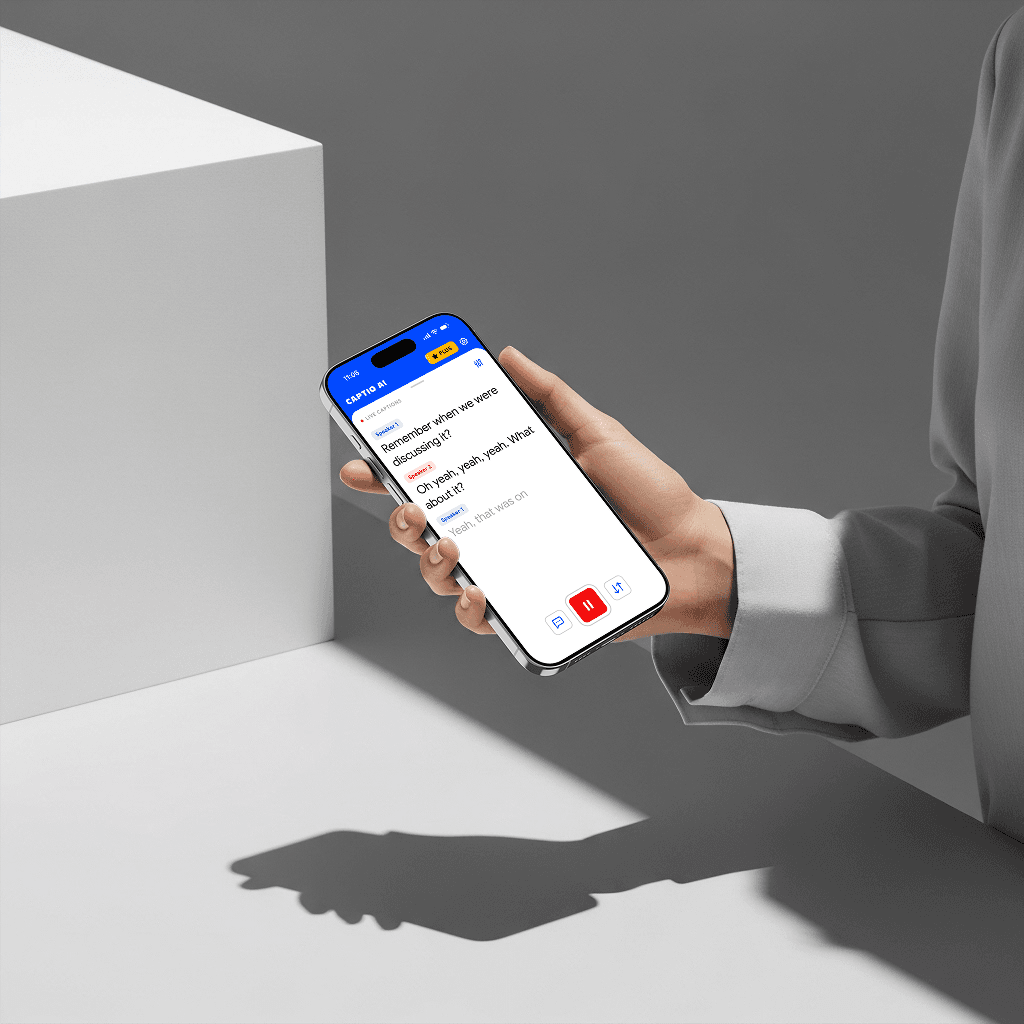
Built for the table — however noisy the room
Follows the person across the table
Point the microphone toward the person speaking and Captio AI captions them through the background noise. You do not need to face them, watch their lips, or lean in.
Works through restaurant noise
Restaurant noise averages 80 dBA — well above comfortable conversation level. Captio AI is built for these real environments, not quiet controlled rooms.
Place it and forget it
Put the phone on the table between you and the other person, microphone facing them. You glance at it as needed. No adjusting between sentences, no managing the setup.
No asking for repeats during the meal
Every word appears in real time. If you missed something, the caption is there — you do not need to stop the conversation and ask anyone to say it again.
Any language
For restaurants abroad, multilingual dining companions, or waitstaff who speak a different language. Live Translator captions and translates in real time with no manual setup.
Discreet
A phone on a restaurant table is unremarkable. Captio AI runs quietly, the screen faces you, and most dining companions adapt naturally once they understand what it does.
Why Thai is hard to understand
Five tones invisible
- Pitch is the entire meaning — nothing on the lips changes
- Thai has five lexical tones: mid, low, falling, high, and rising. Each syllable's meaning is entirely determined by its tone pattern — the same consonants and vowel mean different things in each of the five tones. These distinctions are carried by the vocal cords: there is nothing on the lips or face to read. At a Thai restaurant table, almost every word rests on tonal distinctions a lip-reader cannot access.
Bangkok vs regional dialects
- Northern, Northeastern, and Southern Thai have different tone systems
- Standard Bangkok Thai uses five tones, but Isan (Northeastern Thai, closely related to Lao) has six, Northern Thai (Kham Mueang) has six, and Southern Thai has seven. A hard of hearing person calibrated to Bangkok Thai is navigating a different tonal system when a server or dining companion from another region speaks.
Final consonant loss
- Syllable endings reduce in fast casual Thai
- Thai syllable codas — final consonant sounds (-t, -k, -p, -n, -m, -ŋ) that distinguish many words — shorten or disappear in fast casual conversation. At a busy restaurant, both order-taking and table conversation involve reduced final consonant articulation. A lip-reader working from careful speech is reading a different pattern.
Politeness particle system
- Sentence-final particles compress into nothing
- Thai speakers add polite particles (ครับ khrap for men, ค่ะ kha for women) to almost every social utterance. In fast speech these particles compress entirely. In a restaurant setting where politeness signals whether a remark is a suggestion, refusal, or command, missing these particles changes the meaning of the whole exchange.
Thai-English code-switching
- Urban Bangkok restaurants blend both languages continuously
- In Bangkok's modern restaurant scene, Thai and English are mixed freely: English menus, dish names, service phrases, social terms. The switching happens within sentences and without signal — removing the phonological predictability of pure Thai.
Download for free
Hearing loss in Thailand: the cost of the unheard table
A 2024 hearing health survey in Bangkok found a hearing loss prevalence of 53.02% in the surveyed population, with moderate or greater hearing impairment present in 2.8% of participants. Among older Thais, 38.34% of community-dwelling adults aged 60 and over have hearing disability. Thailand registers over 2 million disability cards, of which 18% are for hearing impairment — approximately 360,000 registered hearing-disabled individuals. Given that registration understates prevalence, the actual population navigating daily life with hearing difficulty is substantially larger.
Research on older Thai adults found that only 1.5% of those aged 60 and over with hearing difficulty were using a hearing aid — reflecting both cost barriers and social stigma. Thailand's vibrant food and restaurant culture, where shared meals are a central social setting, means that hearing loss creates significant daily exclusion from social life for hundreds of thousands of people who cannot follow the fast, tonal Thai spoken around a restaurant table.
Captio AI captions Thai conversation in real time — whether friends share stories over som tum at a Bangkok street restaurant, or a server in Chiang Mai explains the ingredients of khao soi in fast Northern Thai.
[1]PMC11015571 — hearing health survey of the population in Bangkok (2024)
[2]Frontiers in Digital Health — attitudes towards hearing difficulties among older Thai adults (2023)
[3]GBD 2019 — hearing loss prevalence and years lived with disability
[4]ScienceDirect social dining — hearing loss and exclusion from shared meals (2024)
Download for free
What you hear stays with you.
Gone the moment it ends
Captio AI processes your audio in real time and discards it immediately. Nothing is recorded. Nothing is kept.
Not a product
Your conversations are not something Captio AI sells, shares, or monetizes — to anyone, for any reason.
Not used to train anything
What you say in a doctor's appointment or a job interview never ends up in a training dataset. Not ours. Not anyone else's.

Private by default
Captio AI supports 60+ languages
Download for free
Frequently asked questions
Have a real conversation through the noise in Thai.
Captio AI is free to start
Download for free