

Malay live captions and productivity tool for restaurants & cafes
For deaf and hard of hearing people.
Download for free


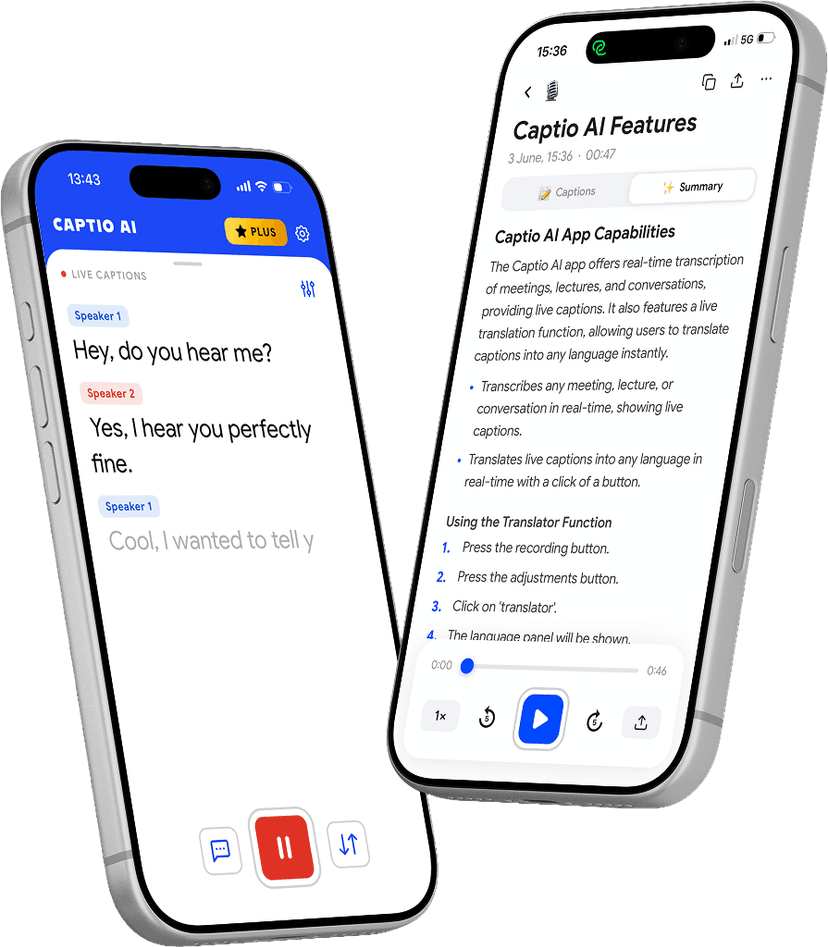
Everything you need to follow Malay restaurants & cafes
Four tools built for deaf and hard of hearing Malay speakers.
Follow the conversation through the noise
- Captions the person across the table in real time
- Works through typical restaurant background noise
- Place the phone between you — no adjustment needed
- No lip reading, no facing the speaker
Restaurants abroad or with foreign speakers
- They speak their language — you read in yours
- For waitstaff, companions, or travel dining
- 60+ languages, no setup
- Translates in real time as they speak
Transcribe any recorded conversation
- Record and get the full conversation in writing
- Review anything you missed after the meal
- Organised by speaker
- Any language, any format
Key points from any conversation
- Important points extracted from any recording
- Useful for business lunches and important catch-ups
- Organised into clear sections
- Works on any saved recording
Download for free
Every situation covered
Designed for the real moments that matter — not just quiet controlled environments.
Dinner with family or friends in Malaysia — shared nasi lemak, rendang, and laksa at a hawker centre — is a communal, lively meal where conversation mixes Malay, English, and dialect freely. A hard of hearing person at that table needs real-time captions.
Business lunches in Kuala Lumpur are common and often move quickly between formal Malay and English. Missing a side comment in Manglish or code-switched Malay can mean missing the actual point of the meeting.
A mamak stall breakfast or teh tarik stop is a cornerstone of Malaysian daily life. Fast orders at a busy mamak, conversation in rapid Malay or Manglish, and the noise of a full stall all add difficulty for a hard of hearing diner.
Travelling and eating out across Malaysia — from a Penang hawker stall to a Johor Bahru kopitiam — means navigating northern, southern, and regional Malay varieties. Captio AI captions whatever is spoken.
Group celebrations in Malaysia — Hari Raya Aidilfitri gatherings, Merdeka Day meals, family weddings — are loud and run long. Overlapping Malay, English, and dialect conversation across a large table is exactly the setting where captioning makes participation possible.
A one-on-one dinner at a quieter KL restaurant carries the expectation of sustained conversation. Missing a sentence — when it could be in Malay, English, or both — creates a gap that real-time captions close.
Most accurate and fastest models
word accuracy
independent benchmark, 2025
real-time captions
first word appears as you speak
Download for free
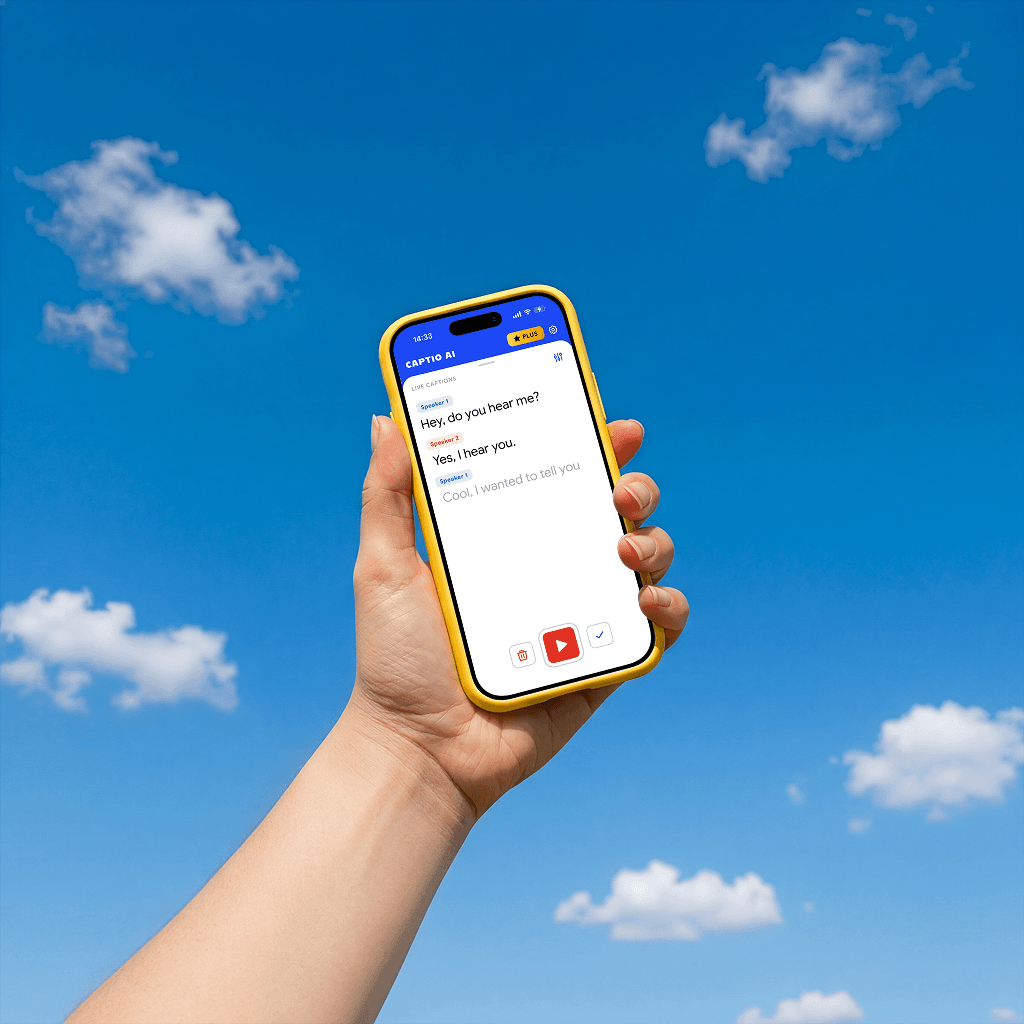
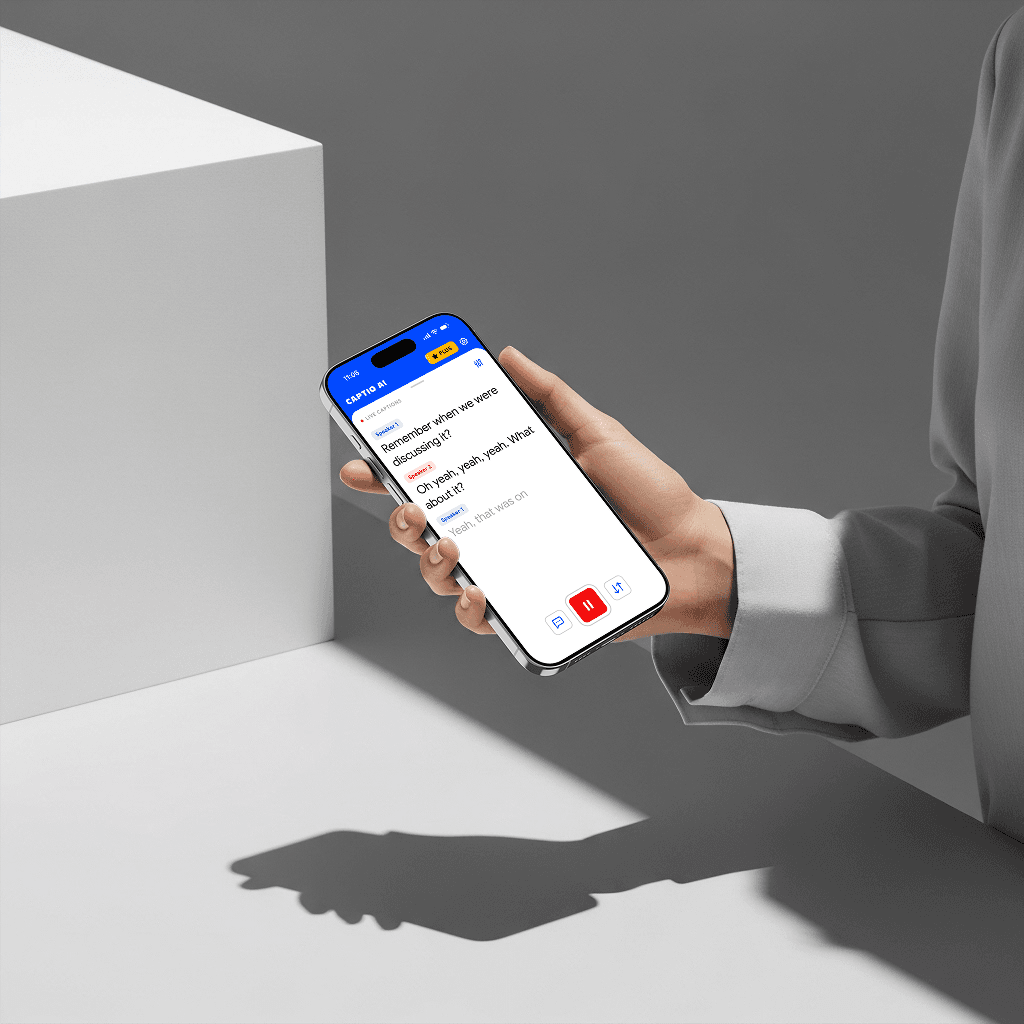
Built for the table — however noisy the room
Follows the person across the table
Point the microphone toward the person speaking and Captio AI captions them through the background noise. You do not need to face them, watch their lips, or lean in.
Works through restaurant noise
Restaurant noise averages 80 dBA — well above comfortable conversation level. Captio AI is built for these real environments, not quiet controlled rooms.
Place it and forget it
Put the phone on the table between you and the other person, microphone facing them. You glance at it as needed. No adjusting between sentences, no managing the setup.
No asking for repeats during the meal
Every word appears in real time. If you missed something, the caption is there — you do not need to stop the conversation and ask anyone to say it again.
Any language
For restaurants abroad, multilingual dining companions, or waitstaff who speak a different language. Live Translator captions and translates in real time with no manual setup.
Discreet
A phone on a restaurant table is unremarkable. Captio AI runs quietly, the screen faces you, and most dining companions adapt naturally once they understand what it does.
Why Malay is hard to understand
Kelantan-Pattani dialect gap
- Northeast Malaysian Malay is a different phonological system
- Kelantan Malay — spoken in northeastern Malaysia and crossing into southern Thailand — differs from Standard Malaysian Malay in vowel inventory, consonant realisations, and prosody to the point of near-mutual unintelligibility. At a restaurant table in Kota Bharu, a hard of hearing person calibrated to standard KL Malay is reading a different language.
Fast informal Malay
- Colloquial Malay compresses away from the standard
- In fast casual Malaysian Malay — spoken at a mamak stall, hawker centre, or among friends — words shorten, prefixes drop ('pergi' becomes 'gi', 'tidak' becomes 'tak'), and the rhythm accelerates. The gap between standard written Bahasa Malaysia and the fast informal Malay spoken at a restaurant table is substantial.
Manglish code-switching
- Malaysian English-Malay blending is constant and unpredictable
- Manglish — the code-switched variety blending Malay, English, Cantonese, and Tamil elements — is the default register for many Malaysians in urban social settings. 'Can' used as a modal, 'lah', 'loh', 'meh' as pragmatic particles, English words embedded in Malay syntax: a deaf or hard of hearing person following pure Malay phonology is already behind by the first sentence.
Word-final reduction
- Malay reduces final consonants in fast speech
- Standard Malay permits only a limited set of word-final consonants. In fast casual speech, final stops (/p/, /t/, /k/) are unreleased and often inaudible — and even less visible on the lips. This reduces the phonological information available at word boundaries.
Bahasa formal vs bahasa pasar
- Market Malay and formal Malay are almost separate registers
- Bahasa pasar ('market Malay') — the informal spoken variety used in restaurants and social settings — differs significantly from formal Bahasa Malaysia in vocabulary, grammar, and pronunciation. A hard of hearing person trained on formal Malay faces a second learning curve in every restaurant setting.
Download for free
Hearing loss in Malaysia: the cost of the unheard table
Malaysia's Health Minister announced in 2026 that 21.5% of Malaysians are affected by hearing problems — one in five of a population exceeding 33 million. As of early 2026, 50,413 individuals were registered as hearing-impaired with disabilities, with 42,652 recorded in 2023 alone. Among those with registered hearing impairment, 28.32% are older adults (60+) and 36.60% are middle adults (36–59) — reflecting a broad age distribution of hearing difficulty across Malaysian society.
Research on hearing care services in Malaysia has identified significant gaps in service delivery outside major urban centres: audiological services are concentrated in Kuala Lumpur and Penang, and hearing aid access is uneven. Malaysia's vibrant food culture — hawker centres, mamak stalls, kopitiams — involves shared eating in high-noise environments that are among the most challenging communication settings a hard of hearing person faces in daily life. The prevalence of hearing disability among Malaysians aged 60+ stands at 6.4%, with only 1.5% of that group using a hearing aid.
Captio AI captions Malay conversation in real time — whether friends at a Penang hawker centre share food and stories in fast Hokkien-influenced Malay, or a colleague makes a key point at a KL business lunch in code-switched Manglish.
[1]Free Malaysia Today — 21.5% of Malaysians have hearing problems (2026)
[2]PubMed — prevalence of hearing disability among older persons in Malaysia (NHMS 2018)
[3]GBD 2019 — hearing loss prevalence and years lived with disability
[4]ScienceDirect social dining — hearing loss and exclusion from shared meals (2024)
Download for free
What you hear stays with you.
Gone the moment it ends
Captio AI processes your audio in real time and discards it immediately. Nothing is recorded. Nothing is kept.
Not a product
Your conversations are not something Captio AI sells, shares, or monetizes — to anyone, for any reason.
Not used to train anything
What you say in a doctor's appointment or a job interview never ends up in a training dataset. Not ours. Not anyone else's.

Private by default
Captio AI supports 60+ languages
Download for free
Frequently asked questions
Have a real conversation through the noise in Malay.
Captio AI is free to start
Download for free