

Telugu live captions and productivity tool for restaurants & cafes
For deaf and hard of hearing people.
Download for free


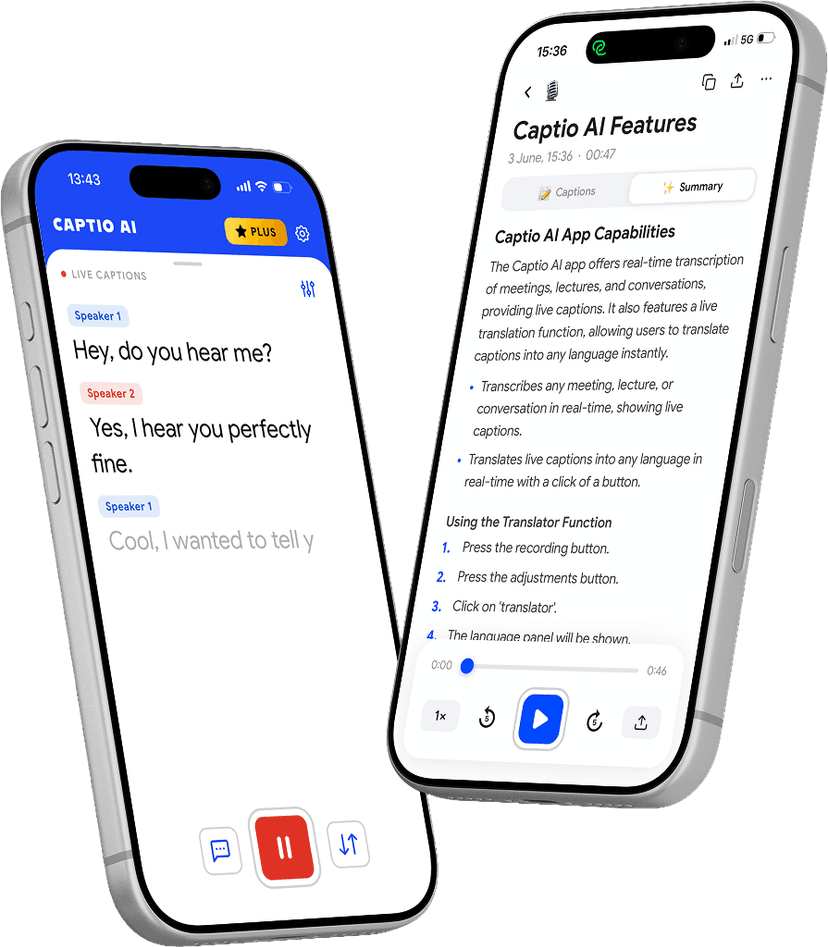
Everything you need to follow Telugu restaurants & cafes
Four tools built for deaf and hard of hearing Telugu speakers.
Follow the conversation through the noise
- Captions the person across the table in real time
- Works through typical restaurant background noise
- Place the phone between you — no adjustment needed
- No lip reading, no facing the speaker
Restaurants abroad or with foreign speakers
- They speak their language — you read in yours
- For waitstaff, companions, or travel dining
- 60+ languages, no setup
- Translates in real time as they speak
Transcribe any recorded conversation
- Record and get the full conversation in writing
- Review anything you missed after the meal
- Organised by speaker
- Any language, any format
Key points from any conversation
- Important points extracted from any recording
- Useful for business lunches and important catch-ups
- Organised into clear sections
- Works on any saved recording
Download for free
Every situation covered
Designed for the real moments that matter — not just quiet controlled environments.
Dinner with family in Andhra Pradesh or Telangana is built around food — gongura pachadi, pesarattu, biryani — and a table where conversation in Telugu runs continuously. A hard of hearing person needs real-time captions to follow.
Business lunches in Hyderabad often happen in the city's busy restaurant scene where Telugu, English, and Hyderabadi Urdu mix. Missing a key remark in code-switched speech can mean missing the point of the meeting.
A quick chai or filter coffee stop at a local restaurant is a daily ritual in Telugu cities. Orders and casual conversation happen fast at the counter, and the noise of a busy Hyderabad café adds a layer of difficulty.
Travelling and eating out across Andhra Pradesh and Telangana — from Visakhapatnam coastal seafood restaurants to Hyderabad dum biryani spots — means navigating different regional Telugu varieties. Captio AI captions whatever is spoken.
Group celebrations — family functions, weddings, or birthday meals — are loud and conversational. Following the table's overlapping speech without captioning means missing most of what is said.
A one-on-one meal in a Hyderabad restaurant carries the expectation of flowing conversation in Telugu or a mix of Telugu and English. Missing a sentence creates the awkward pause that real-time captions prevent.
Most accurate and fastest models
word accuracy
independent benchmark, 2025
real-time captions
first word appears as you speak
Download for free
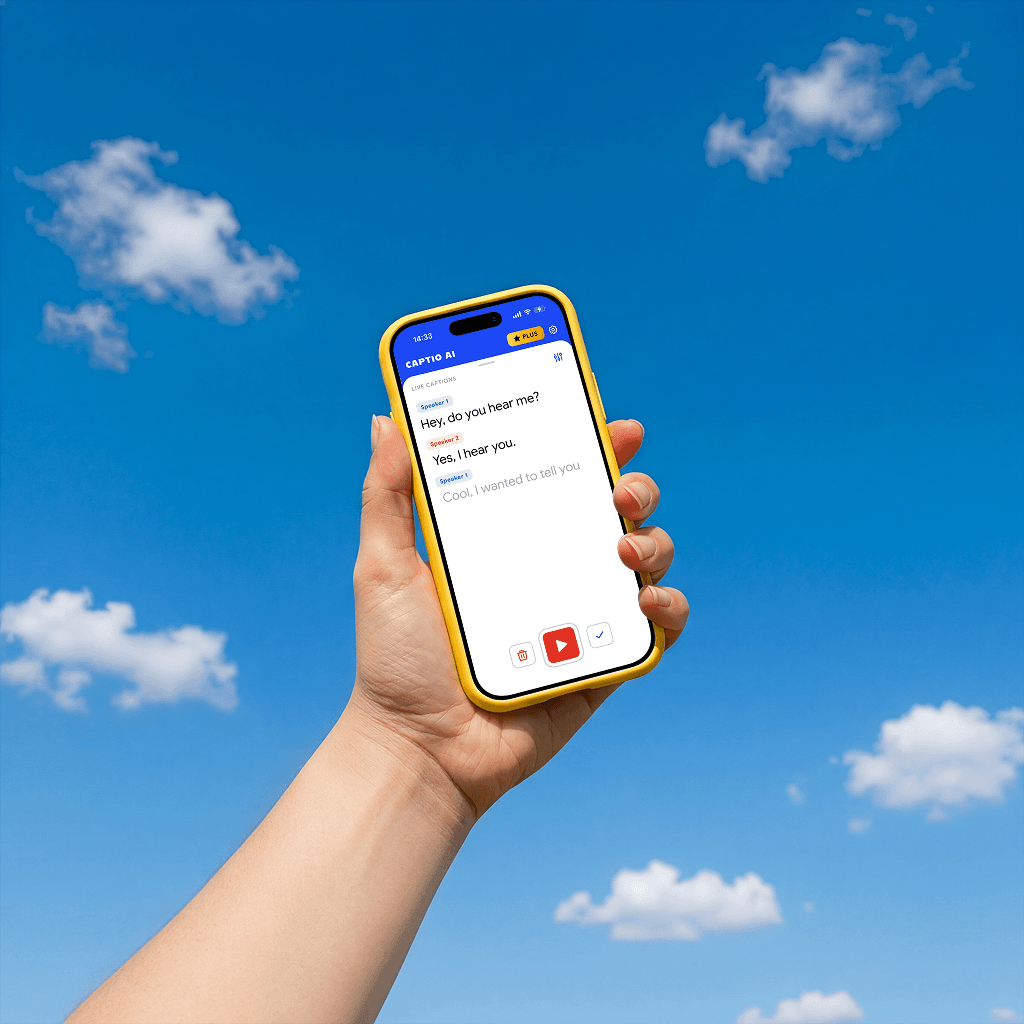
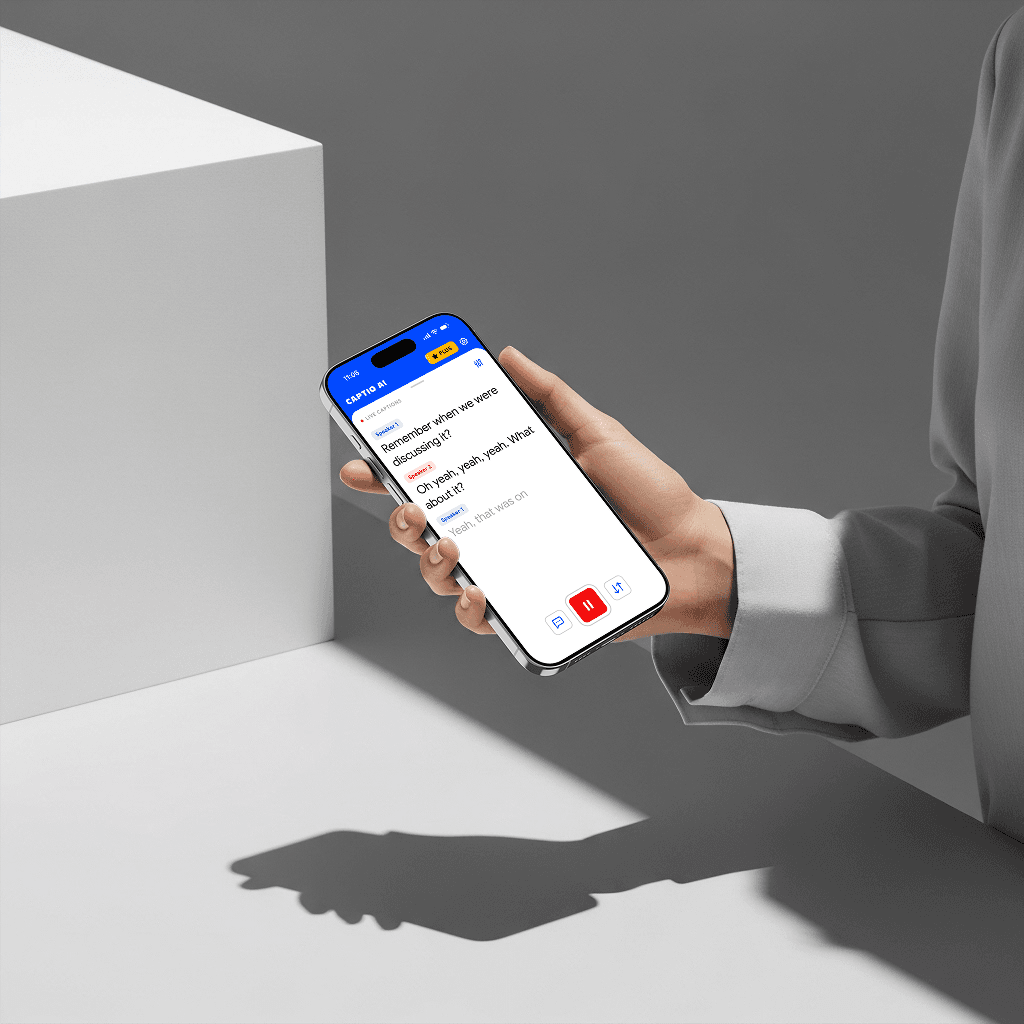
Built for the table — however noisy the room
Follows the person across the table
Point the microphone toward the person speaking and Captio AI captions them through the background noise. You do not need to face them, watch their lips, or lean in.
Works through restaurant noise
Restaurant noise averages 80 dBA — well above comfortable conversation level. Captio AI is built for these real environments, not quiet controlled rooms.
Place it and forget it
Put the phone on the table between you and the other person, microphone facing them. You glance at it as needed. No adjusting between sentences, no managing the setup.
No asking for repeats during the meal
Every word appears in real time. If you missed something, the caption is there — you do not need to stop the conversation and ask anyone to say it again.
Any language
For restaurants abroad, multilingual dining companions, or waitstaff who speak a different language. Live Translator captions and translates in real time with no manual setup.
Discreet
A phone on a restaurant table is unremarkable. Captio AI runs quietly, the screen faces you, and most dining companions adapt naturally once they understand what it does.
Why Telugu is hard to understand
Four-way consonant contrast
- Aspiration and voicing hidden inside the mouth
- Telugu has a four-way stop contrast — voiceless unaspirated, voiceless aspirated, voiced unaspirated, and voiced aspirated/murmured. All four forms of a base consonant are made with essentially the same lip shape. At a restaurant table, menu item names and everyday food words rest on these distinctions.
Vowel length
- Long and short vowels look identical
- Telugu phonology distinguishes long and short vowels (/a/ vs /aː/, /i/ vs /iː/) — pairs that carry different meanings but look the same from outside the mouth. In fast restaurant speech, long vowels may shorten further. A lip-reader cannot reliably distinguish 'kalu' (legs) from 'kaalu' (money) without hearing.
Coastal vs Telangana dialect gap
- Regional speech differs significantly
- Coastal Andhra Telugu and Telangana Telugu (including Hyderabadi Telugu) diverge in vocabulary, intonation, and consonant realisation. Hyderabadi Telugu carries heavy Urdu influence — Arabic-derived words with back-of-throat sounds — that appear unexpectedly in restaurant conversation.
Fast conversational vowel reduction
- Words shorten in natural speech
- In casual Telugu at the table, unstressed vowels reduce or drop entirely. Polysyllabic Telugu words shorten in a way that moves the spoken form away from the written form. Reading lips against the pattern of the written word becomes unreliable in fast restaurant conversation.
Telugu-English code-switching
- Urban and professional settings mix languages freely
- In Hyderabad, Vijayawada, and Visakhapatnam restaurants, Telugu and English are mixed routinely — menu descriptions in English, orders in Telugu, side remarks in either. For a deaf or hard of hearing person, the switching removes predictability and doubles the cognitive load.
Download for free
Hearing loss in India: the human cost in Telugu-speaking states
India's National Sample Survey estimated approximately 291 per lakh population with severe to profound hearing loss — a figure placing the national total at roughly 63 million people with significant hearing impairment, or 6.3% of the population. Andhra Pradesh has approximately 10.4 lakh registered disabled women alone — among the highest in the country — and hearing loss represents a significant share of disability registrations across Andhra Pradesh and Telangana combined.
Oralist education has dominated India's deaf schooling system for decades, teaching speech and lip-reading while limiting sign language access. The result is that many deaf and hard of hearing people develop lip-reading skills but lack systematic support in noisy public settings like restaurants. Research published in 2025 in Springer noted that India's deaf education policies continue to favour oralism, slowing the adoption of captioning-based tools in daily life.
Captio AI captions Telugu conversation in real time — whether a family member explains a new dish across a shared biryani handi in Hyderabad or a colleague mentions a project update over lunch in Vijayawada.
Download for free
What you hear stays with you.
Gone the moment it ends
Captio AI processes your audio in real time and discards it immediately. Nothing is recorded. Nothing is kept.
Not a product
Your conversations are not something Captio AI sells, shares, or monetizes — to anyone, for any reason.
Not used to train anything
What you say in a doctor's appointment or a job interview never ends up in a training dataset. Not ours. Not anyone else's.

Private by default
Captio AI supports 60+ languages
Download for free
Frequently asked questions
Have a real conversation through the noise in Telugu.
Captio AI is free to start
Download for free