

Tagalog live captions and productivity tool for TV & media
For deaf and hard of hearing people.
Download for free


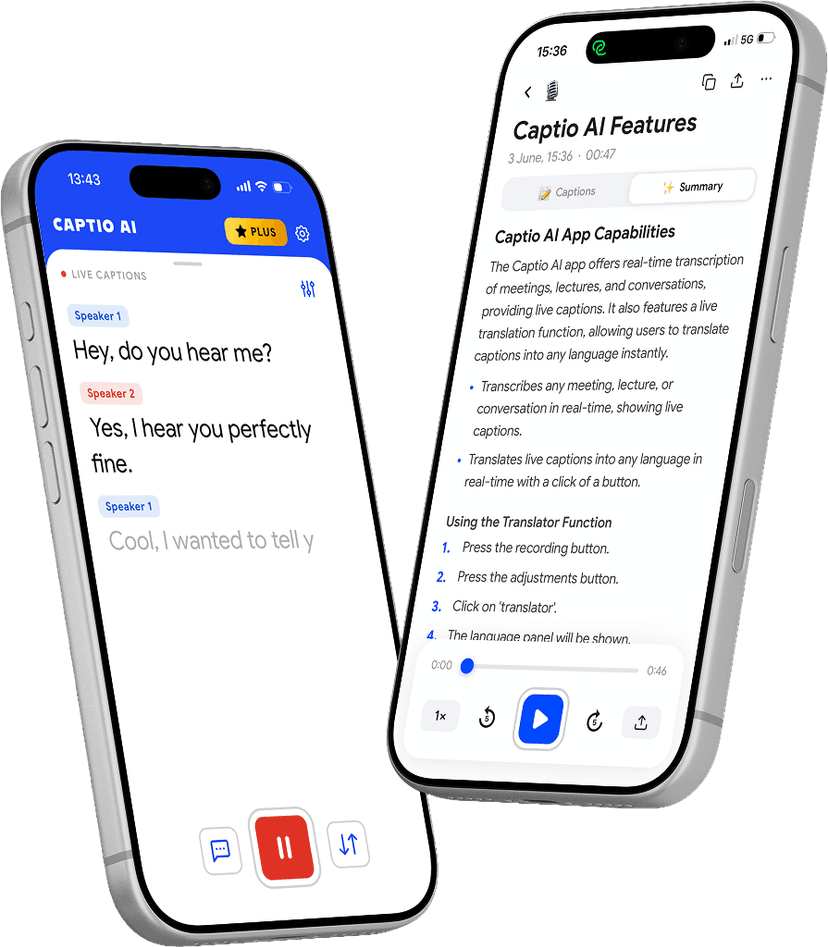
Everything you need to follow Tagalog TV & media
Four tools built for deaf and hard of hearing Tagalog speakers.
Captions anything playing in real time
- Point the phone toward the speaker and read along
- Works on any TV, laptop, tablet, or phone
- No subtitle file required — captions from the audio directly
- Faster than pre-generated subtitles for live content
Watch content in any language
- Foreign films, foreign news, foreign YouTube — all translated in real time
- They speak their language — you read in yours
- 60+ languages, no setup
- Works as content plays
Full transcript of any recording
- Upload a recording and get the complete written transcript
- For lectures, podcasts, talks, or any long-form content
- Searchable and copyable
- Any language, any format
Key points from any content
- Main ideas and takeaways from any transcript
- Useful for news, documentaries, and long-form content
- Organised into clear sections
- Works on any saved recording
Download for free
Every situation covered
Designed for the real moments that matter — not just quiet controlled environments.
GMA and news channels run live bulletins that pre-generated captions can lag behind. Point Captio AI at your TV and read the Tagalog as it is spoken, not several seconds behind the anchor.
iWantTFC, Netflix, and other platforms vary in subtitle quality and availability. Captio AI works as a consistent fallback for any Filipino show or film that ships with wrong, delayed, or missing captions.
YouTube auto-captions for Tagalog are often inaccurate and most social video has none. Point Captio AI at your phone and read accurate Tagalog captions for any clip.
A foreign film, a foreign documentary, a non-Tagalog channel. Live Translator captions and translates in real time so anything becomes watchable in Tagalog as it plays.
Not every cinema showing is captioned. Hold Captio AI near the audio and read real-time Tagalog captions of the dialogue discreetly from your seat.
Most Filipino podcasts have no transcript. Hold Captio AI near the audio or upload a recording, and read the whole episode in writing.
Most accurate and fastest models
word accuracy
independent benchmark, 2025
real-time captions
first word appears as you speak
Download for free
Built for the content that subtitles fail
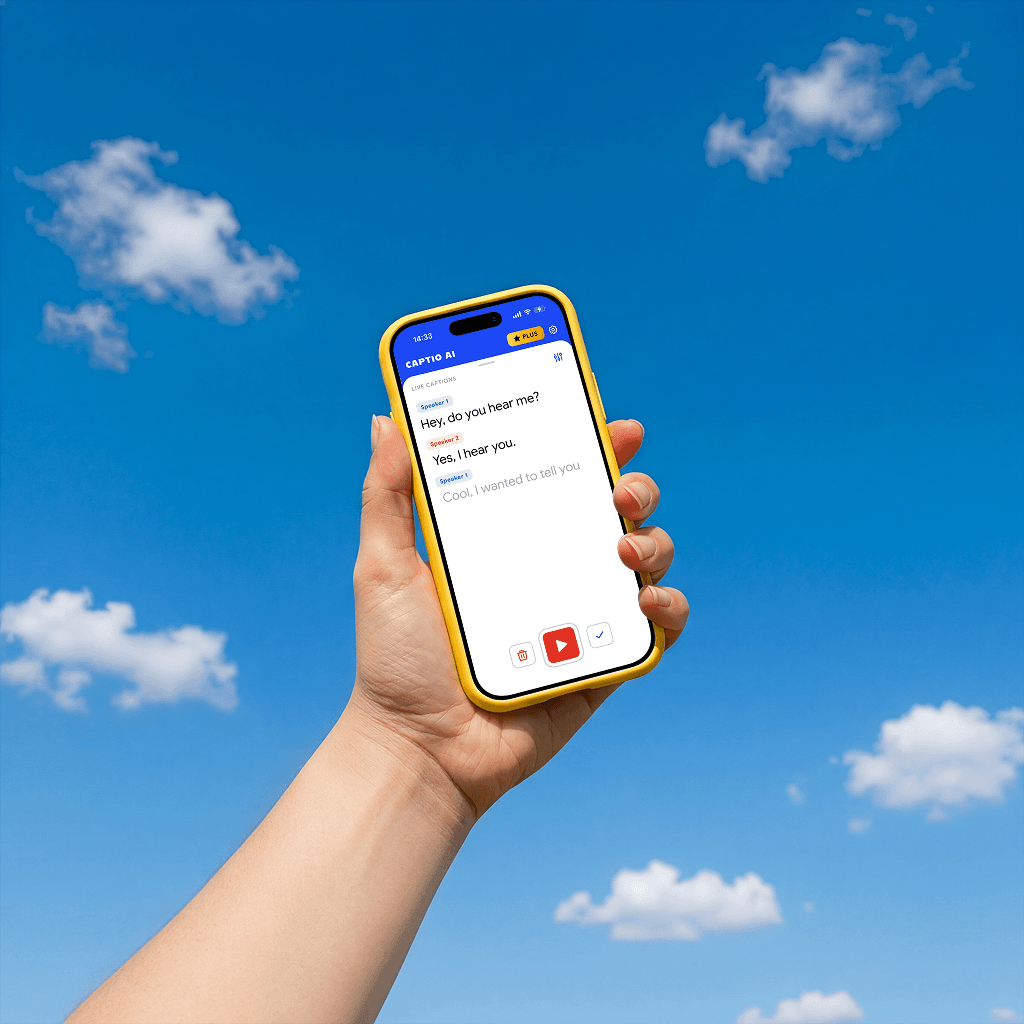
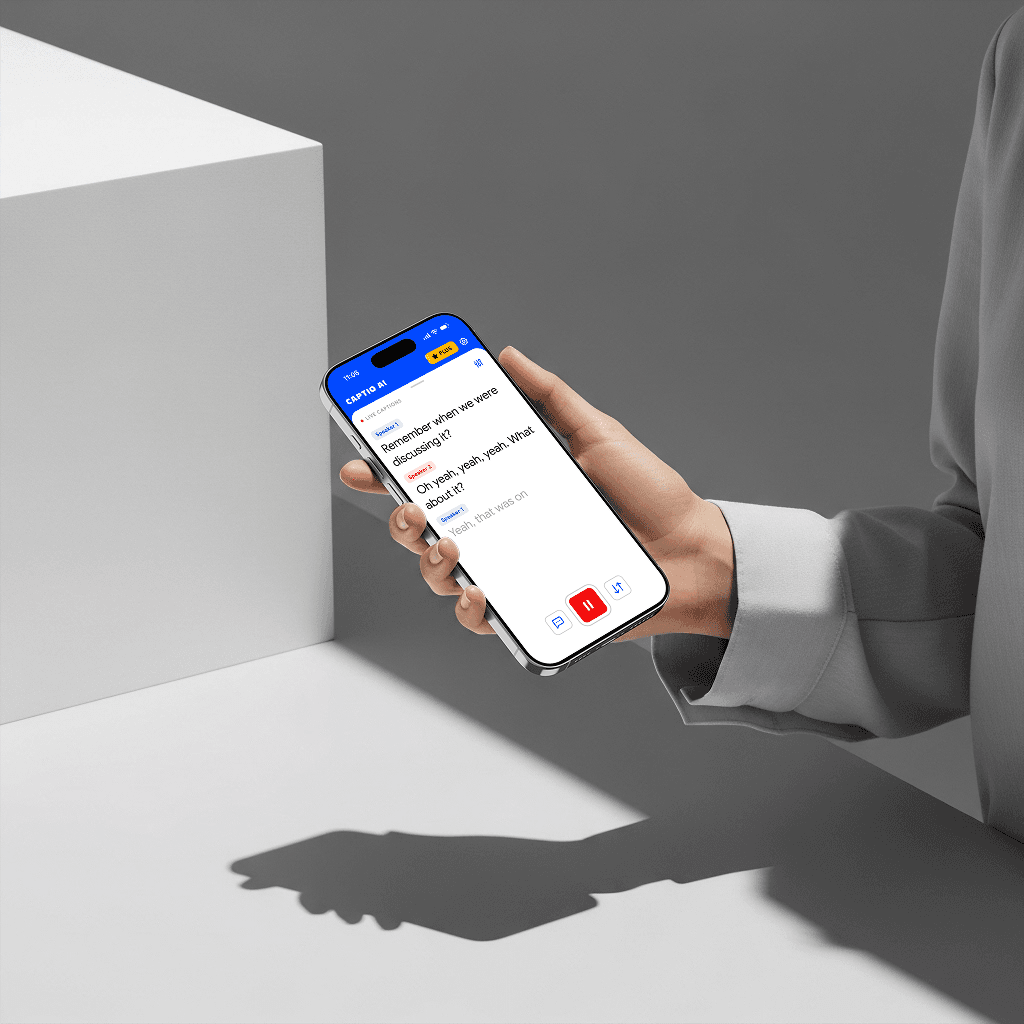
Captions any content in real time
Point the phone toward any speaker — TV, laptop, tablet, cinema screen. Captio AI captions whatever is playing, regardless of whether that platform provides subtitles.
Faster than built-in subtitles for live content
Pre-generated subtitles lag behind live TV by several seconds. Captio AI captions in real time — so you read what is being said as it is being said.
Works on any screen or device
No integration required. Point the phone toward the audio source — the same approach works for a large TV, a laptop screen, a cinema, or a phone held at arm's length.
Any language, translated in real time
For foreign-language content, switch to Live Translator. It translates as content plays — so a French film, a German documentary, or a Japanese series all become watchable.
No subtitle file needed
Captio AI captions from the audio directly. No subtitle file, no platform support, no creator requirement. If audio plays, Captio AI can caption it.
More accurate than auto-generated captions
The industry average for AI-generated subtitles is a 10–15% word error rate — roughly 1 in 10 words wrong (3Play Media). Captio AI is built for accuracy in real-world audio conditions.
Why Tagalog is hard to understand
Glottal stops
- Sounds made in the throat that break words apart
- Tagalog inserts a glottal stop between adjacent vowels and at the start of vowel-initial words — a catch in the throat with no lip movement at all. On a TV drama or a fast news read, a deaf viewer cannot see these stops, so word boundaries and meaning-changing distinctions disappear on screen.
Taglish code-switching
- Tagalog and English woven together sentence by sentence
- Filipino TV, film, and YouTube run on Taglish — a fluent blend of Tagalog and English that switches within a single sentence, often on the key words. A deaf viewer must jump between two phonologies with no visual warning, and no lip to read after a fast cut.
Stress and length
- Where the stress falls changes the word
- In Tagalog, two words can differ only in stress placement or in a final glottal stop, not in their consonants and vowels. These are pitch and timing cues, not lip shapes, so on screen a deaf viewer cannot tell such pairs apart in a scene.
Casual reduction
- Fast speech blurs the distinctions that carry meaning
- The main challenge in spoken Tagalog is hearing the reduced distinctions of casual speech. In a lively teleserye or a comedy scene those distinctions blur and words run together, leaving a deaf viewer with a fast, connected stream and little visual footing.
Regional accents on screen
- Cebuano, Kapampangan, and Ilocano colour the dialogue
- Filipino content features Tagalog coloured by Cebuano, Kapampangan, or Ilocano speech. A deaf viewer calibrated to Manila Tagalog meets shifting speech from one show or character to the next, and the face on a small screen is hard to lip-read anyway.
Download for free
The Philippines passed a closed-caption law — but reality falls short
A national survey found moderate or worse hearing loss in around 15% of the Philippine population — nearly one in six people — and government figures put the number of Filipinos who are deaf or hearing-impaired at roughly 1.44 million. In 2016 the Philippines passed the Closed Caption Law (Republic Act 10905), requiring all television stations and programme producers to broadcast with a closed-caption option, including newscasts and pre-scripted programmes.
But the law has been slow and uneven in practice. It carries exemptions — short public service announcements, programmes aired between 1 and 6 a.m., and cases where compliance would be economically burdensome — and years after passage, deaf advocates have had to press networks to comply. Streaming subtitle quality varies, YouTube auto-captions for Tagalog are unreliable, social video is largely uncaptioned, and the constant Taglish mixing of Filipino content is exactly where automated subtitles struggle most.
Captio AI does not depend on the broadcaster or the platform. Point the phone at any screen — a live GMA bulletin, a teleserye, a YouTube clip — and read Tagalog and Taglish captions in real time, whether or not that content carries the caption option the law requires.
Download for free
What you hear stays with you.
Gone the moment it ends
Captio AI processes your audio in real time and discards it immediately. Nothing is recorded. Nothing is kept.
Not a product
Your conversations are not something Captio AI sells, shares, or monetizes — to anyone, for any reason.
Not used to train anything
What you say in a doctor's appointment or a job interview never ends up in a training dataset. Not ours. Not anyone else's.

Private by default
Captio AI supports 60+ languages
Download for free
Frequently asked questions
Watch anything in Tagalog.
Captio AI is free to start
Download for free