

Chinese live captions and productivity tool for TV & media
For deaf and hard of hearing people.
Download for free


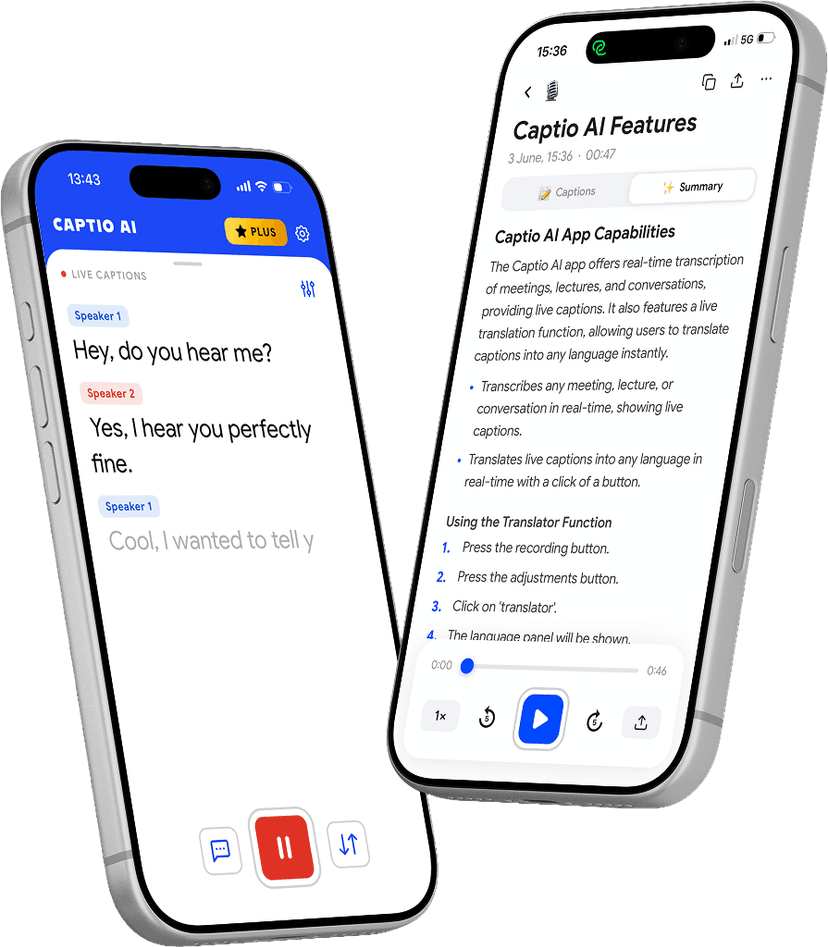
Everything you need to follow Chinese TV & media
Four tools built for deaf and hard of hearing Chinese speakers.
Captions anything playing in real time
- Point the phone toward the speaker and read along
- Works on any TV, laptop, tablet, or phone
- No subtitle file required — captions from the audio directly
- Faster than pre-generated subtitles for live content
Watch content in any language
- Foreign films, foreign news, foreign YouTube — all translated in real time
- They speak their language — you read in yours
- 60+ languages, no setup
- Works as content plays
Full transcript of any recording
- Upload a recording and get the complete written transcript
- For lectures, podcasts, talks, or any long-form content
- Searchable and copyable
- Any language, any format
Key points from any content
- Main ideas and takeaways from any transcript
- Useful for news, documentaries, and long-form content
- Organised into clear sections
- Works on any saved recording
Download for free
Every situation covered
Designed for the real moments that matter — not just quiet controlled environments.
CCTV live news and sport move faster than any pre-generated caption. Point Captio AI at your TV and read the Mandarin as it is spoken, not several seconds behind the broadcast.
iQIYI, Youku, and Tencent Video vary in subtitle quality and availability. Captio AI works as a consistent fallback for any Mandarin drama or film that ships with wrong, delayed, or missing captions.
Douyin, Bilibili, and short-video feeds are where most viewing happens — and captions there are inconsistent. Point Captio AI at your phone and read accurate Mandarin captions for any clip.
A foreign film, a foreign documentary, a non-Mandarin channel. Live Translator captions and translates in real time so anything becomes watchable in Mandarin as it plays.
Not every cinema showing is captioned. Hold Captio AI near the audio and read real-time Mandarin captions of the dialogue discreetly from your seat.
Most podcasts and audio shows have no transcript. Hold Captio AI near the audio or upload a recording, and read the whole Mandarin episode in writing.
Most accurate and fastest models
character accuracy
independent benchmark, 2025
real-time captions
first word appears as you speak
Download for free


Built for the content that subtitles fail
Captions any content in real time
Point the phone toward any speaker — TV, laptop, tablet, cinema screen. Captio AI captions whatever is playing, regardless of whether that platform provides subtitles.
Faster than built-in subtitles for live content
Pre-generated subtitles lag behind live TV by several seconds. Captio AI captions in real time — so you read what is being said as it is being said.
Works on any screen or device
No integration required. Point the phone toward the audio source — the same approach works for a large TV, a laptop screen, a cinema, or a phone held at arm's length.
Any language, translated in real time
For foreign-language content, switch to Live Translator. It translates as content plays — so a French film, a German documentary, or a Japanese series all become watchable.
No subtitle file needed
Captio AI captions from the audio directly. No subtitle file, no platform support, no creator requirement. If audio plays, Captio AI can caption it.
More accurate than auto-generated captions
The industry average for AI-generated subtitles is a 10–15% word error rate — roughly 1 in 10 words wrong (3Play Media). Captio AI is built for accuracy in real-world audio conditions.
Why Chinese is hard to understand
Tonal collapse
- Four tones the screen cannot show
- Mandarin distinguishes words by tone — the same syllable in four pitch contours means four different things. Tone lives in pitch, with no lip cue, so a deaf viewer watching a drama or a news anchor sees the mouth but gets none of the tonal information that separates one word from another.
Retroflex vs alveolar
- zh, ch, sh look identical to z, c, s
- Mandarin's retroflex initials and their alveolar counterparts produce nearly identical lip shapes, and syllables like zhi, chi, shi look the same on the mouth. On a fast variety show or a rapid news read, whole families of words become visually indistinguishable.
Homophone density
- So many same-sounding words that context is everything
- Mandarin has a small syllable inventory and huge numbers of homophones, resolved by context. In a dense drama or a documentary voiceover, a deaf viewer who misses the context has no way to reconstruct which of many identical-sounding words was meant.
Regional accents on TV
- Speakers bring their home province to the screen
- Chinese television and short video feature presenters and guests whose Mandarin carries southern, Sichuan, or northeastern colouring. A deaf viewer calibrated to standard Putonghua meets a new accent with every show, and the face on a phone screen is too small to lip-read anyway.
Chinese–English on screen
- English terms dropped into Mandarin content
- Variety shows, tech content, and vlogs drop English words and product names into Mandarin sentences without pause. A deaf viewer lip-reading Mandarin suddenly has to switch to English phonology for a term, then back, with no visual warning — impossible on a screen that has already cut away.
Download for free
Subtitles reach Chinese screens unevenly — and rarely in real time
China has around 27.8 million registered deaf and hard of hearing people, and broader assessments put the number with significant hearing loss far higher. Research with China's deaf community finds deep dissatisfaction with the limited availability of subtitled content on television and online, and a strong demand for more programmes to be captioned — and for verbatim captions that show exactly what was said, not a cleaned-up summary.
The same research finds that mobile devices, not the television set, are now the primary way the deaf community watches video — and short-video platforms, where most viewing happens, are precisely where captioning is least consistent. Real-time captions for live programming remain scarce, so live news and events are among the hardest content to follow, while regulation focuses on government broadcasts and sign-language news bulletins rather than the streaming and short-video content people actually watch.
Captio AI does not depend on the broadcaster or the platform. Point the phone at any screen — a CCTV news bulletin, an iQIYI drama, a Douyin clip — and read Mandarin captions in real time, verbatim, whether or not that content was ever captioned.
Download for free
What you hear stays with you.
Gone the moment it ends
Captio AI processes your audio in real time and discards it immediately. Nothing is recorded. Nothing is kept.
Not a product
Your conversations are not something Captio AI sells, shares, or monetizes — to anyone, for any reason.
Not used to train anything
What you say in a doctor's appointment or a job interview never ends up in a training dataset. Not ours. Not anyone else's.

Private by default
Captio AI supports 60+ languages
Download for free
Frequently asked questions
Watch anything in Chinese.
Captio AI is free to start
Download for free