

How to keep up in university lectures with hearing loss
Register with disability services early, ask for captioning and a note-taker, sit where you see the lecturer. US and Great Britain rights, plus phone captions.
 Nate from Captio AI8 min read
Short answer
To keep up in university lectures with hearing loss, register with your disability services office before term and ask for the aids you need, such as real-time captioning and a note-taker [1][6]. Sit where you can see the lecturer and the screen, and ask for slides in advance [6]. In the US, Section 504 covers aids at colleges [2]; in England, Wales and Scotland the Equality Act 2010 applies, and in England the Disabled Students' Allowance helps [4][5][14].
20.5%3
of US undergraduates reported a disability in 2019-20, according to the National Center for Education Statistics
£27,7834
a year at most in Disabled Students' Allowance for undergraduates and postgraduates in England, which does not have to be paid back
430 million9
people worldwide need rehabilitation for disabling hearing loss, according to the World Health Organization
On this page
- What should you do before the first lecture?
- What are your rights in the US and in Great Britain?
- How many students does this affect?
- Where should you sit in a lecture hall?
- How do you read what is said and still take notes?
- Can you record a lecture, and what then?
- What about lectures in a second language or in a seminar?
- Which option fits which lecture?
You can keep up in university lectures with hearing loss by arranging support before term starts, choosing where you sit, using one or two ways to read what is said, and getting the content in writing afterwards. A lecture can be hard for a hard of hearing student because speech, slides and note-taking all compete for the same attention. The steps below follow the order you live them: before the first week, in the hall, and when you revise.
This is general information from the sources linked below, not legal advice. Your disability services office can tell you what applies at your own college.
What should you do before the first lecture?
Before the first lecture, contact your university's disability services office and say what you need. In the US, the Section 504 regulation for postsecondary education says colleges may provide auxiliary aids such as taped texts, interpreters or other effective methods2. The ADA.gov page on effective communication lists real-time captioning (also called CART) and a qualified notetaker among the aids for people who are deaf or have hearing loss1. Our CART article explains how captioners work.
A short checklist:
- Write down what is hard: lecture halls, seminars, labs, video clips in class, group work.
- Name the aids you want to try: real-time captioning, a note-taker, slides in advance, a microphone for the lecturer.
- Ask how long arranging each one takes, and ask for something in the meantime.
- Ask whether the college lets you record lectures yourself.
- Keep the replies in writing.
Asking early gives the college time to arrange things before your first lecture, as our suggestion.
What are your rights in the US and in Great Britain?
In the US, the rule that most college students rely on is Section 504 of the Rehabilitation Act, and its postsecondary regulation says a college may not impose rules that limit a student with a disability, and gives "the prohibition of tape recorders in classrooms" as its example2. The same regulation says colleges need not provide "individually prescribed devices" or "readers for personal use or study"2. Separately, ADA.gov says state and local governments must give "primary consideration" to the aid a person with a communication disability asks for, while businesses and nonprofits are encouraged to consult the person1. The page does not discuss universities directly, so ask your college which rule applies to it.
In England, Wales and Scotland, the Equality Act 2010 section 20 sets out a duty to make reasonable adjustments, and says a person under the duty is not entitled to make a disabled person pay any of the costs of complying5. Where information is provided, it says reasonable steps include providing it in an accessible format5. The Act applies to education through its Part 65. The legislation.gov.uk page marks the Act's extent as England, Wales and Scotland, so it does not cover Northern Ireland16.
England also has funding. GOV.UK says Disabled Students' Allowance (DSA) can cover non-medical helpers, such as a British Sign Language (BSL) interpreter or specialist note taker, plus specialist equipment4. Undergraduate and postgraduate students can get up to £27,783 a year, it depends on your individual needs and not household income, and you do not have to pay it back4. To apply, you must live in England and be eligible for full support from Student Finance England (a Tuition Fee Loan and a Maintenance Loan), and deaf students and students with a hearing impairment are among those named14. You can apply when you apply for student finance online15. If you study elsewhere in the UK, ask your own nation's student finance body, as our suggestion.
| Place | What the sources say | Source |
|---|---|---|
| US college | Section 504 regulation: aids such as taped texts and interpreters; no ban on tape recorders in classrooms | 2 |
| US, ADA.gov | Real-time captioning (CART) and a qualified notetaker are listed aids | 1 |
| England, GOV.UK | DSA (full support students in England) up to £27,783 a year for non-medical helpers and equipment; no repayment | 4 |
| England, Wales, Scotland: Equality Act | Duty to make reasonable adjustments; you cannot be charged for them | 5 |
How many students does this affect?
The National Center for Education Statistics (NCES) reports that 20.5% of US undergraduates had a disability in 2019-203. Its table does not split that figure by type of disability, so it does not say how many of those students have hearing loss3. Worldwide, the World Health Organization (WHO) says over 5% of people, or 430 million, need rehabilitation for disabling hearing loss9. Whatever the exact number in your lecture hall, you are unlikely to be the only student asking.
Where should you sit in a lecture hall?
In a lecture hall, sit where you can see the lecturer's face and the board or screen at the same time. Reed College advises that a deaf or hard of hearing student be allowed to sit where they can most easily see the lecturer and the board or screen simultaneously6. Carleton University adds that interpreters sit or stand at the front, so the student can see both the instructor and the interpreter7. For labs, Carleton asks instructors to give you a station with an unobstructed view of the area where introductions and summaries are given7.
Tell the lecturer in the first week what helps. Reed College also asks instructors to use a microphone in large rooms and lecture halls6. If the lecturer paces or turns to the board, a polite reminder is reasonable, as our suggestion.
How do you read what is said and still take notes?
Most deaf and hard of hearing students cannot take notes while lip reading or watching an interpreter, so split the jobs. Reed College says this and lists note-takers as an accommodation6. Carleton University's centre hires a computer notetaker who types verbatim, real-time notes, and these notes are made available only to the student7. Ask for slides, lecture notes and handouts in advance too; Reed College recommends providing them whenever possible6.
The formal route may take weeks, and your first lecture is next week. A second channel on your own phone fills the gap. Captio AI, a live captioning app for deaf and hard of hearing people, shows speech as text while the lecturer is still talking, and its lectures page says you place the phone on your desk and start10. In a large hall it suggests pointing the phone at the PA speaker10.
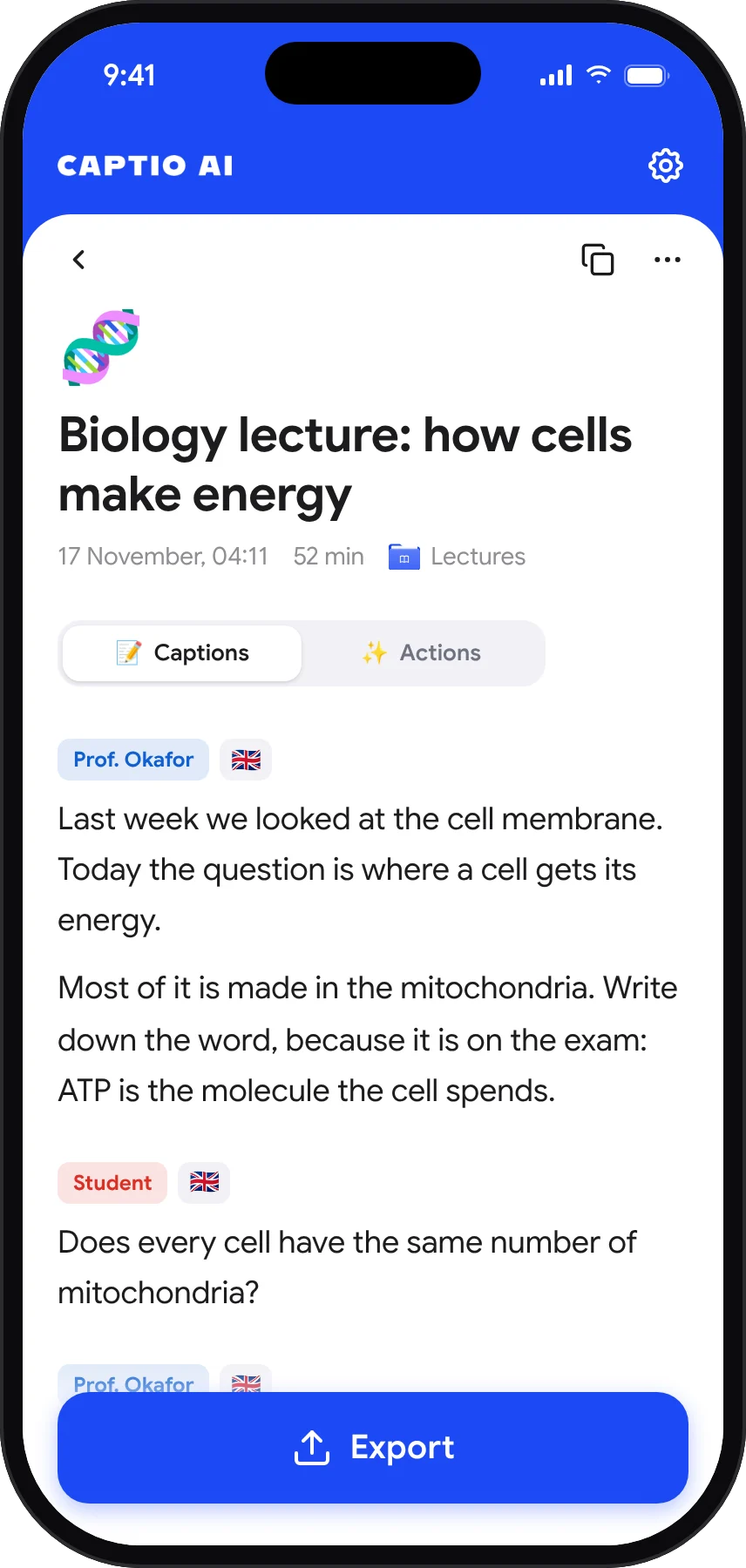
Some limits matter in a lecture. Live captions need an internet connection11. Captions can contain mistakes, so for names and technical terms add them in advance to Words and names, or fix a wrong word afterwards, as our guide to fixing wrong words explains. On iPhone, captions keep running with the screen locked; on Android, they pause when you leave the app. A phone propped on the desk is not a replacement for CART or a note-taker where you are entitled to one; use both if you have both.
Can you record a lecture, and what then?
You can ask to record lectures. In the US, the Section 504 regulation names "the prohibition of tape recorders in classrooms" as an example of a rule a college may not impose on a student with a disability2. The University of Manchester lists allowing disabled students to record lectures if necessary as a reasonable adjustment8. Rules differ between colleges and countries, so ask the lecturer and the disability office before you press record.
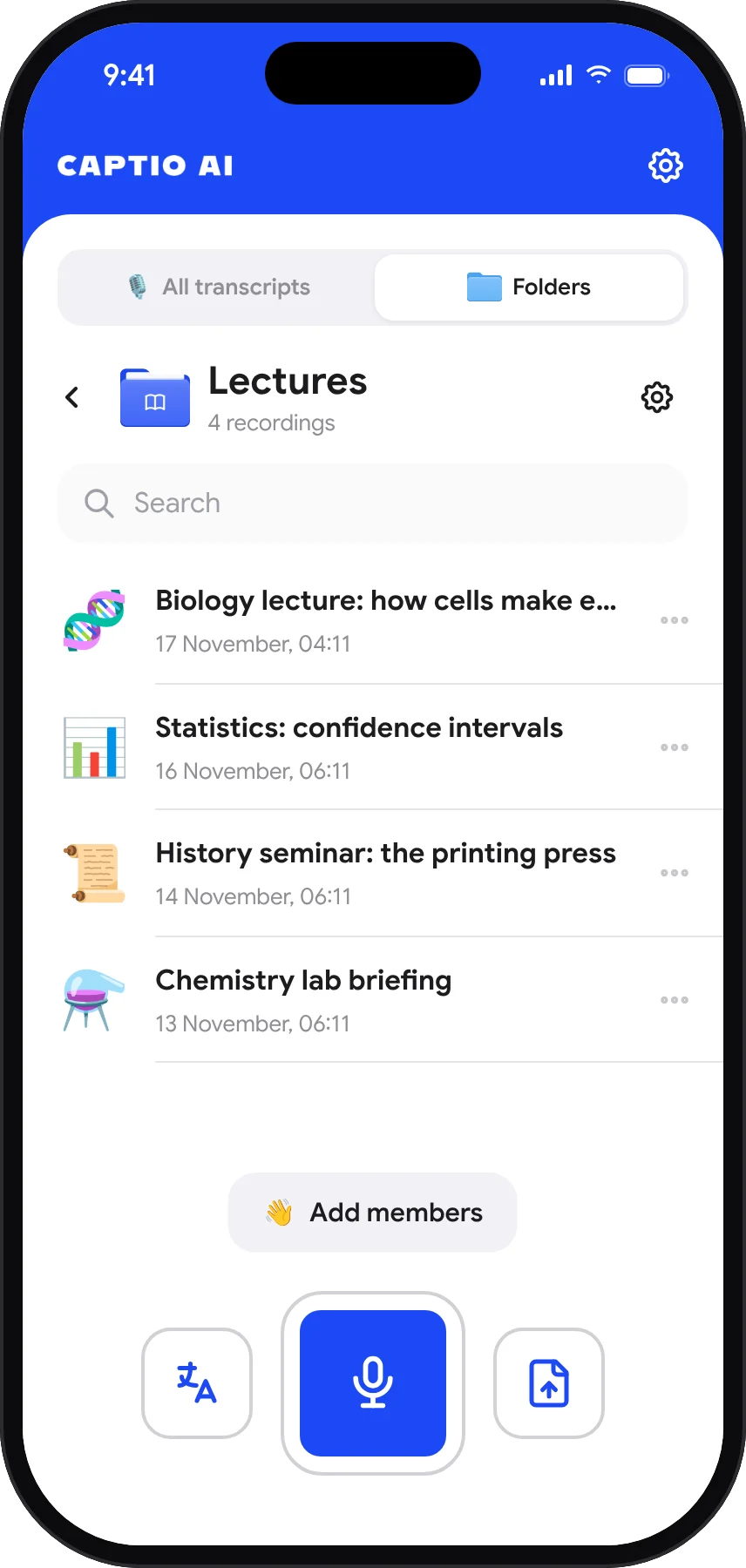
If you may record, Captio AI can record without an internet connection and transcribe the recording once the phone is back online. You can also upload an audio or video file and get a transcript12. From a transcript, Captio AI makes a Summary, Key points, Detailed notes, To-dos, Questions and answers or a Follow-up message; the free plan includes 3 AI results in total13. Read the AI Summary page for what each one does.
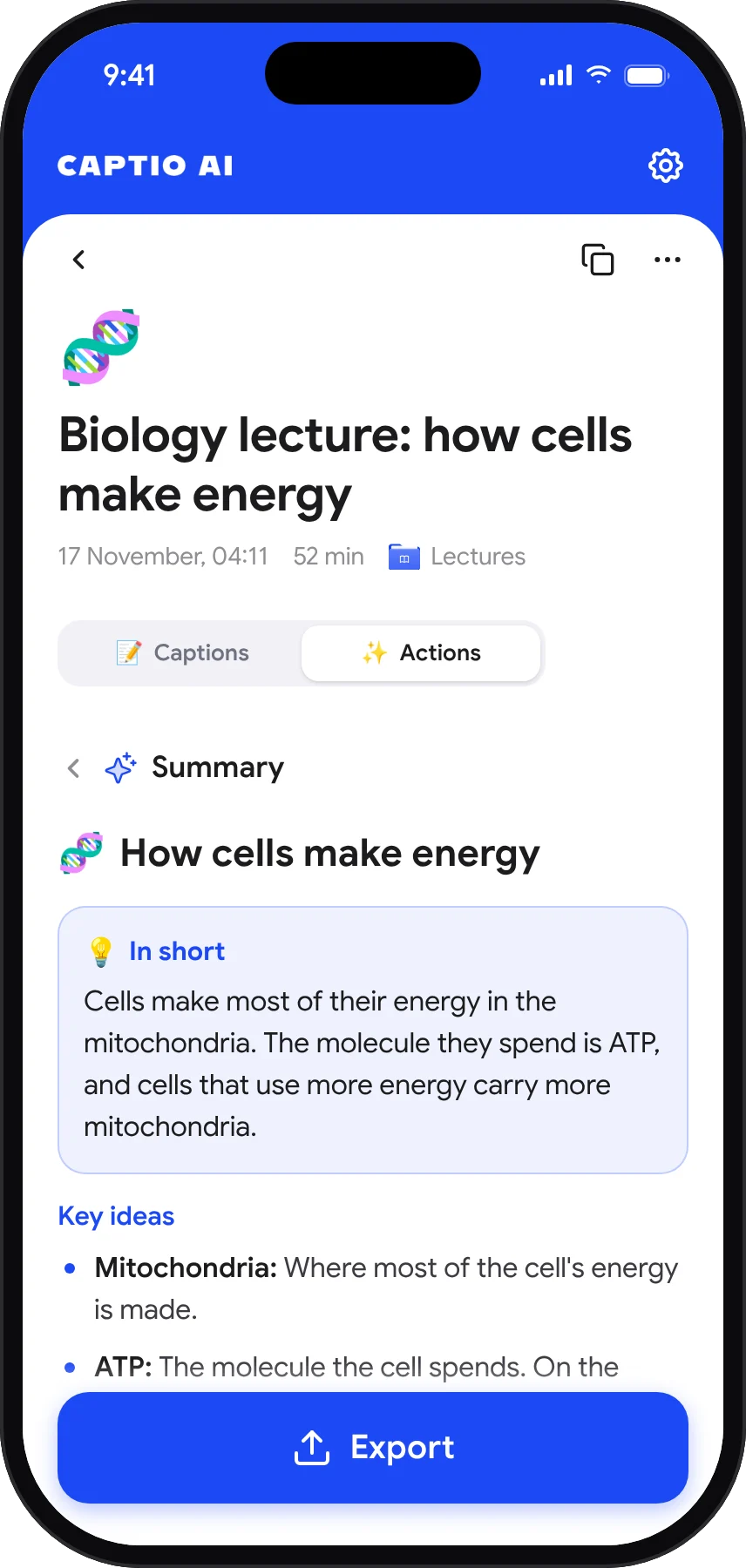
A summary is a memory aid, not a replacement for the lecture or the textbook. Check names, numbers and dates against the slides.
What about lectures in a second language or in a seminar?
If your lectures are in a language you are still learning, Live Translator translates speech in real time and the lectures page suggests it for courses taught in a second language10. See the lectures page for German as an example. In a seminar with several speakers, the speaker tags help you see who said what. Seminars are discussions, so ask the group to speak one at a time and repeat questions, as our suggestion.
Which option fits which lecture?
| Situation | What to try first | Why |
|---|---|---|
| Large lecture hall in the US | Ask the disability office for real-time captioning1 | CART is a listed aid; sit where you see the lecturer and screen together6 |
| Seminar in England, Wales or Scotland | Ask for reasonable adjustments5; in England, also apply for DSA for a note-taker414 | You cannot be charged for adjustments5 |
| Week one, support not yet arranged | Phone on the desk with live captions10 | Quick, no booking needed |
| Revising for an exam | Recording, transcript and summary1213 | Words to search and re-read |
| Lab with demonstrations | Ask for a station with a clear view7 | You can watch and read at the same time |
Captio AI is one tool among these. It does not replace a qualified captioner, interpreter or note-taker, and it is not a phone-call or video-call captioning service. Learn more about live captions for lectures and live captions on an iPad in a lecture.

Read what people say, while they say it
Captio AI puts live captions on your phone for conversations, appointments, lectures and meetings, in 60+ languages. Free to start. Private by default.
Frequently asked questions
What accommodations can a deaf or hard of hearing student ask for at a US college?
The Section 504 regulation for postsecondary education lists taped texts, interpreters and other effective methods as auxiliary aids [2]. ADA.gov lists real-time captioning (CART) and a qualified notetaker among the aids for people who are deaf or hard of hearing [1]. Ask your disability services office which ones your college offers.
Can I record lectures at university if I have hearing loss?
In the US, the Section 504 regulation gives a ban on tape recorders in classrooms as an example of a rule a college may not impose on a student with a disability [2]. The University of Manchester lists letting disabled students record lectures as a reasonable adjustment [8]. Ask your lecturer first and follow your college's recording rules.
Does the Disabled Students' Allowance pay for a note-taker in England?
GOV.UK says Disabled Students' Allowance can help with non-medical helpers, such as a British Sign Language interpreter or a specialist note taker, and that you do not have to pay it back [4]. Your support depends on your individual needs, not household income [4]. It is for students in England who qualify for full student support [14]. Apply when you apply for student finance in England [15].
Where should a hard of hearing student sit in a lecture hall?
Reed College advises that a student who is deaf or hard of hearing should be allowed to sit where they can most easily see the lecturer and the board or screen at the same time [6]. Carleton University adds that interpreters stand at the front so the student can see both [7].
Can I use Captio AI for lectures taught in another language?
Captio AI, a live captioning app for deaf and hard of hearing people, has a Live Translator that translates speech in real time, which its lectures page suggests for courses taught in a second language [10]. For a lecture in German, see the German lectures page. Captions can contain mistakes, so check key terms.
Do I need an internet connection for live captions in a lecture hall?
Captio AI needs an internet connection for live captions [11]. Without a connection it can still record, and the recording is transcribed when the phone reconnects. If the lecture hall has weak Wi-Fi, mobile data works too, as our suggestion.
Is Captio AI a replacement for CART or a note-taker at university?
No. Captio AI is one tool among your accommodations and does not replace a human captioner, a note-taker or an interpreter where you are entitled to one. The free plan has 100 free credits a day and 3 AI results in total, so ask your university about formal support as well.
Sources
- 1ADA Requirements: Effective CommunicationU.S. Department of Justice, Civil Rights Division (ADA.gov), 2020
- 234 CFR 104.44 Academic adjustmentsLegal Information Institute, Cornell Law School, 2026
- 3Number and percentage distribution of students enrolled in postsecondary institutions, by level, disability status, and selected student characteristics: Academic year 2019-20 (Digest of Education Statistics 2022, Table 311.10)National Center for Education Statistics, 2022
- 4Help if you're a student with a learning difficulty, health problem or disability: Disabled Students' AllowanceGOV.UK, 2026
- 5Equality Act 2010, section 20: Duty to make adjustmentslegislation.gov.uk, 2010
- 6Accessible Instruction for Students Who Are Deaf or Hard of HearingDisability & Accessibility Resources, Reed College, 2026
- 7Instructional Strategies: Students Who are Deaf or Hard of HearingPaul Menton Centre for Students with Disabilities, Carleton University, 2026
- 8Recording lecturesThe University of Manchester, 2026
- 9Deafness and hearing loss (fact sheet)World Health Organization, 2025
- 10Live captions for lecturesCaptio AI, 2026
- 11Live CaptionsCaptio AI, 2026
- 12Audio TranscriptionCaptio AI, 2026
- 13AI Summary and actionsCaptio AI, 2026
- 14Disabled Students' Allowance (DSA): EligibilityGOV.UK, 2026
- 15Disabled Students' Allowance (DSA): How to applyGOV.UK, 2026
- 16Equality Act 2010, section 217: Extentlegislation.gov.uk, 2010
Written by Nate from Captio AI. Published 17 November 2026. Every figure on this page links to its source. Spotted a mistake? hello@captioai.app