

How accurate are automatic captions? What the research shows
Automatic captions can miss twice as many words for some speakers: 35% vs 19% in a PNAS study. What noise, accents and rules mean in daily life.
 Nate from Captio AI9 min read
Short answer
There is no single accuracy for automatic captions. In quiet studio tests, systems made roughly 9 to 10 errors per 100 words in doctor-patient conversations [3]. With some speakers the error rate doubled: 35% for Black speakers against 19% for white speakers across five commercial systems [1]. Noise louder than speech pushed errors up sharply [2]. US rules set no percentage for captions [5].
35% vs 19%1
average word error rate for Black vs white speakers across five commercial speech recognition systems (US, 2020)
8.8% to 10.5%3
word error rates of four speech recognition engines on 36 primary care conversations re-enacted in a quiet studio
3 dB2
signal-to-noise ratio below which transcription errors rose sharply in a 2025 German emergency-dialogue test
On this page
- The numbers at a glance
- How accurate are automatic captions in a quiet room?
- Do automatic captions make more mistakes for some speakers?
- Do automatic captions work in a noisy restaurant or crowd?
- Does a low word error rate mean captions are good for deaf viewers?
- What does the law say about caption accuracy?
- Which use cases and countries do these numbers apply to?
- How can you get more accurate captions in practice?
- What is missing from the research?
Automatic captions have no single accuracy number. Studies that measured them found about 9 to 10 errors per 100 words in a quiet studio3, double that for some speakers1, and sharp drops when noise was louder than the voice2. For a deaf or hard of hearing reader, the useful question is how accurate the captions will be for this speaker, in this room, on these words.
The numbers at a glance
The table puts the measured error rates side by side. A word error rate (WER) counts substitutions, deletions and insertions, divided by the number of words actually spoken4. A WER of 0.10 means about 10 errors per 100 words.
| What was tested | Result | Source |
|---|---|---|
| Five commercial systems, white speakers (US interviews) | Average WER 0.19 | 1 |
| The same systems, Black speakers (US interviews) | Average WER 0.35 | 1 |
| Four engines on 36 primary care conversations, quiet studio | WER 8.8% to 10.5% | 3 |
| Six German systems, noise much louder than speech (-2 dB) | WER up by 0.196 against the study's reference level | 2 |
| Six German systems, restaurant or household chatter | WER up by 0.007 against roadside traffic noise | 2 |
| Six German systems, crowded public space such as a station | WER up by 0.079 against roadside traffic noise | 2 |
| A "99% accurate" caption, by a vendor's definition | At most 15 errors per 1,500 words | 7 |
These tests used different speech, languages and years, so do not compare one row with another as if they were a league table. Each row shows what one factor does.
How accurate are automatic captions in a quiet room?
In a quiet room, a study from the 2022 AMIA Annual Symposium of four speech recognition engines measured a word error rate of 8.8% to 10.5% on primary care conversations3. The researchers used 36 conversations, re-enacted by two native English speakers reading de-identified transcripts into a high-quality microphone in a quiet studio3. They wrote that their figures likely represent "an upper bound in potential performance" for real conditions3.
That is the best case in this article. Real doctor's appointments have a patient who mumbles, a nurse in the corridor and a computer fan.
Do automatic captions make more mistakes for some speakers?
Yes, they can. A study published in PNAS in 2020 tested speech recognition systems from Amazon, Apple, Google, IBM and Microsoft, and the average word error rate was 0.35 for Black speakers against 0.19 for white speakers1. The data came from interviews with 42 white speakers and 73 Black speakers, matched on age, gender and snippet length into 19.8 hours of audio in total1. Microsoft's system was the best overall, at 0.27 for Black speakers against 0.15 for white speakers, and Apple's the worst, at 0.45 against 0.231. Every system made roughly twice as many errors for Black speakers1.
The authors traced the disparity to the acoustic models, not the language models, and said the likely cause was too little audio from Black speakers in training1. The study is from 2020 and covers US English interviews, so it does not describe every system today or every accent. It does show that an overall accuracy number can hide who the captions fail.
In everyday conversations, a reader should expect the error rate to move with the speaker. The researchers also noted that adding non-native speakers or noise would likely raise errors in their test3. Both facts point the same way: test the app with the people you talk to most.
Do automatic captions work in a noisy restaurant or crowd?
Noise louder than the voice does the most damage, and the type of noise matters. A 2025 study from Bern University of Applied Sciences tested six German-capable systems on 99 synthetic emergency dialogues, overlaid with four noise types at five signal-to-noise ratios (SNR), giving 1,980 noisy samples2. Performance stayed stable until about 3 dB SNR, below which it fell sharply, and at -2 dB, where the noise exceeded the speech, WER rose by 0.196 against the study's reference level2.
The type of noise changed the result:
- Background talking (indoor chatter such as restaurant or household conversation): WER up by 0.007 against the traffic-noise reference, close to traffic noise and the smallest difference of the three other noise types (the ambulance interior was +0.019)2.
- Large enclosed public spaces such as a train station: WER up by 0.079 against the same reference, the most damaging type2.
- System choice: one of the systems tested had a WER 0.518 higher than the best system in the study, a commercial one called recapp2.
For a restaurant in a German-speaking country, that is mixed news: the chatter of other tables was close to roadside traffic noise in this test (+0.007), while an echoing hall was the most damaging (+0.079). For a train station announcement in German, the test points to the hard case. The test used synthetic dialogues in German, not recordings of real conversations.
Distance helps because it raises the signal over the noise. The blog's guide on choosing the microphone for live captions on iPhone covers what to connect and when.
Does a low word error rate mean captions are good for deaf viewers?
No. In a 2024 study presented at the CHI conference, researchers tested four accuracy metrics (word error rate, weighted word error rate, ACE and ACE2) against how deaf, hard of hearing and hearing viewers rated live TV captions, and the correlation was weak4. The authors wrote that other factors besides accuracy affect user ratings, and that even high-quality captions were perceived to have problems4. Viewer comments named three concerns: errors within captions, difficulty in following them, and how they look4.
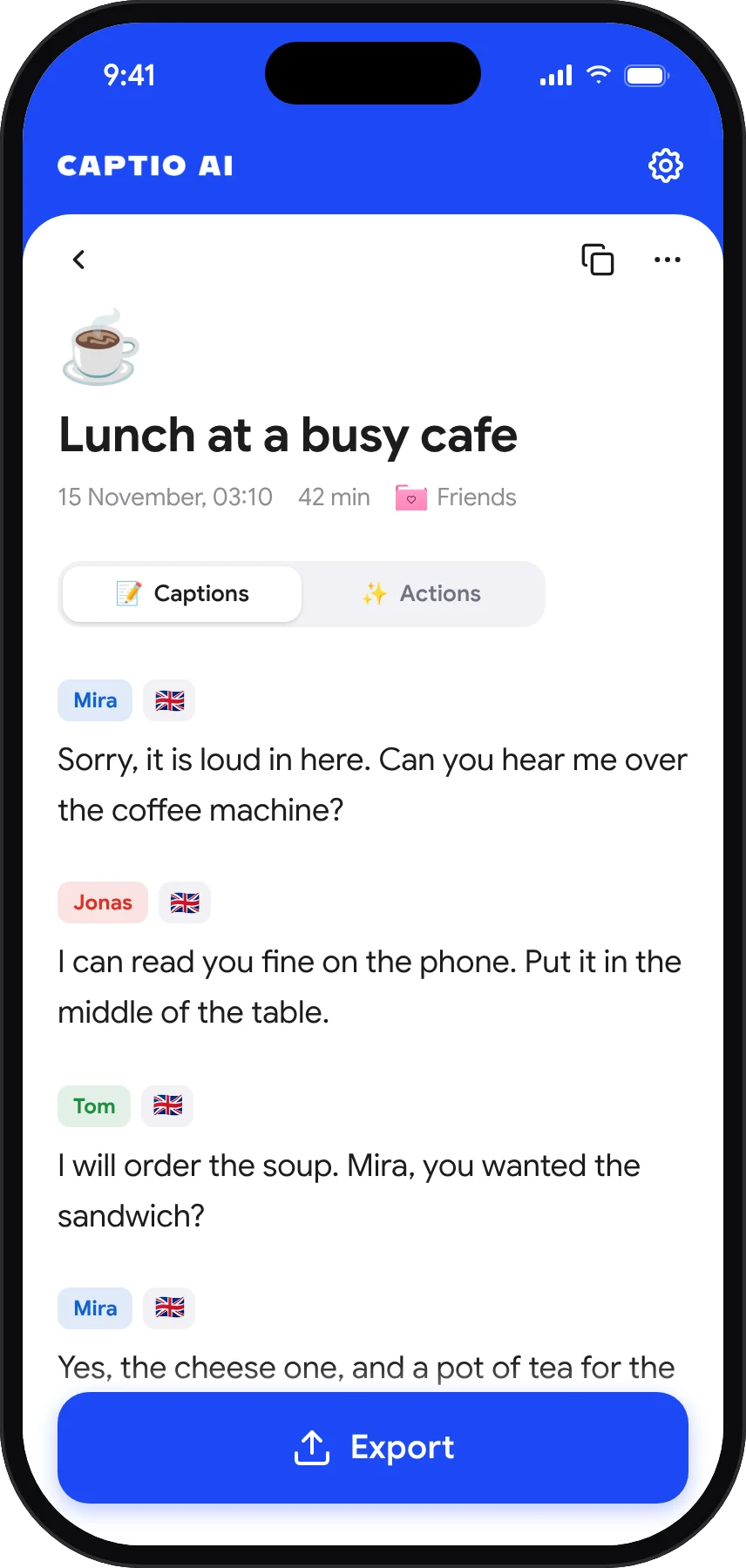
So a caption can score well and still be hard to read: too fast, badly placed, or missing who is speaking. For a group setting such as a family dinner, speaker names matter as much as the exact words. The explainer on speaker diarization in captions shows how names are added.
The same paper notes that Canada adopted a WER-based rule for captions and retracted it in 2016, because the targets were not achievable for live broadcasts4.
What does the law say about caption accuracy?
This section is legal information, not legal advice. For your own case, ask ADA.gov, a disability rights organisation or a lawyer.
US television rules set four quality standards and no accuracy percentage. The Federal Communications Commission (FCC) adopted standards for accuracy, synchronicity, completeness and placement in 2014, and described them as qualitative rather than quantitative5. Under the rule, captions "shall match the spoken words" in their original language, and paraphrasing is allowed only when needed to meet time constraints6. Live and near-live programming is judged case by case, looking at overall accuracy or understandability6.
These rules cover TV programming from video distributors, not captions made by an app or in a lecture hall. In the FCC proceeding, one commenter recommended 99% for post-production captioning and 98.5% for real-time captioning, and the FCC adopted no figure5.
The 99% number you see online is a vendor's definition. 3Play Media writes that 99% accuracy means 15 errors in 1,500 words, and that automatic speech recognition is "good, but not good enough to remove humans from the process"7.
For a US state or local government, the Americans with Disabilities Act (ADA) guidance says it must give primary consideration to the aid the person requests, and it describes real-time captioning as useful for people who are deaf or have hearing loss and do not use sign language8. If a captioner is the better fit for a conference or a long meeting, ask for one. The explainer on CART captioning says how.
Which use cases and countries do these numbers apply to?
The studies cover narrow settings, so the table says where each one applies.
| Use case | What the research says | Country and language | Source |
|---|---|---|---|
| Doctor's appointment | 8.8% to 10.5% WER in a quiet studio, likely a best case | US, English | 3 |
| Restaurant | Background chatter raised WER by only 0.007 against traffic noise | Test in German | 2 |
| Busy public space | Crowded enclosed spaces raised WER by 0.079 against traffic noise | Test in German | 2 |
| Everyday conversations | Error rate varied by speaker: 0.35 vs 0.19 | US, English | 1 |
| TV and media | Four standards, no accuracy percentage | US | 56 |
| Live TV captions | WER correlated weakly with viewer ratings | US viewers | 4 |
Nothing here measures captions in Spanish, Japanese or any language other than English and German. If a language is not in the table, no source in this article says how accurate it is.
How can you get more accurate captions in practice?
You cannot change the model, but you can change the signal and the vocabulary. These steps follow from the studies above:
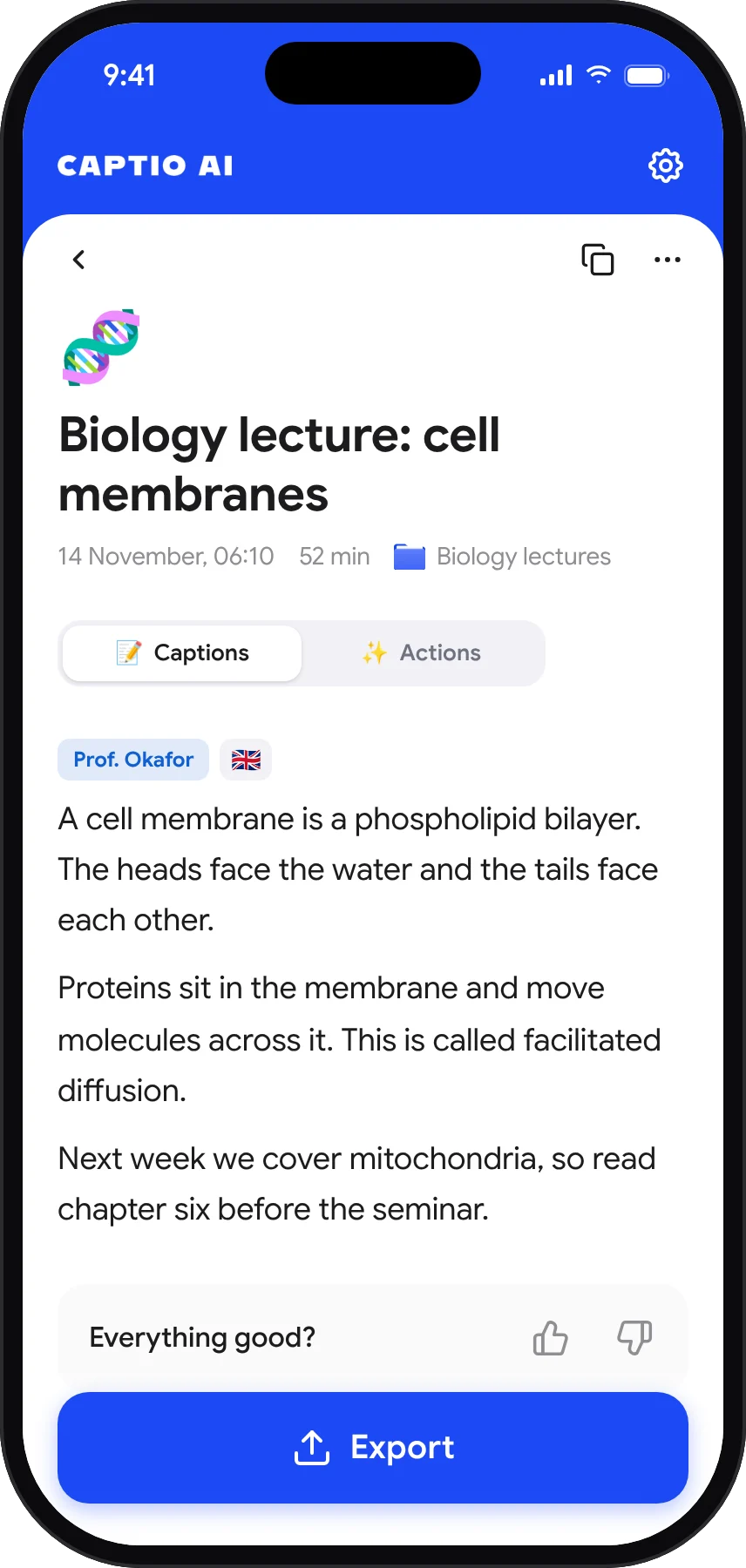
- Put the phone close to the speaker. A higher signal over the noise kept errors low in the German test until about 3 dB2.
- Pick the quieter spot. An echoing hall hurt accuracy more than chatter at nearby tables2.
- Tell the app the language and the names. Captio AI has a language hint so it starts tuned in from the first word, and a Words and names list for names, medical terms and specialist words9.
- Check the first sentences. If a speaker's words come out wrong from the start, move or ask them to face the phone.
- Fix the words that matter after the recording. In Captio AI, uncertain words are underlined and a long-press corrects a word everywhere in the recording. The guide on fixing wrong words in a transcript walks through it.
Captio AI, a live captioning app for deaf and hard of hearing people, shows speech as text word by word while the person is still talking, and needs an internet connection for live captions9. The free plan gives 100 free credits a day. It also separates speakers and lets you rename them. Its page for a language lists the regional varieties it supports, and no accuracy claim is made here beyond that.
For a comparison of apps on these criteria, see the best live caption apps for deaf people.
What is missing from the research?
The numbers above leave gaps a reader should know about:
- Newer systems. The PNAS study is from 2020 and the clinical study from 2022. Systems change quickly, and none of the studies tested Captio AI.
- Real rooms. The clinical test re-enacted conversations in a studio3, and the noise test used synthetic dialogues2.
- The UK. No UK source on caption quality is used here, so UK rules such as Ofcom's are not covered.
- Other languages and accents. The studies cover English and German only.
- Reading, not only hearing. Viewer ratings depended on more than accuracy4.
When a source does not say, this article does not say either.

Read what people say, while they say it
Captio AI puts live captions on your phone for conversations, appointments, lectures and meetings, in 60+ languages. Free to start. Private by default.
Frequently asked questions
Is 99% accuracy realistic for live automatic captions in a lecture?
The studies here did not show it. The best figures were 8.8% to 10.5% word error in a quiet studio, which is about 90% correct [3]. The 99% figure is a vendor definition of a high-quality caption, meaning at most 15 errors per 1,500 words [7]. For a lecture, ask the school about a human captioner; ADA.gov describes real-time captioning as an aid for people with hearing loss [8].
Do automatic captions work worse in a noisy restaurant?
It depends on the noise. In a German test, background talking such as restaurant or household chatter raised the word error rate by only 0.007 compared with the study's reference noise (roadside traffic), while crowds in large enclosed public spaces raised it by 0.079 [2]. Noise louder than the speaker did the most damage [2]. That is a German test with synthetic dialogues. A phone on the table close to the speaker helps in any restaurant.
Do automatic captions make more mistakes with accents?
They can. In a US study of five commercial systems, the average word error rate was 0.35 for Black speakers and 0.19 for white speakers [1]. The authors traced the gap to the acoustic models and linked it to too little audio from Black speakers in training [1]. Results for other accents were not part of that study.
Are automatic captions accurate enough at a doctor's appointment in the US?
Not as a replacement for effective communication. A quiet-studio test of patient-clinician conversations measured 8.8% to 10.5% word error, and its authors said real conditions would likely add errors [3]. Under the ADA, a US state or local government must give primary consideration to the aid the person asks for [8].
Does the FCC require a minimum accuracy for captions?
No percentage. The FCC's 2014 order set four standards (accuracy, synchronicity, completeness and placement) and described them as qualitative rather than quantitative [5]. The rule says captions must match the spoken words, with paraphrasing only when needed to meet time constraints [6]. These rules cover TV programming, not apps.
How can a German speaker or a Spanish speaker check caption accuracy in an app?
Read the captions against what you hear or what a friend confirms, and note which words fail: names, numbers and specialist terms are usual suspects. Captio AI lets you set the language to expect, add names and words, and correct a word everywhere in a recording. Its German page lists the regional varieties it supports.
Sources
- 1Racial disparities in automated speech recognitionProceedings of the National Academy of Sciences (PNAS), via PubMed Central, 2020
- 2Benchmarking speech-to-text robustness in noisy emergency medical dialogues: an evaluation of models under realistic acoustic conditionsJAMIA Open, 2025
- 3Automatic speech recognition performance for digital scribes: a performance comparison between general-purpose and specialized models tuned for patient-clinician conversationsAMIA Annual Symposium Proceedings, via PubMed Central, 2022
- 4How Users Experience Closed Captions on Live Television: Quality Metrics Remain a ChallengeACM CHI Conference on Human Factors in Computing Systems (arXiv preprint), 2024
- 5Closed Captioning of Video Programming, Report and Order (FCC 14-12)Federal Communications Commission, 2014
- 647 CFR 79.1 Closed captioning of video programmingLegal Information Institute, Cornell Law School, 2026
- 7What Is 99% Accuracy, Really? Why Caption Quality Matters3Play Media, 2021
- 8Effective CommunicationADA.gov, US Department of Justice, 2026
- 9Live CaptionsCaptio AI, 2026
Written by Nate from Captio AI. Published 15 November 2026. Every figure on this page links to its source. Spotted a mistake? hello@captioai.app