

UK hearing loss statistics 2026: 18 million adults, by age and nation
About 18 million adults in the UK have hearing loss, 12.3 million if you count both ears only. The main UK figures from RNID, CRIDE and census data, compared.
 Nate from Captio AI7 min read
Short answer
About 18 million adults in the UK, about 1 in 3, have some degree of hearing loss, counting one ear or both, according to a 2024 analysis by the Universities of Manchester and Nottingham that used 2021 and 2022 census data. Counting only milder loss in both ears or worse, the figure is 12.3 million, about 1 in 4 adults aged 18 to 80. Services reported 53,225 deaf children and young people in the UK in 2024/25.
18 million1
UK adults with hearing loss in one or both ears, an estimate published in 2024
12.3 million1
UK adults with hearing loss in both ears, milder loss included, about 1 in 4 aged 18 to 80
53,2254
deaf children and young people reported by UK education services in 2024/25
On this page
- The numbers at a glance
- Why do UK hearing loss figures say 12 million and 18 million?
- How common is hearing loss by age in the UK?
- What does this mean at a UK doctor's appointment?
- How many people have hearing loss in England, Scotland, Wales and Northern Ireland?
- How many people use British Sign Language in the UK?
- How many UK adults use hearing aids?
- What do the numbers mean for work and study in the UK?
- Which use cases do these UK numbers apply to?
- Where does a captioning app fit in?
About 18 million adults in the UK, 1 in 3, have some degree of hearing loss in one or both ears1. That is the newest estimate, published in 2024 in the International Journal of Audiology by Professor Kevin Munro of the University of Manchester and Professor Michael Akeroyd of the University of Nottingham. It replaces an older figure of about 12 million. This page puts the UK numbers side by side, explains why they differ, and says what each one means for daily life.
The numbers at a glance
The main UK figures differ because each counts something slightly different. Read the "what it counts" column before you quote one.
| Measure | Number | What it counts | Source |
|---|---|---|---|
| Adults with hearing loss, one or both ears | About 18 million (1 in 3) | Any degree, 2021 and 2022 census population | University of Manchester1 |
| Adults with milder loss in both ears or worse | 12.3 million (1 in 4 aged 18 to 80) | Both ears, milder loss included | University of Manchester1 |
| People deaf, with hearing loss or with tinnitus | Over 18 million (about 1 in 3) | Includes people with tinnitus only | RNID2 |
| Hearing loss that makes most conversational speech hard to hear | 2.4 million | Severity not defined on the page | RNID2 |
| Working-age people with hearing loss | 9 million | Any degree | RNID25 |
| Deaf children and young people | 53,225 (2024/25) | Reported by education services, permanent deafness, under 20 | CRIDE4 |
| People using British Sign Language (BSL) | 151,000, of whom 87,000 are deaf | Anyone who can communicate in BSL to any level | British Deaf Association, via RNID2 |
Why do UK hearing loss figures say 12 million and 18 million?
The UK figure rose from about 12 million to 18 million because RNID and the researchers changed what they count, not because hearing got worse. RNID says the new calculation uses 2021 and 2022 census population data instead of the 2011 census, counts milder hearing loss, and includes people with hearing loss in one ear only, who were left out before3. The Manchester release also gives a middle figure: 12.3 million adults, about 1 in 4 aged 18 to 80, when milder loss in both ears is included but one-ear loss is not1.
The authors warn that the survey data behind the hearing levels dates from the 1980s and may no longer match today, for example because of less heavy industry noise and a more ethnically diverse population1. RNID adds that these estimates are proxies, likely underestimates, and should not be used to decide who is eligible for support2. If you see "12 million" on an older page, it is the earlier method, not a different country.
How common is hearing loss by age in the UK?
Hearing loss in the UK becomes the majority experience after 60. RNID's figures show 45% of people over 40 have hearing loss, 55% over 50, 65% over 60 and almost 80% of those aged 70 and over2. These shares come from RNID's calculation based on the 1995 National Study of Hearing, applied to current population projections2.
For an older adult at a GP or hospital appointment, that means most people in the waiting room over 70 are likely to have some hearing loss. The NHS advises seeing a GP if hearing is gradually getting worse, and says some pharmacies and opticians offer free hearing tests9.
What does this mean at a UK doctor's appointment?
At a UK doctor's appointment, hearing loss is the norm for older patients: almost 80% of people aged 70 and over have it, and 65% of those over 602. The NHS says a GP can treat some causes and refer you to a hearing specialist if the cause is not treatable by a GP9. Once referred, four in ten patients wait longer than six weeks for an audiology assessment, according to RNID7.
How many people have hearing loss in England, Scotland, Wales and Northern Ireland?
RNID estimates over 14 million people in England, over 1.4 million in Scotland, nearly 850,000 in Wales and over 450,000 in Northern Ireland have hearing loss2. These apply UK-level rates to each nation's population, so they show scale rather than exact counts2.
Deaf children are counted differently, directly from education services, which makes the national split more reliable for young people [4]:
| Nation | Deaf children and young people, 2024/25 |
|---|---|
| England | 45,9024 |
| Scotland | 3,6494 |
| Wales | 2,1474 |
| Northern Ireland | 1,5274 |
| UK total | 53,225 (2% fewer than 54,321 in 2024)4 |
Scotland counts children under 19 and the other nations under 20. The Consortium for Research in Deaf Education says its figures need caution: half of the services in England only hold figures for children they support4.
How many people use British Sign Language in the UK?
Estimates of BSL users range from about 22,000 to over 150,000, depending on how the question is asked. The British Deaf Association estimates 151,000 UK people use BSL, 87,000 of them deaf2. The 2021 census found about 22,000 people in England and Wales using BSL as their main language, and Scotland's 2022 census found 117,300 people who can use it2. RNID says census data likely underestimate BSL use because of accessibility problems and question wording2.
BSL is recognised as a language of England, Wales and Scotland by section 1 of the British Sign Language Act 20228. The recognition does not by itself change other laws, and the Act places duties on the Secretary of State to promote and facilitate its use8. That is legal information, not legal advice.
How many UK adults use hearing aids?
Most UK adults who could benefit from hearing aids do not use them, and RNID's own estimates differ. Its prevalence page says over 10 million adults could benefit and only 3 million use them2. Its January 2025 audiology response says about 2 million of an estimated 8 million adults who could benefit use them7. The two pages give different totals, so treat both as rough27.
The same RNID response says audiology is among the worst-performing NHS specialities for diagnostic tests, with four in ten patients waiting longer than six weeks for an assessment7.
What do the numbers mean for work and study in the UK?
For a deaf employee or job candidate in the UK, the numbers describe a large group that is less likely to be in work. RNID estimates 9 million working-age people have some degree of hearing loss and says they are less likely to be employed than the general population5. Among working-age BSL users, only 37% are in employment, against 77% of non-disabled people6.
Employers must make reasonable adjustments so disabled workers are not substantially disadvantaged, and GOV.UK gives an audio-visual fire alarm for a deaf person as one example10. Access to Work can pay for communication support, and RNID says deaf people are among its largest user groups. In an RNID survey run with DeafATW, many people waited four months or more for a decision6. A job interview is often where the first adjustment is needed.
In education, UK services reported 53,225 deaf children and young people in 2024/25, and 64% of the 9,396 referrals to services in 2024 were for children identified as deaf after they had started statutory education4. For a student in a lecture, that points to hearing loss that is often found during school years, not at birth.
Which use cases do these UK numbers apply to?
Hearing loss touches every setting where people talk, and each has its own UK number to keep in mind.
| Situation | UK fact | Source |
|---|---|---|
| Doctor's appointments | Nearly 80% of people aged 70 and over have hearing loss; the NHS advises seeing a GP if hearing is getting gradually worse | RNID2, NHS9 |
| Meetings and work | 9 million working-age people with hearing loss; employers must make reasonable adjustments | RNID5, GOV.UK10 |
| Lectures and school | 53,225 deaf children and young people, 2024/25 | CRIDE4 |
| Everyday conversations | 18 million adults with hearing loss, 1 in 3 | University of Manchester1 |
| Group settings | 2.4 million have hearing loss that makes most conversational speech hard to hear | RNID2 |
Where does a captioning app fit in?
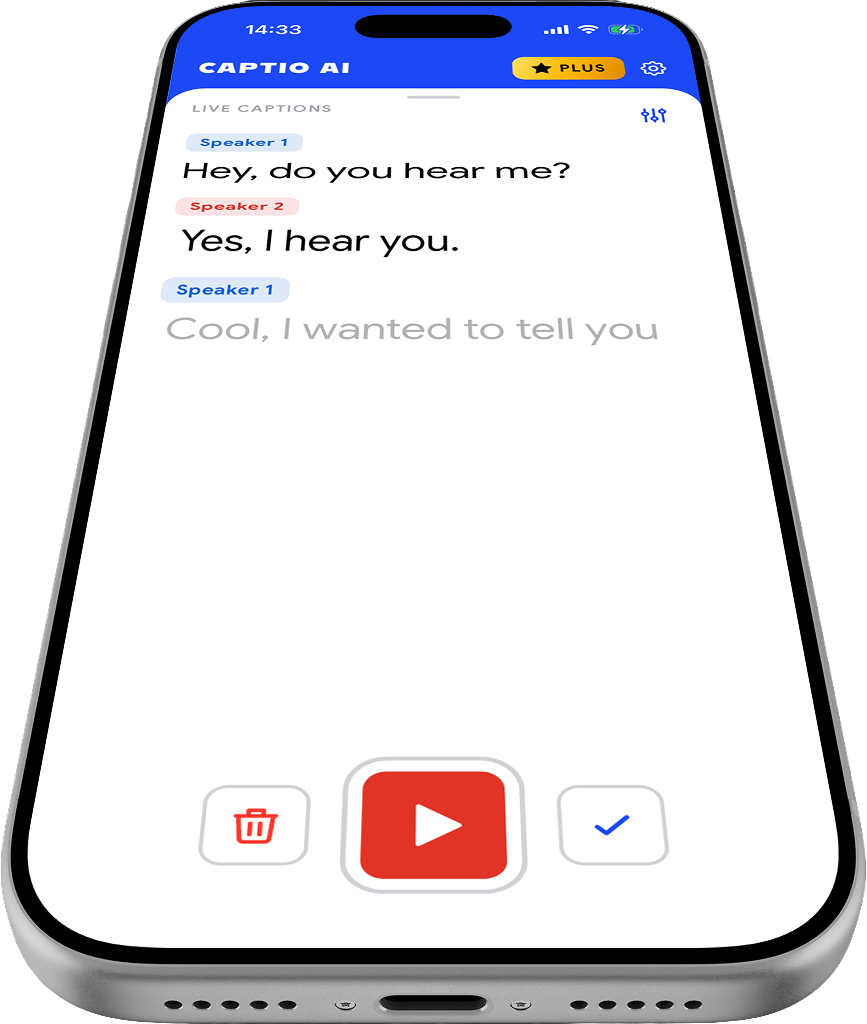
Captions are one tool among many, and a phone app does not replace a BSL interpreter, a hearing aid or an audiologist. In a UK doctor's appointment, Captio AI, a live captioning app for deaf and hard of hearing people, supports captions in English and shows what the person across the desk is saying as text while they speak, and you can add names and medical terms so they are recognised. The free plan gives 100 free credits a day. Captio AI works for in-person speech, needs an internet connection for live captions, and is not a phone-call service.
For worldwide and US figures, see how many people are deaf or hard of hearing and hearing loss statistics in the US.

Read what people say, while they say it
Captio AI puts live captions on your phone for conversations, appointments, lectures and meetings, in 60+ languages. Free to start. Private by default.
Frequently asked questions
How many people in the UK are deaf or have hearing loss?
About 18 million adults in the UK have some degree of hearing loss in one or both ears, according to a 2024 paper in the International Journal of Audiology. RNID adds people with tinnitus and says over 18 million people in the UK are deaf, have hearing loss or have tinnitus, about 1 in 3. The count is an estimate, not a register.
How common is hearing loss among people at a UK doctor's appointment?
RNID's figures show 45% of people over 40, 65% over 60 and almost 80% of those aged 70 and over in the UK have hearing loss, so many patients at a GP or hospital appointment are likely to have some. The NHS advises seeing a GP if hearing is gradually getting worse. This is general information, not medical advice.
Why did the UK figure change from 12 million to 18 million?
The people did not change; the way of counting did. RNID's earlier 12 million used the 2011 census. The 2024 recalculation uses the 2021 and 2022 censuses and also counts milder hearing loss and loss in one ear only. RNID says 6 million more people have not suddenly developed hearing loss.
How many people in the UK use British Sign Language?
It depends on the question. The British Deaf Association estimates 151,000 people in the UK use BSL, 87,000 of them deaf. The 2021 census found 22,000 people in England and Wales using BSL as their main language, and Scotland's 2022 census found 117,300 people who can use it. RNID says census data likely underestimate BSL use.
How many deaf children are there in the UK?
UK education services reported 53,225 deaf children and young people under 20 in 2024/25 (under 19 in Scotland): 45,902 in England, 3,649 in Scotland, 2,147 in Wales and 1,527 in Northern Ireland. The Consortium for Research in Deaf Education says the figures should be used with caution because services record deafness differently.
How many people in the UK use hearing aids?
RNID gives two estimates. Its prevalence page says over 10 million adults could benefit from hearing aids but only 3 million use them. Its January 2025 response on NHS audiology says about 2 million of an estimated 8 million adults who could benefit use them. Both show that most people who could benefit do not use hearing aids.
Is British Sign Language an official language in the UK?
British Sign Language is recognised as a language of England, Wales and Scotland under section 1 of the British Sign Language Act 2022. The Act also puts duties on the Secretary of State relating to promoting and facilitating its use. This is legal information, not legal advice.
How many working-age adults in the UK have hearing loss?
RNID estimates that 9 million working-age people in the UK have some degree of hearing loss, and says they are less likely to be employed than the general population. RNID also reports that only 37% of working-age BSL users are in employment, against 77% of non-disabled people.
Sources
- 1New analysis reveals 18 million people have hearing lossThe University of Manchester, 2024
- 2Deafness and hearing loss prevalenceRNID, 2026
- 3Why the number of people with hearing loss has increasedRNID, 2024
- 4CRIDE 2025 UK-wide summary: education provision for deaf children in 2024/25Consortium for Research in Deaf Education (NDCS and BATOD), 2025
- 5Employment factsRNID, 2026
- 6Access to Work: why reform can't waitRNID, 2026
- 7Reforming elective care: our response and the need to transform audiology servicesRNID, 2025
- 8British Sign Language Act 2022, section 1: Recognition of British Sign Languagelegislation.gov.uk, 2022
- 9Hearing lossNHS, 2026
- 10Reasonable adjustments for disabled workersGOV.UK, 2026
Written by Nate from Captio AI. Published 4 November 2026. Every figure on this page links to its source. Spotted a mistake? hello@captioai.app