

Hearing loss in Germany 2026: 1 in 3 adults report problems
32.5% of adults in Germany report hearing difficulties, 5.4% use a hearing aid and about 80,000 people are deaf. Main figures from RKI and Destatis, compared.

Short answer
32.5% of adults in Germany, nearly 1 in 3, report difficulties hearing, according to the Robert Koch Institute's 2019/2020 GEDA survey of 22,708 adults, published in August 2026. 5.4% use a hearing aid and 0.5% are deaf. The Deutscher Gehörlosen-Bund and the VdK estimate about 80,000 deaf people. No official register counts everyone with hearing loss, so every figure is a survey or estimate.
32.5%1
of adults in Germany report difficulties hearing, GEDA 2019/2020
50.5%2
of adults aged 80 and over in Germany report hearing difficulties
About 80,0006
deaf people in Germany, an estimate by the Deutscher Gehörlosen-Bund and the VdK
On this page
- The numbers at a glance
- How many adults in Germany have hearing difficulties?
- How does hearing loss in Germany change with age?
- What does this mean at a doctor's appointment in Germany?
- How many people in Germany use a hearing aid?
- Why do German figures say 16% and 32.5%?
- How many people in Germany are deaf?
- How many severely disabled people in Germany have a hearing impairment?
- Do deaf people in Germany have a right to a sign language interpreter in daily life?
- Which use cases do these German numbers apply to?
- Where does a captioning app fit in?
32.5% of adults in Germany, nearly 1 in 3, report difficulties hearing1. That is the newest national figure, from the Robert Koch Institute (RKI), Germany's public health institute, in a paper published on 19 August 202612. It comes from a survey, not a hearing test, and Germany has no register that counts everyone with hearing loss. This page puts the German numbers side by side, says what each one measures, and links them to daily life in Germany.
The numbers at a glance
The German figures differ because each counts something different. Read the "what it counts" column before you quote one.
| Measure | Number | What it counts | Source |
|---|---|---|---|
| Adults reporting hearing difficulties | 32.5% | Self-reported, GEDA 2019/2020, 22,708 adults | RKI12 |
| Adults using a hearing aid | 5.4% | Self-reported, same survey | RKI12 |
| Adults highly hard of hearing or deaf | 0.5% | Self-reported, same survey | RKI12 |
| Hearing loss by WHO classification | 16% | Estimate from the HÖRSTAT study, cited in the Gutenberg paper | Ärzteblatt International3 |
| People with hearing loss who wear a hearing aid | About 37% | Estimate by the authors of the Gutenberg paper | Ärzteblatt International3 |
| Deaf people | About 80,000 | Estimate by the Deutscher Gehörlosen-Bund and the VdK | bpb6 |
| People recognised as severely disabled through hearing loss | 307,480 (2023), about 0.4% of the population | Official recognition only, so likely too low | bpb6 |
How many adults in Germany have hearing difficulties?
32.5% of adults in Germany report hearing difficulties: 33.2% of men and 31.7% of women2. The figure comes from the 2019/2020 round of the survey "Gesundheit in Deutschland aktuell" (GEDA), which asked 22,708 adults2. The authors say they studied subjectively perceived hearing problems, which differ from measured hearing thresholds2. They also found hearing loss was more common among people with lower social support, poorer self-rated health and depressive symptoms1.
How does hearing loss in Germany change with age?
Hearing difficulties in Germany become the majority experience after 80. The RKI found 23.3% of adults aged 18 to 49 report them, 37.6% of those aged 50 to 79 and 50.5% of those aged 80 and over2. Even among adults under 50, almost 1 in 4 report difficulties2.
What does this mean at a doctor's appointment in Germany?
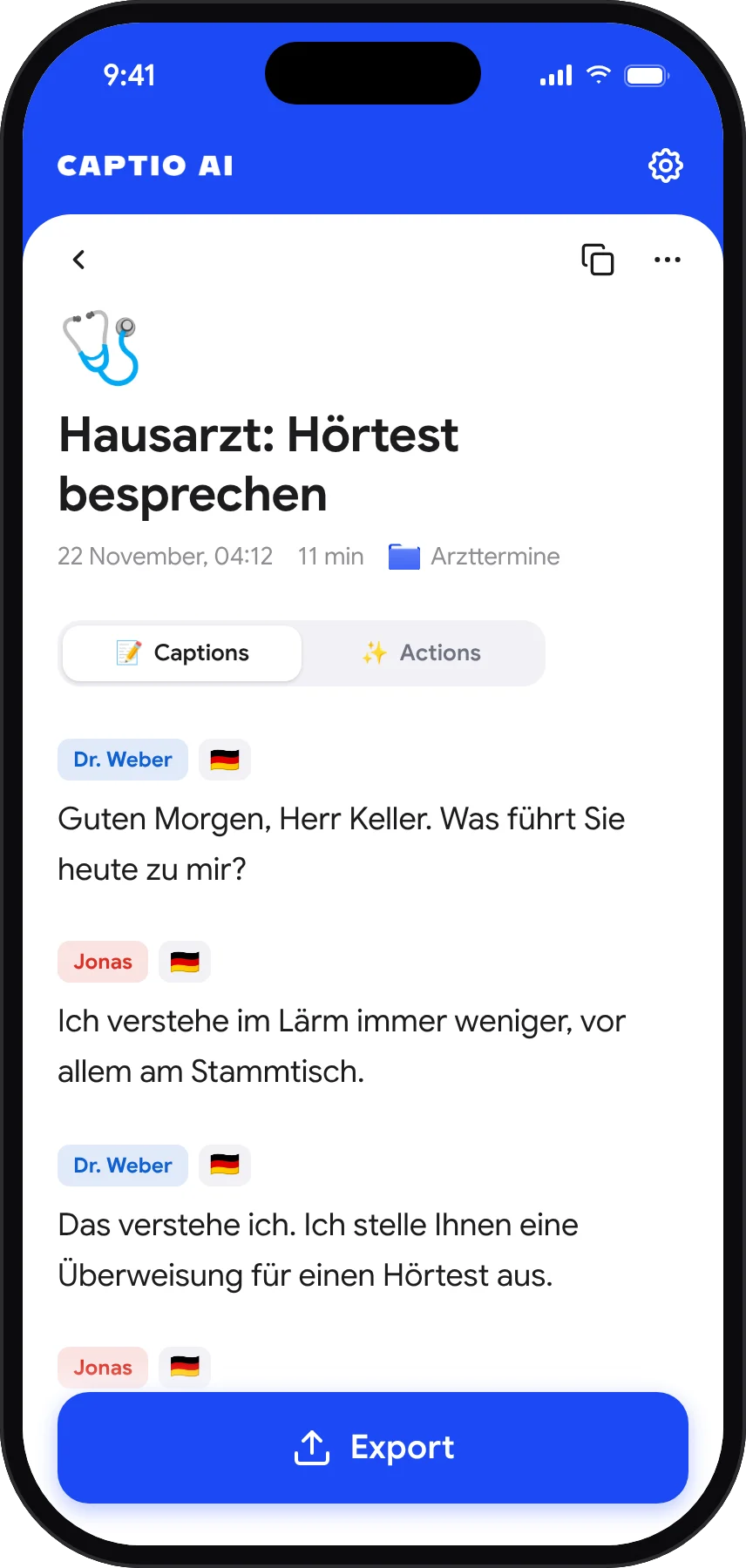
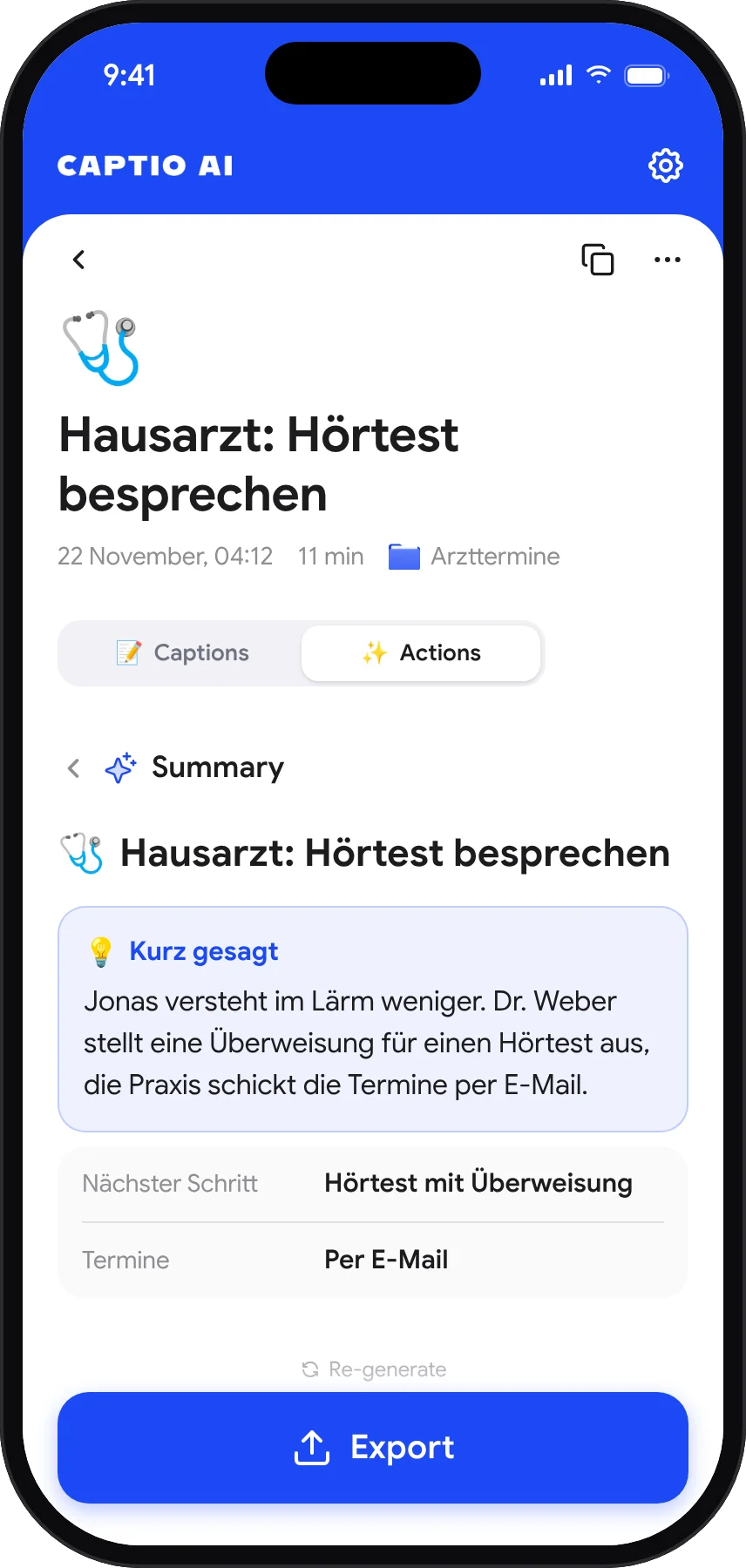
At a German doctor's appointment, hearing difficulties are common among older patients: 50.5% of people aged 80 and over and 37.6% of those aged 50 to 79 report them2. A patient who cannot follow the doctor may miss instructions. This is general information, not medical advice. For German speakers, the page on doctor's appointments in German explains how captions fit into a consultation.
How many people in Germany use a hearing aid?
5.4% of adults in Germany use a hearing aid, and the share rose significantly between 2009 and 201912. The RKI trend analysis covers 109,330 participants across five survey waves since 20092. The RKI authors conclude that national studies suggest hearing aids are underprovided1. The authors of the Gutenberg Health Study paper estimate that only about 37% of people with hearing loss in Germany wear one3. The two figures answer different questions: 5.4% is a share of all adults, 37% a share of people with hearing loss.
Why do German figures say 16% and 32.5%?
The German figure is 16% in one study and 32.5% in another because they measure different things. The RKI's 32.5% counts adults who say they have difficulty hearing2. The HÖRSTAT study, cited in the Gutenberg paper, estimated 16% with hearing loss by WHO classification, which rests on measured hearing levels3. The same paper cites another German estimate of 19% with a hearing level above 40 dB, and 2% of respondents owning a hearing aid3. If you see a single German number without its method, ask which one it is.
How many people in Germany are deaf?
About 80,000 people in Germany are deaf, according to an estimate by the Deutscher Gehörlosen-Bund (the German Deaf Association) and the Sozialverband VdK6. It is an estimate, not a count. The RKI survey found 0.5% of adults highly hard of hearing or deaf, a self-reported share that is much larger than 80,000 people16. The two figures use different definitions, so do not subtract one from the other.
German Sign Language (Deutsche Gebärdensprache, DGS) has been recognised as a language in its own right since 2002 by the Behindertengleichstellungsgesetz6. The sources opened for this page do not give a count of DGS users.
How many severely disabled people in Germany have a hearing impairment?
Destatis, the Federal Statistical Office, reports about 7.8 million severely disabled people in Germany at the end of 2025, 9.4% of the population4. 4% of them had hearing impairments, speech disorders or balance disorders4. At the end of 2023 the figure was about 7.9 million, 9.3% of the population, and the same 4% share45. Destatis says the two years are hard to compare because Hesse and Saxony cleaned up their administrative data, lowering their combined count by about 195,0004.
The Federal Ministry of Labour and Social Affairs gave 307,480 people with deafness or hearing loss for 2023, about 0.4% of the population6. That counts only people officially recognised as severely disabled through hearing, so the real number is higher6.
Do deaf people in Germany have a right to a sign language interpreter in daily life?
In one 2025 Berlin case, yes: the Sozialgericht Berlin ruled on 17 October 2025 that a deaf woman is entitled to sign language interpreting for everyday matters, not only special occasions7. The court based the claim on section 78 of Book IX of the Social Code (SGB IX), which covers taking part in community and cultural life, and set a reasonable scope of 8 hours a month7. The district social welfare office must pay7. The judgment was not final and could be appealed7. This is legal information, not legal advice; a Teilhabeberatung or a lawyer can look at your own case.
Which use cases do these German numbers apply to?
Hearing loss touches every setting where people talk, and each has its own German number to keep in mind.
| Situation in Germany | German fact | Source |
|---|---|---|
| Doctor's appointments | 50.5% of adults aged 80 and over report hearing difficulties | RKI2 |
| Everyday conversations | 32.5% of adults report hearing difficulties | RKI12 |
| Communication with deaf people | About 80,000 deaf people; DGS recognised since 2002 | bpb6 |
| Social participation | A 2025 Berlin ruling covers interpreting for everyday matters, 8 hours a month | Sozialgericht Berlin7 |
| Hearing aids | 5.4% of adults use one | RKI12 |
Where does a captioning app fit in?
Captions are one tool among many, and a phone app does not replace a sign language interpreter, a hearing aid or an audiologist. In a German doctor's appointment, Captio AI, a live captioning app for deaf and hard of hearing people, supports captions in German and shows what the person across the desk is saying as text while they speak. You can add names and medical terms so they are recognised. The free plan gives 100 free credits a day. Captio AI works for in-person speech, needs an internet connection for live captions, and is not a phone-call service.
For worldwide and other country figures, see how many people are deaf or hard of hearing, hearing loss statistics in the UK and hearing loss statistics in the US.

Read what people say, while they say it
Captio AI puts live captions on your phone for conversations, appointments, lectures and meetings, in 60+ languages. Free to start. Private by default.
Frequently asked questions
How many people in Germany have hearing loss?
It depends on how you count. The Robert Koch Institute's 2019/2020 survey found that 32.5% of adults in Germany report difficulties hearing. A study cited in a 2023 paper on the Gutenberg Health Study estimated 16% with hearing loss by WHO classification. Self-reported and measured figures are not the same thing, so quote the method with the number.
How many people in Germany are deaf?
The Deutscher Gehörlosen-Bund and the Sozialverband VdK estimate that about 80,000 deaf people live in Germany, according to the Federal Agency for Civic Education (bpb). The RKI survey found 0.5% of adults were highly hard of hearing or deaf. Germany has no official count of everyone who is deaf.
How many people in Germany use a hearing aid?
The RKI's GEDA 2019/2020 survey found that 5.4% of adults in Germany use a hearing aid, and the share rose significantly between 2009 and 2019. The authors of a 2023 paper on the Gutenberg Health Study write that an estimated 37% of people with hearing loss in Germany wear one.
How common is hearing loss among older patients at a doctor's appointment in Germany?
50.5% of adults aged 80 and over in Germany report hearing difficulties, and 37.6% of those aged 50 to 79, according to the RKI. In a German doctor's appointment, many older patients are therefore likely to have trouble hearing. This is general information, not medical advice.
Is German Sign Language an official language in Germany?
German Sign Language (Deutsche Gebärdensprache, DGS) has been recognised as a language in its own right since 2002 under the Behindertengleichstellungsgesetz, the federal law on equal treatment of disabled people, according to the Federal Agency for Civic Education. The sources found do not give a count of DGS users.
Do deaf people in Germany have a right to a sign language interpreter in everyday life?
A Berlin Social Court ruling of 17 October 2025 granted a deaf woman sign language interpreting for everyday matters, not only special occasions, set at 8 hours a month. The judgment was not yet final when published. This is legal information, not legal advice; ask a Teilhabeberatung or a lawyer about your own case.
How many severely disabled people in Germany have a hearing impairment?
Destatis reports about 7.8 million severely disabled people at the end of 2025, 9.4% of the population, and 4% of them had hearing impairments, speech disorders or balance disorders. The Federal Ministry of Labour and Social Affairs gave 307,480 people with deafness or hearing loss for 2023, about 0.4% of the population.
Can a live captioning app help with German speech at a doctor's appointment?
A live captioning app shows spoken German as text while the person talks. Captio AI, a live captioning app for deaf and hard of hearing people, supports captions in German and lets you add names and medical terms. It works for in-person speech and needs an internet connection. It does not replace an interpreter or your doctor.
Sources
- 1Prevalence and trends in self-reported hearing difficulties among adults in Germany: Results from the GEDA studyRobert Koch-Institut (RKI), edoc, 2026
- 2Fast jeder dritte Erwachsene berichtet über HörstörungenDeutsches Ärzteblatt, 2026
- 3Prävalenz von Schwerhörigkeit sowie Hörgeräteversorgung in der Gutenberg-GesundheitsstudieDeutsches Ärzteblatt International, 2023
- 47,8 Millionen schwerbehinderte Menschen leben in Deutschland (Pressemitteilung Nr. 246)Statistisches Bundesamt (Destatis), 2026
- 579 Millionen Menschen in Deutschland gelten als schwerbehindertÄrzte Zeitung, citing Destatis, 2024
- 6Internationaler Tag der GebärdensprachenBundeszentrale für politische Bildung (bpb), 2025
- 7Mit Gebärdensprachdolmetscherin zur Museumsführung: Gehörlose haben auch Anspruch auf TeilhabeSozialgericht Berlin, 2025
Written by Nate from Captio AI. Published 11 November 2026, last updated 22 November 2026. Every figure on this page links to its source. Spotted a mistake? hello@captioai.app