

Deaf, deaf or hard of hearing: what do the words mean?
Hard of hearing means mild to severe hearing loss, deaf mostly means profound loss, and capital-D Deaf is a cultural identity. WHO, NAD and RNID explain.
 Nate from Captio AI7 min read
Short answer
Hard of hearing describes hearing loss from mild to severe, and deaf mostly describes profound loss with very little or no hearing, according to the World Health Organization [1]. Capital-D Deaf is a cultural identity: people who identify with the Deaf community, its culture and a sign language [5]. Many people choose their own word, so the safest advice is to ask [4].
430 million1
people worldwide need rehabilitation for disabling hearing loss, WHO says
15%7
of US adults, 37.5 million, report some trouble hearing, NIDCD says
150,000+9
people in the UK use British Sign Language, 87,000 of them deaf, RNID estimates
On this page
- The words at a glance
- What does hard of hearing mean?
- What does deaf mean, and what does capital-D Deaf mean?
- What does late-deafened mean?
- Which words should you avoid?
- How do you know which word a person uses?
- Which words and tools fit which situation?
- How many people use each word?
- Where do captions fit?
"Hard of hearing" and "deaf" are not two names for the same thing. The World Health Organization (WHO) says hard of hearing refers to hearing loss ranging from mild to severe, and deaf people mostly have profound hearing loss, which means very little or no hearing1. A capital D adds a third meaning: culture and language, not decibels5. This guide explains each word, who uses it, which words to avoid in the US and the UK, and what it means for a doctor's appointment, a meeting or a lecture.
The words at a glance
The words below overlap, and people pick the ones that fit their own life. The table shows what each one usually describes and where that comes from.
| Word | What it usually describes | Source |
|---|---|---|
| Hard of hearing | Hearing loss from mild to severe | WHO1 |
| deaf (lowercase) | Mostly profound loss: very little or no hearing | WHO1, Ontario Association of the Deaf5 |
| Deaf (capital D) | Identity with the Deaf community, Deaf culture and sign language | Ontario Association of the Deaf5, NAD2 |
| Late-Deafened | Became deaf later in life | NAD2 |
| DeafBlind | Deaf, with some degree of vision loss | NAD2 |
| Hearing impaired | An older, well-meant term many people do not accept | NAD2, RNID4 |
What does hard of hearing mean?
Hard of hearing means a person has hearing loss somewhere from mild to severe, according to the WHO1. WHO says hard of hearing people usually communicate through spoken language and can benefit from hearing aids, cochlear implants and captioning1.
The line between "normal" and "loss" is itself a choice. WHO treats hearing thresholds of 20 decibels (dB) or better in both ears as normal hearing1. The Hearing Loss Association of America (HLAA) says people with normal hearing do not lose more than 25 dB, and it lists mild loss at 26 to 40 dB, moderate at 41 to 60 dB, severe at 61 to 80 dB and profound above 81 dB6. So two bodies can give slightly different cut-offs for the same words.
In the US, the National Institute on Deafness and Other Communication Disorders (NIDCD) reports that about 15% of adults, 37.5 million, report some trouble hearing7. Worldwide, WHO says over 5% of people, 430 million, need rehabilitation for disabling hearing loss1.
What does deaf mean, and what does capital-D Deaf mean?
Lowercase deaf is the medical and audiological term for little or no functional hearing, and capital-D Deaf is the sociological and cultural term. The Ontario Association of the Deaf puts it this way: Deaf describes people, medically deaf or hard of hearing, who identify with the Deaf community, Deaf culture and sign language5.
That is why the capital letter is not about how much a person hears. The National Association of the Deaf (NAD) says Deaf communities are diverse, with people who identify as Deaf, DeafBlind, DeafDisabled, Hard of Hearing and Late-Deafened, and that individuals can choose an audiological or cultural perspective2. The NAD also describes the deaf and hard of hearing community as a linguistic and cultural minority3.
Sign language matters here, but not every deaf person signs. WHO writes that some deaf people use sign language1. In the US, the NIDCD calls American Sign Language (ASL) the primary language of many North Americans who are deaf and hard of hearing8, and says 9 out of 10 children who are born deaf have parents who hear8. For more on how that plays out at home, read what dinner table syndrome is.
What does late-deafened mean?
Late-deafened is a term some people use to show they became deaf later in life, according to the NAD2. It sits in the NAD's list of identities in Deaf communities2. It is a reminder that a person's word follows their own story: someone who grew up hearing and lost most of their hearing as an adult may not call themselves Deaf, and may not know a sign language.
Which words should you avoid?
In the US and the UK, "hearing impaired" is the word most often named as one to leave out. The NAD says it was a well-meaning term that many deaf and hard of hearing people do not accept or use2. Its media guidelines call "deaf-mute," "hearing impaired" and "hearing disabled" outdated and inaccurate, and recommend "deaf," "hard of hearing," "deaf or hard of hearing" or "deaf and hard of hearing"3.
In the UK, RNID, the charity for deaf people and people with hearing loss, lists "deaf," "deaf people," "hearing loss" and "hard of hearing" as generally accepted terms, and asks writers to avoid "hearing impaired" and "the deaf"4. The NAD adds that for many people the words "deaf" and "hard of hearing" are not negative2.
| Country | Terms the organisation recommends | Terms it asks you to avoid |
|---|---|---|
| US (NAD) | deaf, hard of hearing, deaf or hard of hearing, deaf and hard of hearing3 | deaf-mute, hearing impaired, hearing disabled3 |
| UK (RNID) | deaf, deaf people, hearing loss, hard of hearing4 | hearing impaired, the deaf4 |
How do you know which word a person uses?
You ask them. RNID's advice on terms is "simple: just ask"4, because people's words differ and can change over a lifetime. Write the answer down once and use it.
A useful habit is to ask two things together: which word the person uses, and what helps them follow a conversation. The second answer is the one that changes what you do.
Which words and tools fit which situation?
The word a person uses tells you about identity, not about the tool they need. These situations come up most often, and the answer in each one is to ask the person first4.
- Everyday conversations and deaf and hard of hearing communication. Ask which word the person prefers, and whether they want you to face them, write things down or use captions. The deaf and hard of hearing communication use case covers the settings people name most.
- Doctor's appointments. Tell the clinic which word you use and what helps before you arrive. A sign language interpreter, a clear view of the clinician's face or live captions on a phone between you can each be the right answer for a different person. See doctor's appointments and the doctor's appointment guide.
- Meetings and job interviews. A colleague who says "I am hard of hearing" and a colleague who says "I am Deaf" may ask for different things, one captions and the other an interpreter. The work meetings guide lists the rights and habits that apply in the US and Great Britain.
- Lectures. A student who is hard of hearing may want captions of the lecturer, and a Deaf student may want a sign language interpreter. See lectures.
- Restaurants and group settings. At a table of several people, the same person may use captions on a phone and ask everyone to take turns.
How many people use each word?
No count separates "hard of hearing" from "deaf" cleanly, because the words describe both hearing and identity. What the sources do give is the size of the wider group and of sign language use.
| Measure | Number | Source |
|---|---|---|
| People worldwide who need rehabilitation for disabling hearing loss | Over 5%, 430 million | WHO1 |
| People worldwide projected to have some degree of hearing loss by 2050 | Nearly 2.5 billion | WHO1 |
| US adults who report some trouble hearing | About 15%, 37.5 million | NIDCD7 |
| People in the UK who are deaf, have hearing loss or have tinnitus | Over 18 million | RNID9 |
| People in the UK who use British Sign Language (BSL) | Over 150,000, of whom 87,000 are deaf | RNID9 |
| BSL users in the UK who use it as their main language | About 25,000 | RNID9 |
RNID separates anyone who can communicate in BSL at any level from the narrower group that uses it as a main language9. So most people counted in the 18 million are not BSL users. For the full picture by country, see how many people are deaf or hard of hearing.
Where do captions fit?
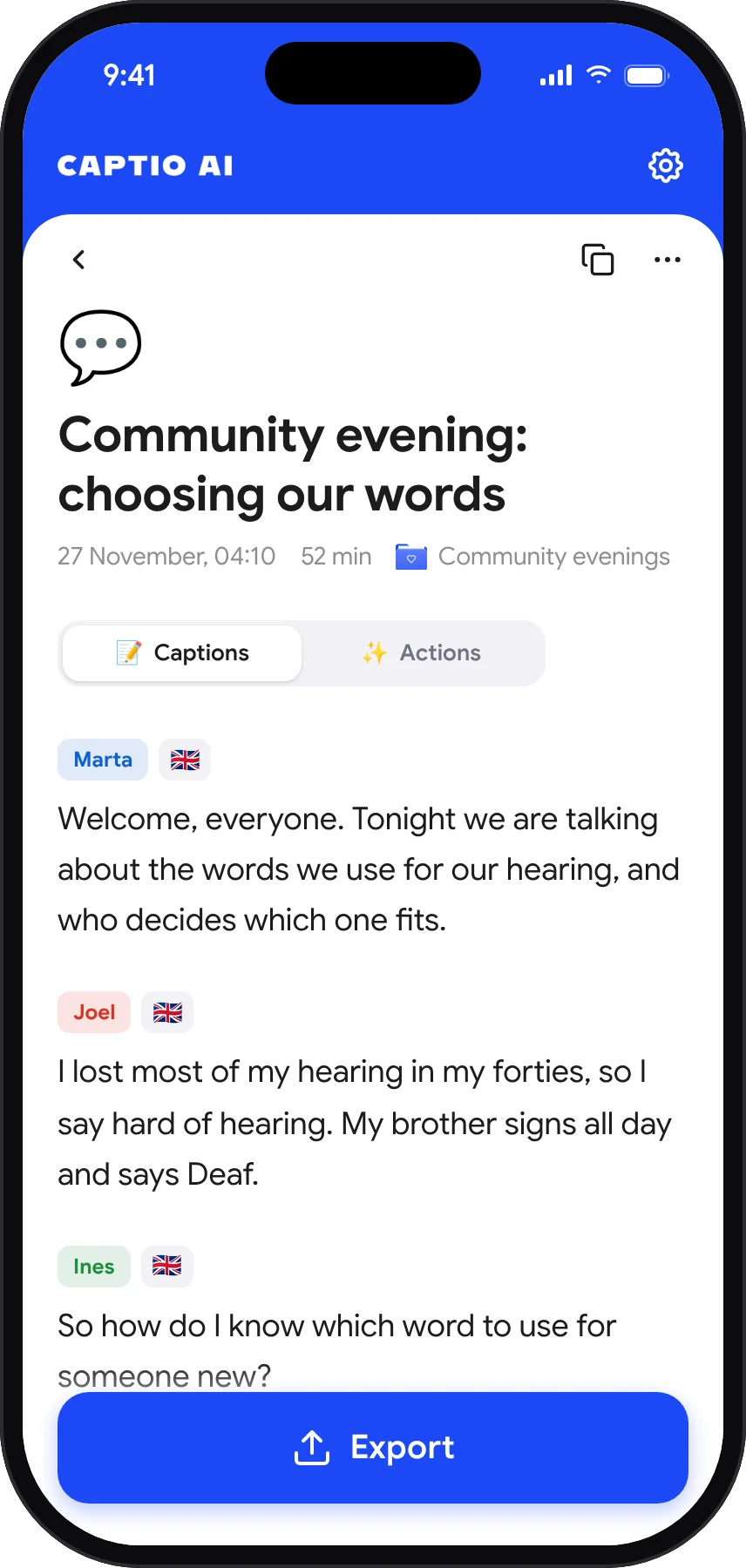
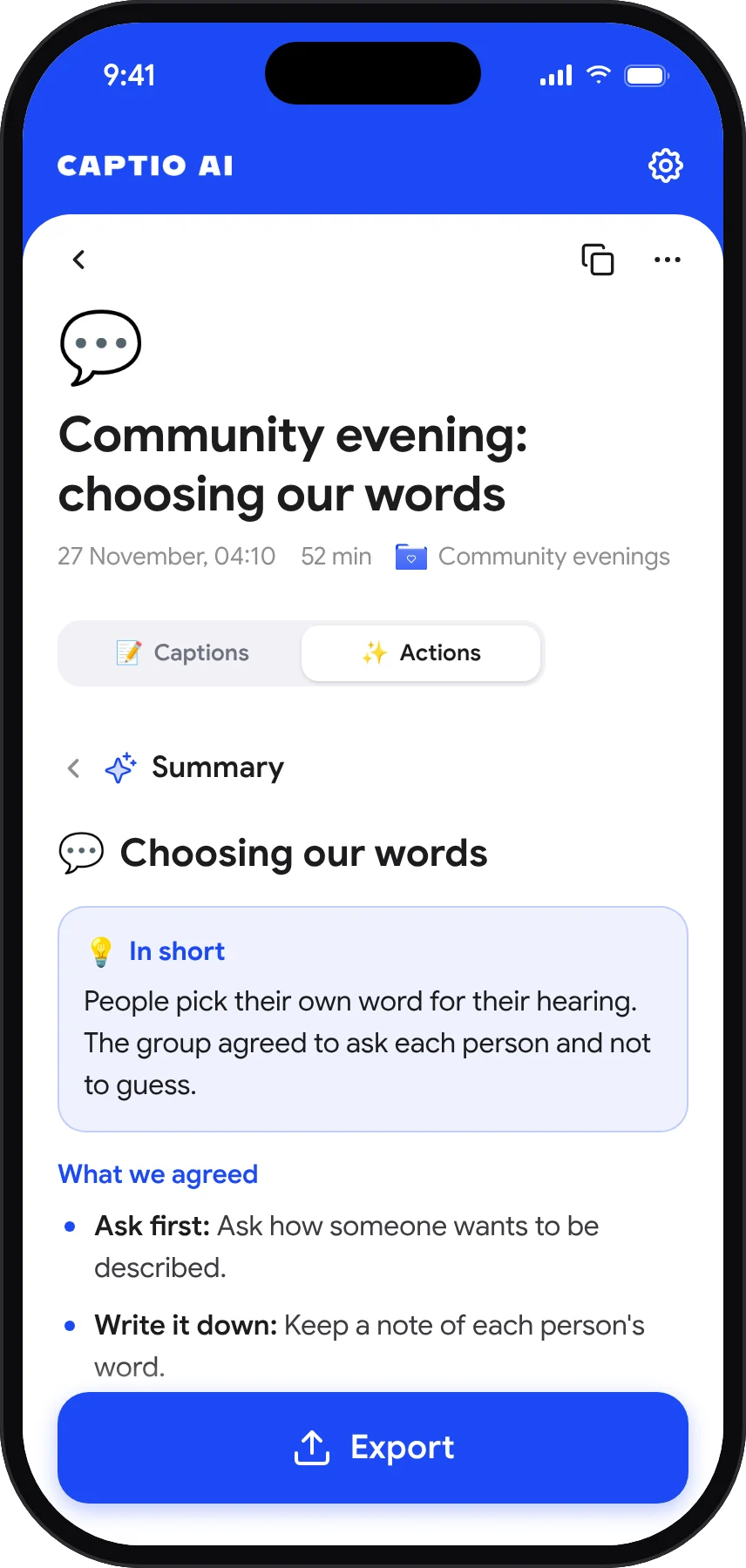
Captions are one tool, and the person who uses them decides whether they fit. Captio AI, a live captioning app for deaf and hard of hearing people, turns speech in the room into text on an iPhone or Android phone, with speaker labels, and needs an internet connection for live captions. It does not do sign language and is not a replacement for an interpreter where one is wanted. A person who calls themselves hard of hearing, late-deafened or Deaf can each use captions in some settings and not in others.
For where human captioners come in, read what CART captioning is.
This is general information, not medical advice. For a hearing test or help choosing hearing aids, see an audiologist or your doctor.

Read what people say, while they say it
Captio AI puts live captions on your phone for conversations, appointments, lectures and meetings, in 60+ languages. Free to start. Private by default.
Frequently asked questions
Is hard of hearing the same as deaf?
No. The World Health Organization (WHO) says hard of hearing refers to hearing loss ranging from mild to severe, while deaf people mostly have profound hearing loss, meaning very little or no hearing. The words describe different amounts of hearing, and some people use both words about themselves.
Why do people write Deaf with a capital D?
A capital D marks a cultural identity, not a hearing test result. The Ontario Association of the Deaf describes Deaf as a term for people, medically deaf or hard of hearing, who identify with the Deaf community, Deaf culture and sign language. Lowercase deaf is the medical and audiological term for little or no functional hearing.
Should I say hearing impaired in the US or the UK?
No. In the US, the National Association of the Deaf (NAD) says hearing impaired is a well-meaning term that many deaf and hard of hearing people do not accept. In the UK, RNID, the charity for deaf people and people with hearing loss, lists hearing impaired among terms to avoid and says to use deaf, hearing loss or hard of hearing.
What does late-deafened mean?
Late-deafened is a term some people use to say they became deaf later in life. The NAD lists Late-Deafened among identities in Deaf communities, next to Deaf, DeafBlind, DeafDisabled and Hard of Hearing. A person who became deaf as an adult may be a hearing aid user, a captions user or a sign language learner.
What should I say to a deaf person at a doctor's appointment?
Ask which word they use and what helps them follow the appointment, then do that. RNID's advice is simple: just ask. Some people want to lip-read with a clear view of your face, some want a sign language interpreter, and some want live captions on a phone placed between you and the clinician.
Do all deaf people use sign language in meetings or lectures?
No. WHO says some deaf people use sign language, not all of them. In the UK, RNID estimates over 150,000 people use British Sign Language (BSL), and 87,000 of them are deaf, a small share of the 18 million people in the UK who are deaf, have hearing loss or have tinnitus. Ask each person what they want for a meeting or lecture.
Does Captio AI work for deaf and hard of hearing people?
Captio AI, a live captioning app for deaf and hard of hearing people, shows speech from a conversation, a lecture or a meeting as text on the phone, with speaker labels, and needs an internet connection. It does not do sign language. Whether captions fit is the person's choice, as with any access tool.
Sources
- 1Deafness and hearing loss (fact sheet)World Health Organization, 2026
- 2Community and Culture: Frequently Asked QuestionsNational Association of the Deaf (NAD), 2026
- 3Guidelines for Media Portrayal of the Deaf CommunityNational Association of the Deaf (NAD), 2026
- 4Talking about hearing loss at workRNID, 2026
- 5Deaf TerminologyOntario Association of the Deaf, 2026
- 6Hearing Loss 101Hearing Loss Association of America (HLAA), 2026
- 7Quick Statistics About Hearing, Balance, & DizzinessNational Institute on Deafness and Other Communication Disorders (NIDCD), 2024
- 8What Is American Sign Language (ASL)?National Institute on Deafness and Other Communication Disorders (NIDCD), 2021
- 9Prevalence of hearing loss, tinnitus and British Sign Language in the UKRNID, 2026
Written by Nate from Captio AI. Published 27 November 2026. Every figure on this page links to its source. Spotted a mistake? hello@captioai.app