

Captions vs subtitles: what's the difference?
Captions carry speech and sounds for people who can't hear; subtitles translate for people who can. Rules from W3C, the FCC and Netflix side by side.
 Nate from Captio AI6 min read
Short answer
Captions are text for people who cannot hear the audio. They carry the speech and the non-speech sounds, such as speaker names and music. Subtitles are usually text for people who can hear but do not understand the language. The words overlap by region: the W3C says the two terms mean the same thing in different parts of the world [1], and the US and Canada keep them apart [3].
4 standards2
US television captions must be accurate, synchronous, complete and well placed under FCC rules
42 characters4
per line in Netflix's English SDH subtitle rules, with 2 lines at most
On this page
- What is the difference between captions and subtitles?
- Why do some countries use the two words differently?
- What does SDH mean?
- Are open captions different from closed captions?
- What do the rules require for captions on US television?
- Where do you meet captions and subtitles in daily life?
- Why do pre-recorded captions and live captions differ?
- Which one do you need?
Captions and subtitles are both text on a screen, but they answer different needs. Captions put the speech and the important sounds into text for someone who cannot hear the audio. Subtitles are usually written for someone who can hear and does not understand the language. The two words swap places in some countries, so look at what the text contains, not only what it is called.
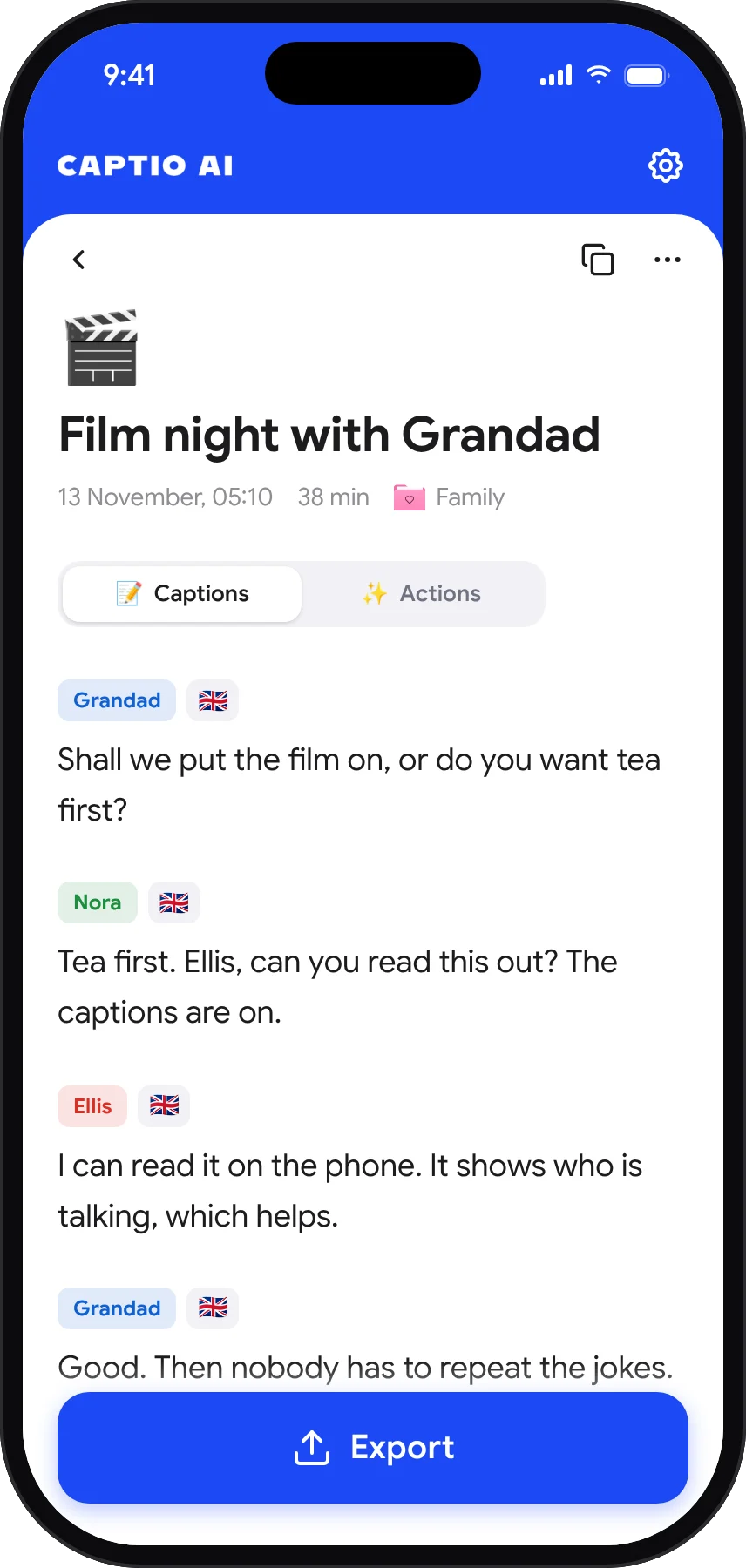
What is the difference between captions and subtitles?
The difference is the audience and what the text carries. The captioning company 3Play Media says that in the United States and Canada, subtitles are intended for hearing viewers who do not understand the language, while closed captions are designed for d/Deaf and hard of hearing audiences3. Captions convey all the audio, including sound effects and speaker identification3.
The World Wide Web Consortium (W3C) takes a wider view. Its accessibility initiative says the terms "captions" and "subtitles" are used for the same thing in different regions of the world1. It defines captions as a text version of the speech and non-speech audio information needed to understand the content1.
| Captions | Subtitles | |
|---|---|---|
| Written for | People who cannot hear the audio3 | People who can hear but do not know the language3 |
| Speech | Yes | Yes |
| Sounds, music, speaker names | Yes3 | Usually not |
| Language | Usually the spoken language | Often a translation |
| Accessibility aid | Yes1 | Not directly, when in another language1 |
Why do some countries use the two words differently?
Some countries use the two words differently because of local habit, not because the text differs. The W3C says the two terms are used for the same thing in different regions1, and 3Play Media says that in the UK and similar regions, subtitles also covers captions3. So the word on a menu does not tell you what the track contains. Check the label in the menu. If a service offers "English [CC]" or "English [SDH]", that is the track written for people who cannot hear.
What does SDH mean?
SDH means subtitles for the deaf and hard of hearing3. It is a subtitle file that carries what a caption carries, including music cues and sound effects, for viewers who cannot hear the dialogue3. Streaming services use it because their players show subtitle tracks.
Netflix, for example, publishes rules for its English SDH, with 42 characters per line and two lines at most4. Our article on sound descriptions in captions compares those rules with the FCC and DCMP ones.
Are open captions different from closed captions?
Open and closed describe whether you can turn the text off, not what it says. Closed captions can be hidden or shown by the viewer, and open captions are always displayed and cannot be turned off1. A cinema screening with burned-in text is open. A video where you tap a CC button is closed.
This is separate from the captions versus subtitles question. You can have closed captions in the same language as the audio, closed subtitles in another language, and open versions of both.
What do the rules require for captions on US television?
US television captions must meet four standards: accuracy, synchronicity, completeness and placement. The FCC rule at 47 CFR 79.1 says captioning shall match the spoken words in their original language2. It must also provide nonverbal information that is not observable, such as the identity of speakers, the existence of music, sound effects and audience reaction, to the greatest extent possible2.
Captions must coincide with the spoken words and sounds2, run from the beginning to the end of the program2, and not block other important visual content such as character faces2. The same section says open captioning or subtitles in the language of the target audience may be used instead of closed captioning in some cases2. This is a rule for television programming, not for a phone app.
The Described and Captioned Media Program (DCMP) gives the editorial side. Its Captioning Key says sound effects are "sounds other than music, narration, or dialogue", and that establishing who is speaking, on screen or off, is vital for clarity5.
Where do you meet captions and subtitles in daily life?
You meet them in television, lectures, travel, family evenings and appointments, and the right choice differs in each.
- TV and media: a deaf viewer needs the caption or SDH track, because it names who speaks and what is heard. A hearing viewer watching a foreign film uses subtitles. See TV and media.
- Lectures: a lecture hall has no caption track to switch on. The ADA lists real-time captioning among the aids for people who are deaf or have hearing loss6. For a student, live captions in lectures fill that gap.
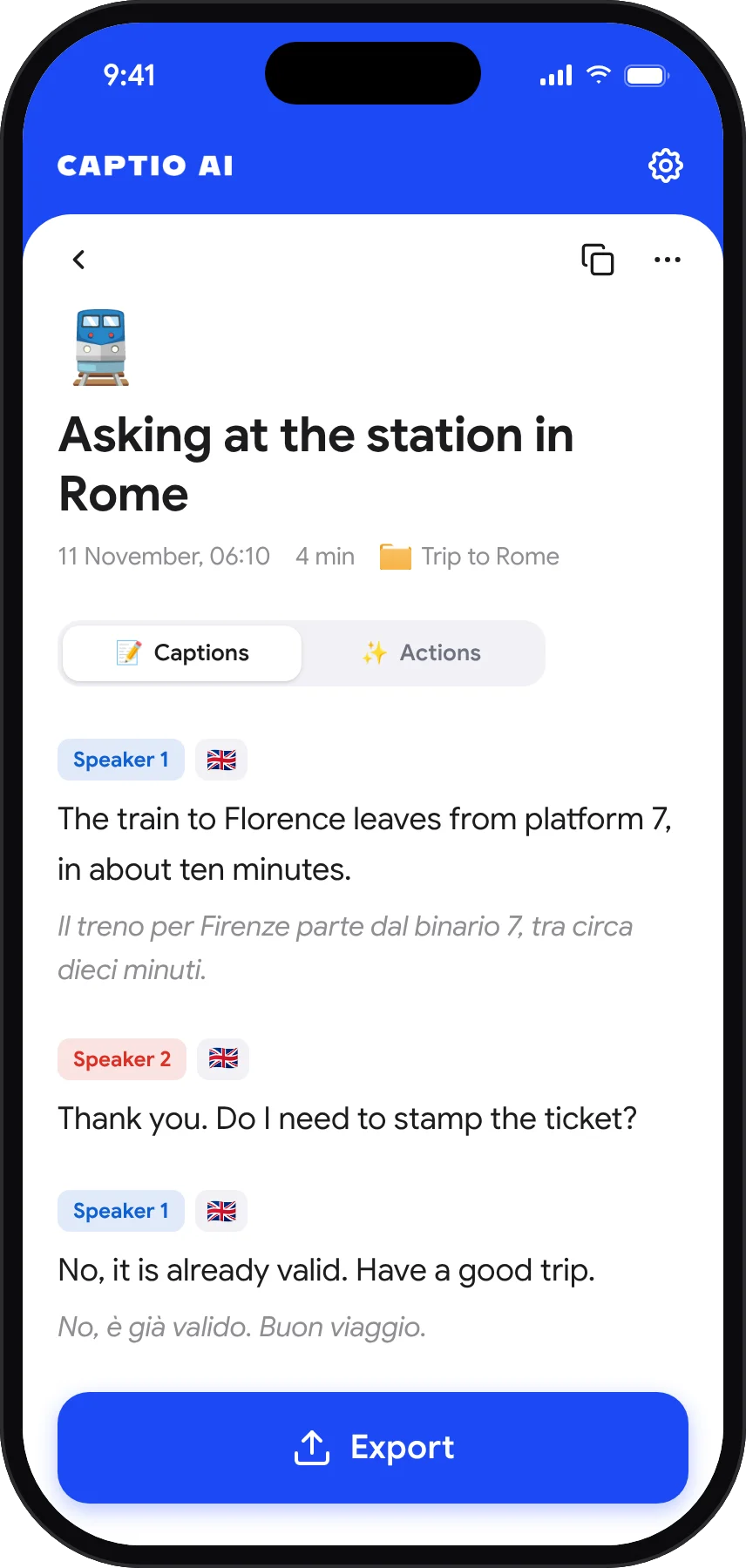
- Travel in Italy, Spain or Germany: a traveller who is hard of hearing and does not speak Italian needs both: the words in a language they read, and the confirmation of who said what. Live translation while travelling covers the first part.
- Family evenings and group settings: a pre-recorded film has captions, but the conversation around it does not. A phone on the table can caption the people in the room. See group settings and our guide on seeing who is talking.
- Doctor's appointments: there is no track to switch on in a consulting room. Our guide to following a doctor's appointment shows how to prepare.
Why do pre-recorded captions and live captions differ?
Pre-recorded captions are written and checked before you watch, and live captions are made as people speak. A film caption file is timed to the frame and edited for reading speed. Live speech has no file in advance, so the text appears as the words are said and may contain mistakes. You can fix a wrong word afterwards in a saved recording, as in our guide to fixing wrong words in a transcript.
Captio AI, a live captioning app for deaf and hard of hearing people, works on the live side. It turns speech in the room into text word by word on iPhone and Android. Speaker labels separate the people talking, and the Live Translator shows a translation next to the original captions. On iPhone, Recognize sounds also writes sounds such as [doorbell rings] into the captions, which brings live captions closer to what a caption file does for a film. It can miss sounds and is not an always-on alarm. See Live Captions and Live Translator.
Which one do you need?
You need captions if you cannot hear the audio, and subtitles if you hear it but do not know the language. Many people need both at once, such as a deaf traveller listening to a film in a language they do not read.
- Cannot hear the audio, same language: pick a track marked CC or SDH.
- Can hear the audio, different language: pick subtitles in your language.
- Cannot hear the audio, different language: pick SDH in your language if one exists, or a live translation.
- Live speech in a room: no track exists, so use a human captioner or a live captioning app.

Read what people say, while they say it
Captio AI puts live captions on your phone for conversations, appointments, lectures and meetings, in 60+ languages. Free to start. Private by default.
Frequently asked questions
Are closed captions the same as subtitles in the UK?
Mostly, yes. The W3C says the two terms are used for the same thing in different regions [1], and 3Play Media says that in the UK and similar regions, subtitles also covers captions [3]. In the US and Canada, subtitles are intended for hearing viewers who do not understand the language [3].
What does SDH mean on a streaming service in the US?
SDH stands for subtitles for the deaf and hard of hearing [3]. It is written for viewers who cannot hear the dialogue and includes cues such as music and sound effects [3]. Netflix's English style guide says plot-pertinent sound effects should always be included unless inferred by the visuals [4].
Do captions have to include sounds like a doorbell in US television?
For US television, yes, where the program allows it. The FCC rule says captioning shall provide nonverbal information that is not observable, including the existence of music, sound effects and audience reaction, to the greatest extent possible [2]. The rule covers TV programming, not captions made by an app.
What is the difference between open and closed captions at the cinema?
Open captions are always displayed and cannot be turned off, while closed captions can be hidden or shown by the viewer [1]. At a cinema or on a shared screen, open captions mean everyone sees the text. Closed captions need a setting, a device or an app.
Can I use captions for a lecture if I am hard of hearing?
Yes. The Americans with Disabilities Act (ADA) lists real-time captioning among the aids and services for people who are deaf or have hearing loss [6]. For a lecture, a school can provide a human captioner, and some students also use a phone app. Captio AI shows live captions word by word on iPhone and Android.
Is a translated subtitle the same as a caption for a deaf traveller in Italy?
No. A translation helps you understand a language, and does not tell you who spoke or what sound just happened. The W3C says subtitles in other languages are not directly an accessibility accommodation [1]. Captio AI's Live Translator shows live translation next to the original captions, which gives you both.
Sources
- 1Captions/SubtitlesW3C Web Accessibility Initiative (WAI), 2026
- 247 CFR 79.1 Closed captioning of video programmingLegal Information Institute, Cornell Law School, 2026
- 3What's the Difference: Subtitles for the Deaf and Hard of Hearing (SDH) vs Closed Captions?3Play Media, 2026
- 4English Timed Text Style GuideNetflix Partner Help Center, 2026
- 5Captioning KeyDescribed and Captioned Media Program (DCMP), 2026
- 6Effective CommunicationADA.gov, US Department of Justice, 2026
Written by Nate from Captio AI. Published 13 November 2026. Every figure on this page links to its source. Spotted a mistake? hello@captioai.app