

How to follow a doctor's appointment when you are hard of hearing
Tell the practice when you book, ask for written instructions and repeat back what you heard. A step-by-step plan, with US and UK rights explained.

Short answer
To follow a doctor's appointment when you are hard of hearing, tell the practice what you need when you book, give staff a written communication plan, ask for treatment details in writing and repeat back what you heard [2]. In the US, the ADA aims for communication that is equally effective [1]; in England, NHS services must follow the Accessible Information Standard [3]. Phone captions can add a second way to read what is said, as our suggestion.
no cost2
to the patient for the aids and services used in an outpatient visit, according to the Hearing Loss Association of America's guide
6 steps3
in the Accessible Information Standard as one NHS trust describes it for England: identify, record, flag, share, meet, review
430 million4
people worldwide need rehabilitation for disabling hearing loss, according to the World Health Organization
On this page
- What should you do before a doctor's appointment?
- What can you say, word for word?
- What are your rights at a doctor's appointment in the US and England?
- How do you follow the conversation in the consulting room?
- Which words and names should you prepare for a specialist appointment?
- How do you remember what was said after you leave?
- How many people does this affect?
- Which option fits which appointment?
You can follow a doctor's appointment when you are hard of hearing by sorting out communication before you arrive, using one or two ways to read what is said during the visit, and getting the important parts in writing before you leave. Each step below takes a few minutes and covers three moments: the booking call, the consulting room and the time after you leave.
This is general information drawn from the sources linked below. It is not medical or legal advice. Your doctor, your audiologist or a disability rights organisation can tell you what applies to you.
What should you do before a doctor's appointment?
Before a doctor's appointment, tell the practice you are hard of hearing and say exactly what you will need. The Hearing Loss Association of America (HLAA), a US consumer group, advises telling the receptionist that you are hard of hearing or deaf, saying what your communication needs are, and asking for the office manager's name in case you need help getting the services2.
A short checklist for the booking:
- Say that you are hard of hearing or deaf, and which aids you use: captioning, a sign language interpreter, a hearing loop or written notes.
- Ask whether you can fill in forms online, so you are not called to a desk and asked questions you cannot lip-read2.
- Repeat back the date and time, and ask for an email confirmation2.
- Ask for a text number or email address to use if you will be late2.
- If you use a captioned phone or relay operator, tell the receptionist that the call may take longer2.
HLAA also describes a Communication Access Plan (CAP): a written note of what helps you, which should become part of your medical record2. You can email or fax it ahead if the office allows2. Writing it once means you do not explain it at every visit.
What can you say, word for word?
Short scripts make the first minute easier. These are our wording, built on what the Hearing Loss Association of America (HLAA) suggests [2]:
- On the phone: "I am hard of hearing. For the appointment I will need captioning or an interpreter. Can you note that on my file and send a confirmation by email?"2
- At reception: "I am hard of hearing. Here is my communication plan. Could someone come and find me when it is my turn, or use a vibrating pager?"2
- In the room: "I have hearing loss. Could you write down the plan and the medicines? I will repeat back what I understood."2
- At the end: "Who can I contact with questions, and by text or email?"2
What are your rights at a doctor's appointment in the US and England?
In the US, the Americans with Disabilities Act (ADA) aims for communication with people who have disabilities to be "equally effective" as communication with people who do not1. The ADA.gov page on effective communication lists real-time captioning (also called CART) among the aids for people who are deaf or have hearing loss, and says it is particularly useful for those who do not use sign language1. It also says that in a doctor's office an interpreter will generally be needed for a patient who uses sign language1.
Who chooses the aid depends on the provider. Under the ADA, state and local government entities must give primary consideration to the aid the person asks for, while businesses and nonprofits are encouraged to consult with the person1. HLAA's guide adds that the services you use for an outpatient visit are at no cost to you, your family or your caregiver2. Ask the practice to confirm this for your case.
In England, NHS and adult social care services have to follow the Accessible Information Standard3. One NHS trust describes six steps: services ask about your communication needs at the earliest opportunity, record them in your health record, flag them for staff, share them when appropriate, make sure you get information in the format you need, and review them over time3. The standard is published by NHS England, and this description comes from a trust that follows it, so check NHS England's own page for the full wording. Its example of communication support is a British Sign Language (BSL) interpreter, and it names d/Deaf people among those who may need accessible information3.
| Place | What the sources say | Source |
|---|---|---|
| US doctor's office | Communication should be "equally effective"; real-time captioning is a listed aid | 1 |
| US outpatient visit | Aids and services are at no cost to the patient, per HLAA's guide | 2 |
| England, NHS | The Accessible Information Standard: identify, record, flag, share, meet, review | 3 |
These rules are legal information, not legal advice, and other countries have their own. If a practice refuses, an official disability rights body in your country is the place to ask.
How do you follow the conversation in the consulting room?
In the consulting room, tell the doctor you have hearing loss, hand over your plan, and check understanding by repeating things back. HLAA suggests the patient says they have hearing loss, asks questions until all are answered, and repeats back information to make sure it was understood2. It also suggests asking that the details of your treatment plan and medicines come in writing, and asking for a contact name and number for questions about your care2.
Three things from HLAA's list are easy to forget under stress:
- Ask whether a new medicine might make hearing, balance or tinnitus worse2.
- If you have a cochlear implant, tell the doctor before an MRI2.
- Ask staff to come and find you rather than call your name, or to use a vibrating pager2.
For the conversation itself, a second channel helps. Captio AI, a live captioning app for deaf and hard of hearing people, turns speech into text as people talk5. At a doctor's appointment, our suggestion is to ask the doctor if you may use it, then lay the phone on the desk between you. The captions label each speaker separately, so you know who said what5.
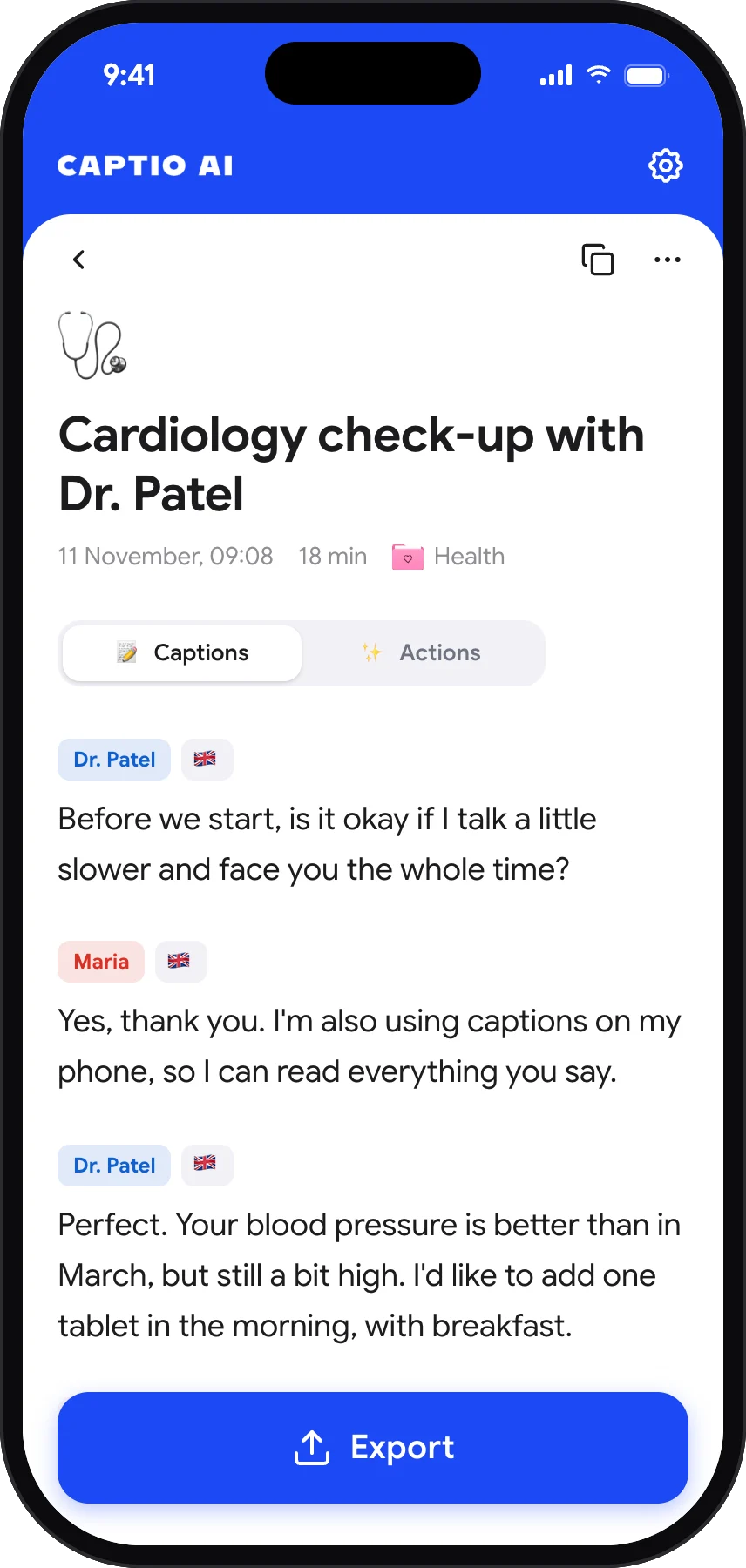
Two limits are worth knowing. Live captions need an internet connection, and offline captioning is not currently supported5. And captions can contain mistakes, so for drug names and doses, ask for the written version. If you know a long or unusual term is coming, you can add it to Words and names beforehand. Learn more on the Live Captions page.
Which words and names should you prepare for a specialist appointment?
For a specialist appointment, add the terms you expect to hear before you go, and write down your questions in advance. Unfamiliar condition and drug names are easy to get wrong when you only hear them once, as our suggestion. Captio AI lets you add your own terms so conversations are captioned more accurately5. This list of terms does not need to be long: three or four from your referral letter is a good start, as our suggestion.
How do you remember what was said after you leave?
After the appointment, rely on writing, not memory. HLAA recommends getting information about your treatment plan and medicines in writing2. If you used captions, you can save the recording as a transcript. Captio AI can also create a Summary, Key points, Detailed notes, To-dos, Q&A or a Follow-up message from a transcript, and the free plan includes 3 AI results in total6. Read the AI Summary page for what each one does.
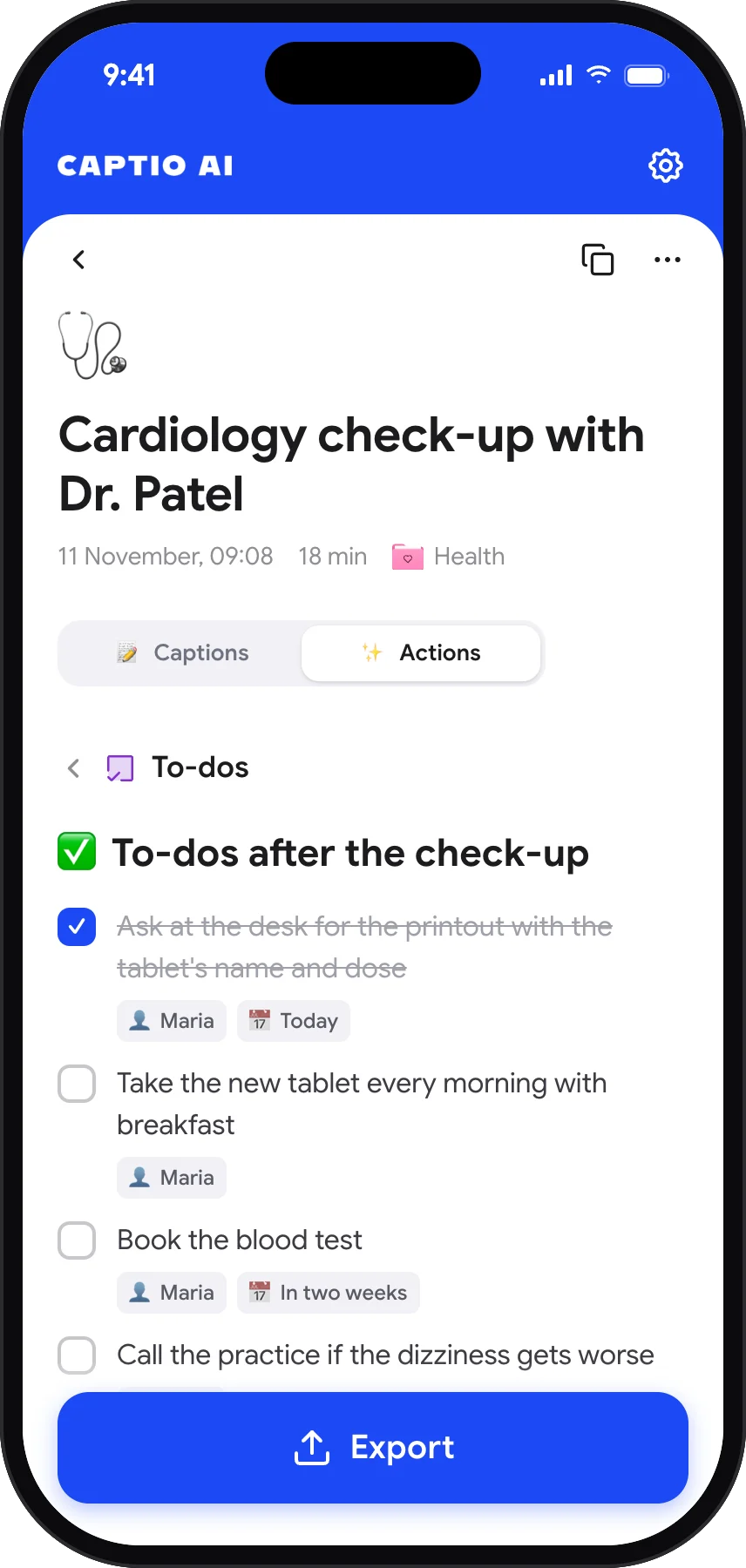
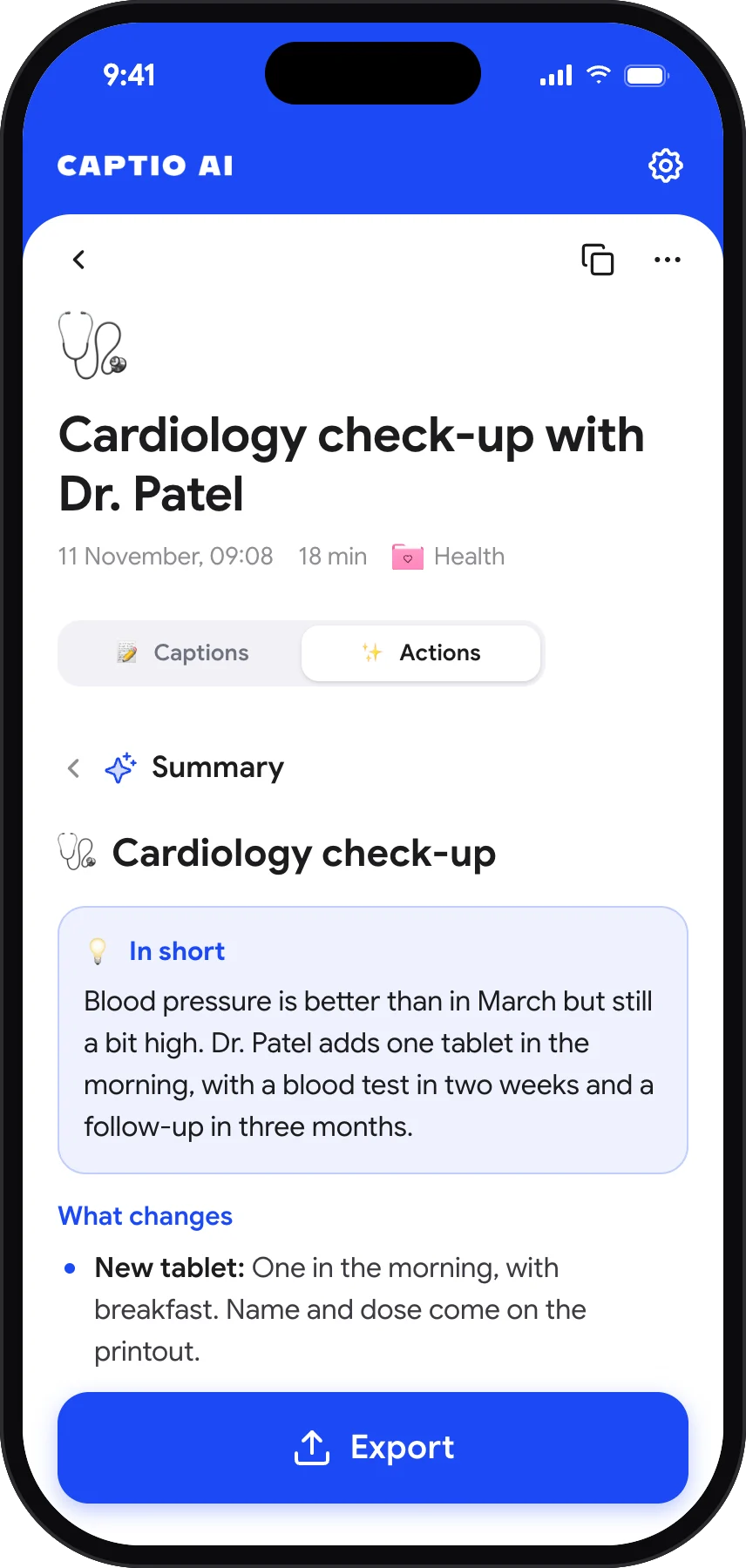
A summary is a memory aid, not a medical record. Compare it with what the clinic gives you in writing, and phone the practice if the two differ. If you want to share the notes with a family member, Captio AI can export a result as text, a link, a PDF or an email7.
How many people does this affect?
The World Health Organization (WHO) says over 5% of the world's population, or 430 million people, require rehabilitation for their disabling hearing loss, and that nearly 2.5 billion people are projected to have some degree of hearing loss by 20504. The same fact sheet says hard of hearing people usually communicate through spoken language and can benefit from hearing aids, cochlear implants, other assistive devices and captioning4.
Which option fits which appointment?
| Situation | What to try first | Why |
|---|---|---|
| GP or family doctor visit in England | Ask for your needs to be recorded under the Accessible Information Standard3 | Your needs are flagged for staff involved in your care3 |
| Appointment in a US doctor's office | Ask for real-time captioning or an interpreter when you book1 | The ADA lists both as aids |
| Short pharmacy or reception conversation | Phone on the counter with live captions, plus a written note | Quick, no booking needed, as our suggestion |
| Long specialist consultation | Communication Access Plan, terms added in advance, treatment plan in writing2 | Most information, highest stakes |
Captio AI is one tool among these. It does not replace a qualified interpreter or a captioner where one is your right, and it does not replace asking the doctor to repeat something. It is also not a phone-call or video-call captioning service. For a telephone appointment, ask the practice about relay or call-captioning services.

Read what people say, while they say it
Captio AI puts live captions on your phone for conversations, appointments, lectures and meetings, in 60+ languages. Free to start. Private by default.
Frequently asked questions
What should a hard of hearing patient in the US say when booking a doctor's appointment?
Say that you are hard of hearing or deaf and name what you will need, such as a sign language interpreter or real-time captioning [1][2]. The Hearing Loss Association of America also suggests asking for the office manager's name in case the services do not arrive [2].
Do I have to pay for an interpreter or captioning at a doctor's appointment?
The Hearing Loss Association of America's guide says the aids and services you use for an outpatient visit are at no cost to you, your family or your caregiver [2]. This is legal information, not legal advice. Check with the practice or a disability rights organisation about your own case.
What is the Accessible Information Standard for patients in England?
It is a national standard that all NHS and adult social care services have to follow [3]. Services ask about your communication needs, record them, flag them for staff, share them when appropriate, meet them and review them. Its example of communication support is a British Sign Language interpreter [3].
Can I use live captions on my phone during a doctor's appointment?
Captio AI, a live captioning app for deaf and hard of hearing people, turns speech into text as people talk, and its Live Captions page says it needs an internet connection [5]. Ask the doctor first, as our suggestion, and put the phone on the desk between you.
How can I remember what the doctor said in a pharmacy or a follow-up visit?
Ask for the treatment plan and medicines in writing [2]. With Captio AI you can make a Summary, To-dos or a Follow-up message from a transcript [6]. Check the details with your doctor or pharmacist before you act on them.
Does Captio AI keep medical names right at a specialist appointment?
Captio AI lets you add your own terms in advance and uses that list to caption conversations more accurately [5]. It can still get words wrong, so confirm drug names and doses in writing with the clinic.
Is Captio AI free to use at a doctor's appointment in the UK or the US?
Captio AI is free to start [5]. The free plan includes 3 AI results in total [6], and Captio AI Plus is a paid plan. Prices differ by country and are shown in the store.
Sources
- 1ADA Requirements: Effective CommunicationU.S. Department of Justice, Civil Rights Division (ADA.gov), 2020
- 2Communication in Outpatient Settings (Patients)Hearing Loss Association of America, 2024
- 3Accessible Information Standard (AIS)Devon Partnership NHS Trust, 2026
- 4Deafness and hearing loss (fact sheet)World Health Organization, 2025
- 5Live CaptionsCaptio AI, 2026
- 6AI Summary and actionsCaptio AI, 2026
- 7ExportCaptio AI, 2026
Written by Nate from Captio AI. Published 10 November 2026, last updated 11 November 2026. Every figure on this page links to its source. Spotted a mistake? hello@captioai.app