

Hearing loss in Spain: INE and EuroTrak numbers compared
About 1.23 million people in Spain live with a hearing disability, 27.6 per 1,000 aged 6+ (INE 2020), and 10.6% report hearing loss (EuroTrak 2023).
 Nate from Captio AI8 min read
Short answer
About 1.23 million people aged 6 and over in Spain have a hearing disability, 27.6 per 1,000, according to the 2020 disability survey of the National Statistics Institute (INE). EuroTrak 2023 found that 10.6% of the Spanish population report hearing loss and 39% of them use hearing aids. Only about 27,300 of the 1.23 million use sign language, as reported to Congress in 2024. Spain has no single count of deaf people.
27.6 per 1,0001
people aged 6 and over in Spain have a hearing disability, INE 2020
10.6%2
of the Spanish population report hearing loss, EuroTrak 2023
About 27,3006
of the 1.23 million people with a hearing disability use sign language, as told to Congress in 2024
On this page
- The numbers at a glance
- How many people in Spain have a hearing disability?
- How does hearing disability in Spain change with age?
- What does this mean at a doctor's appointment in Spain?
- How many people in Spain use hearing aids?
- Why do Spanish figures say 27.6 per 1,000 and 10.6%?
- How many deaf people are there in Spain?
- How many people use sign language in Spain?
- Is Spanish Sign Language recognised by law?
- What interpreting services do deaf people in Spain use?
- What do the numbers say about school and work?
- Which use cases do these Spanish numbers apply to?
- Where does a captioning app fit in?
About 1.23 million people aged 6 and over in Spain have a hearing disability, 27.6 for every 1,000 people, according to the 2020 disability survey of the Instituto Nacional de Estadística (INE), Spain's national statistics office1. The newest hearing loss survey, EuroTrak Spain 2023, found that 10.6% of the population report hearing loss2. Neither counts deaf people as such: the INE counts a limitation reported by people in family homes, and EuroTrak counts what people say about their own hearing12. This page puts the Spanish numbers side by side, says what each one measures, and links them to daily life in Spain.
The numbers at a glance
The figures differ because each one counts something else. Read the "what it counts" column before you quote one.
| Measure | Number | What it counts | Source |
|---|---|---|---|
| People aged 6+ with a hearing disability | 27.6 per 1,000 (about 1.23 million) | Reported limitation, people in family homes, 2020 | INE1 |
| People reporting hearing loss | 10.6% of the population, 12.3% of adults | Self-reported, EuroTrak 2023, 15,387 people | HearingYou2 |
| Hearing aid use among people with hearing loss | 39% (37% in 2020) | Same EuroTrak survey | HearingYou2 |
| People reporting hearing loss, earlier survey | 11.3% | First EuroTrak study for Spain, 2020 | The Hearing Review3 |
| People with a hearing disability who use sign language | About 27,300 | INE survey as quoted by FIAPAS to Congress, 2024 | Congreso6 |
| Interpreting services funded for deaf people | 15,047 in person, 885 remote | One year, 2021, CNSE's own report | CNSE5 |
How many people in Spain have a hearing disability?
27.6 people in every 1,000 aged 6 and over in Spain have a hearing disability: 24.1 per 1,000 men and 31.0 per 1,000 women1. The INE survey, called EDAD 2020, found 4.38 million people with a disability or limitation in Spain, 94.9 per 1,000 inhabitants, and 28.5% of those aged 6 and over with a disability had hearing difficulties, about 1.23 million people1. Hearing was the fourth most common type of disability in the survey, behind mobility, domestic life and self-care1.
The survey reached about 67,500 homes between August 2020 and October 2021, and the results were published on 19 April 20221. It covers people who live in family homes, and a person can have more than one type of disability, so the types do not add up to the total1.
How does hearing disability in Spain change with age?
Hearing difficulties in Spain become common among people with a disability as they age. Among people with a disability, 12.4% of those aged 6 to 44 have hearing difficulties, 21.2% of those aged 45 to 64, 31.0% of those aged 65 to 79 and 38.5% of those aged 80 and over1. The table shows the share of each age group with a disability, not of the whole population.
| Age group in Spain | People with a disability who have hearing difficulties | Source |
|---|---|---|
| 6 to 44 | 12.4% | INE1 |
| 45 to 64 | 21.2% | INE1 |
| 65 to 79 | 31.0% | INE1 |
| 80 and over | 38.5% | INE1 |
What does this mean at a doctor's appointment in Spain?
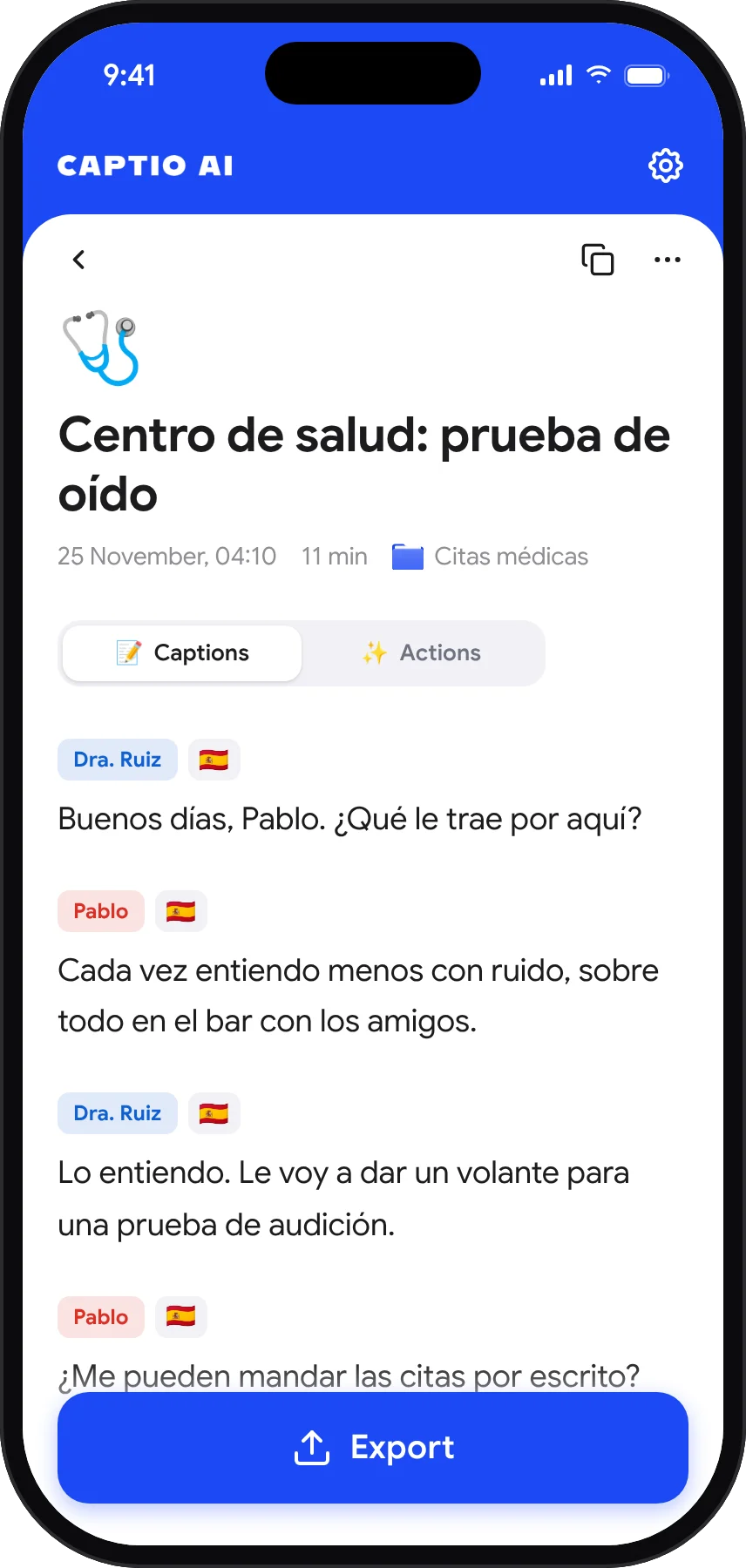
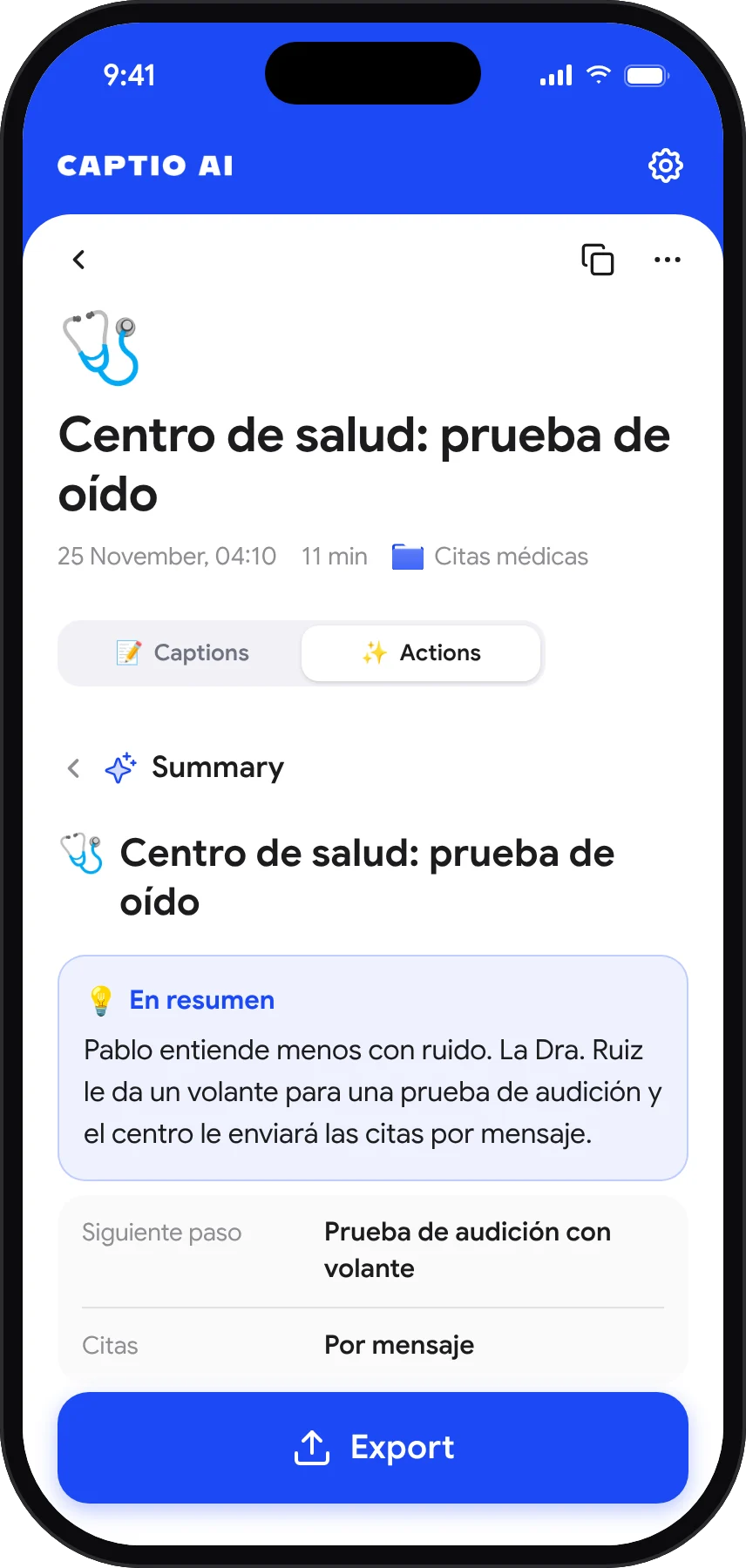
At a Spanish doctor's appointment, hearing difficulties are common among older patients: 38.5% of people aged 80 and over with a disability and 31.0% of those aged 65 to 79 report them1. A patient who cannot follow the doctor at the centro de salud may miss instructions about medicines or the next appointment. This is general information, not medical advice. For Spanish speakers, the page on doctor's appointments in Spanish explains how captions fit into a consultation.
How many people in Spain use hearing aids?
39% of the people in Spain with self-reported hearing loss use hearing aids, according to EuroTrak Spain 2023, up from 37% in 20202. The 2023 survey reached 15,387 people, including 1,311 who reported hearing loss, and was run by Anovum for the hearing aid industry association EHIMA2. The 2020 study, which reported 36.5% among people who recognise their loss, was based on more than 1,300 people with hearing loss aged 14 to 743. EuroTrak is an industry survey and rests on what people say about their own hearing, not on a hearing test2.
Why do Spanish figures say 27.6 per 1,000 and 10.6%?
The Spanish figure is 2.76% in one survey and 10.6% in another because they ask different questions. The INE counts people who report a hearing limitation that affects daily activity, among people aged 6 and over in family homes1. EuroTrak reports hearing loss as people say they have it, across the whole population2. Neither is a hearing test. EuroTrak's 2020 study gave 11.3% and covered ages 14 to 74, while the 2023 figure covers the whole population, so compare the two with care23. If you see a single Spanish number without its method, ask which one it is.
How many deaf people are there in Spain?
Spain has no single count of deaf people, and the number often printed for it is the INE's count of hearing difficulties. The INE's roughly 1.23 million is a count of people aged 6 and over with a hearing disability of any degree, not of deaf people1. The president of the Confederación Española de Familias de Personas Sordas (FIAPAS), speaking to a committee of the Spanish Congress on 26 June 2024, used the same figure, 1,230,000, and said that 27,300 of them use sign language6. She concluded that more than 98% of the population with a hearing disability in Spain communicate in spoken language6. She attributed the 27,300 to the INE survey, and the INE's own summary opened for this page does not give that breakdown, so treat it as a second-hand figure16.
How many people use sign language in Spain?
About 27,300 people with a hearing disability in Spain use sign language, according to the figure FIAPAS gave Congress in 20246. That is about 2% of the 1.23 million counted by the INE16. The figure counts people with a hearing disability who sign, so it leaves out hearing signers such as family members and interpreters. The sources opened for this page give no count of those.
Is Spanish Sign Language recognised by law?
Yes. Ley 27/2007 of 23 October 2007 recognises Spanish Sign Language (lengua de signos española) as the language of deaf, hard of hearing and deafblind people in Spain who choose to use it, and recognises Catalan Sign Language in Catalonia4. The same law regulates supports for oral communication, and its preamble names lip-reading, hearing devices and subtitling as fundamental and basic rights4. It leaves the choice with the people concerned or, for minors, their parents or guardians4. This is legal information, not legal advice.
What interpreting services do deaf people in Spain use?
In 2021 the Confederación Estatal de Personas Sordas (CNSE), Spain's national deaf confederation, reported 15,047 in-person and 885 remote sign language interpreting services financed by the Ministerio de Derechos Sociales y Agenda 20305. Its SVIsual video interpreting service took 174,738 calls, available on emergency and service lines such as 091, 062 and 0165. These are the CNSE's own numbers for one year, and they do not say how many people needed an interpreter and did not get one.
What do the numbers say about school and work?
In Spanish classrooms, 16.3% of children aged 6 to 15 with hearing problems said they needed curricular adaptations or supports and did not receive them1. At work, hearing problems were among the most common disabilities of employed people aged 16 to 64 with a disability: 33.2% overall and 37.9% of men1. For a Spanish job interview or a lecture, those figures are a reminder that many people in the room may need a written version of what is said.
Which use cases do these Spanish numbers apply to?
Hearing loss touches every setting where people talk, and each has a Spanish number to keep in mind. Every row below describes discapacidad auditiva, hearing disability, in Spain.
| Situation in Spain | Spanish fact | Source |
|---|---|---|
| Doctor's appointments | 38.5% of people aged 80 and over with a disability have hearing difficulties | INE1 |
| Everyday conversations | 27.6 per 1,000 people aged 6 and over have a hearing disability | INE1 |
| School and classrooms | 16.3% of children aged 6 to 15 with hearing problems lacked the supports they needed | INE1 |
| Job interviews and work | 33.2% of employed people with a disability aged 16 to 64 have hearing problems | INE1 |
| Communication with deaf people | Spanish Sign Language recognised by Ley 27/2007 | BOE4 |
| Hearing aids | 39% of people with hearing loss use one | HearingYou2 |
Where does a captioning app fit in?
Captions are one tool among many, and a phone app does not replace a sign language interpreter, a hearing aid or an audiologist. In a Spanish everyday conversation, Captio AI, a live captioning app for deaf and hard of hearing people, supports captions in Spanish and shows what the person across the counter is saying as text while they speak, as the page on everyday conversations in Spanish describes. You can add names and medical terms so they are recognised. The free plan gives 100 free credits a day. Captio AI works for in-person speech, needs an internet connection for live captions, and is not a phone-call service.
For other countries, see how many people are deaf or hard of hearing, hearing loss statistics in Germany and how many people use sign language.

Read what people say, while they say it
Captio AI puts live captions on your phone for conversations, appointments, lectures and meetings, in 60+ languages. Free to start. Private by default.
Frequently asked questions
How many people in Spain have hearing loss?
It depends on the survey. EuroTrak 2023 found that 10.6% of the Spanish population, and 12.3% of adults, report hearing loss. The INE counts people with a hearing disability that limits daily activity: about 1.23 million aged 6 and over in 2020, or 27.6 per 1,000. The two measure different things, so quote the method with the figure.
How many deaf people are there in Spain?
No single count exists. The INE counts hearing difficulties, about 1.23 million people aged 6 and over in 2020. A June 2024 hearing in Congress heard that about 27,300 of them use sign language and that over 98% communicate orally. These are figures from an advocacy group quoting the INE.
How many people in Spain use hearing aids?
39% of people in Spain with self-reported hearing loss use hearing aids, according to EuroTrak Spain 2023, up from 37% in 2020. EuroTrak is an industry-run survey of 15,387 people, 1,311 of whom reported hearing loss. HearingYou, the site of the hearing aid industry association EHIMA, notes that public funding is mostly limited to people under 26.
How common is hearing loss among older patients at a doctor's appointment in Spain?
Among people in Spain with a disability, 38.5% of those aged 80 and over and 31.0% of those aged 65 to 79 have hearing difficulties, according to the INE survey of 2020. An older patient at a centro de salud is therefore likely to have trouble hearing. This is general information, not medical advice.
Is Spanish Sign Language recognised in Spain?
Yes. Ley 27/2007 of 23 October 2007 recognises Spanish Sign Language (lengua de signos española) and Catalan Sign Language, and regulates oral communication supports such as lip-reading, hearing devices and subtitling. The law says people choose freely whether to use sign language. It gives no count of signers.
Do deaf people in Spain have interpreters for medical or public services?
The CNSE reports that in 2021 the Ministerio de Derechos Sociales y Agenda 2030 funded 15,047 in-person and 885 remote sign language interpreting services, and that the SVIsual video interpreting service took 174,738 calls. Those are the CNSE's own figures for one year and do not say how many people needed one.
Do children with hearing difficulties in Spanish schools get the support they need?
Not always. The INE found that 16.3% of children aged 6 to 15 with hearing problems said they needed curricular adaptations or supports and did not receive them. The survey covers children with a disability who live in family homes. For a Spanish classroom, subtitles and written notes are among the supports the law lists.
Can a live captioning app help with Spanish speech in a conversation?
A live captioning app shows spoken Spanish as text while the person talks. Captio AI, a live captioning app for deaf and hard of hearing people, supports captions in Spanish and lets you add names and specialist words. It works for in-person speech and needs an internet connection. It does not replace an interpreter or your doctor.
Sources
- 1Encuesta de Discapacidad, Autonomía personal y Situaciones de Dependencia (EDAD). Principales resultados. Año 2020Instituto Nacional de Estadística (INE), 2022
- 2EuroTrak Spain 2023HearingYou (European Hearing Instrument Manufacturers Association, EHIMA), 2023
- 3New EuroTrak Study Compiles Data From SpainThe Hearing Review, 2020
- 4Ley 27/2007, de 23 de octubre, por la que se reconocen las lenguas de signos españolas y se regulan los medios de apoyo a la comunicación oral de las personas sordas, con discapacidad auditiva y sordociegasBoletín Oficial del Estado (BOE), 2007
- 5Resumen Ejecutivo 2021Confederación Estatal de Personas Sordas (CNSE), 2021
- 6Diario de Sesiones, Comisión de Políticas Integrales de la Discapacidad, núm. 143, 26 de junio de 2024 (appearance of the president of FIAPAS)Congreso de los Diputados, 2024
Written by Nate from Captio AI. Published 25 November 2026. Every figure on this page links to its source. Spotted a mistake? hello@captioai.app